OK so sticking some googly eyes on my Quest 2 wasn’t a serious solution to any problem, but there was another aspect of Apple Vision Pro I found interesting: they didn’t make any allowances for eyeglasses. Users need to have perfect vision, or wear contacts, or order lens inserts that clip onto their headset. This particular design decision allows a much slimmer headset and a very Apple thing to do.
Quest 3 headset has similar provisions for clip-on lenses, but my Quest 2 did not. And even though Quest 2 technically allowed for eyeglasses, it is a tiny bit too narrow for my head and would pinch my glasses’ metal arms against my head. I thought having corrective lenses inside the headset would eliminate that side pressure and was worth investigating.
Since Zenni isn’t standing by to make clip-on lenses for my Quest 2, I thought I would try to get creative and reuse one of my retired eyeglasses. I have several that were retired due to damaged arms and they would be perfect for this experiment. I selected a set, pulled out my small screwdriver set, and unfastened the arms leaving just the front frame.
For this first test, my aim is for quick-and-dirty. I used tape to hold the sides in place. For this first test I didn’t bother trying to find an ideal location.
The center was held with two rolled-up wads of double-sided foam tape. I believe the ideal spacing is something greater than zero, but this was easy for a quick test.
Clipping the face interface back on held my side strips of tape in place. I put this on my face and… it’s marginally usable! My eyesight is bad enough that I would just see a blur without my eyeglasses. With this taped-on solution, made without any consideration for properly aligned position, I could make out majority of features. I still couldn’t read small text, but I could definitely see well enough to navigate virtual environments. I declare this first proof-of-concept test a success, I will need to follow it up with a more precise positioning system to see if I can indeed make my own corrective lenses accessory for my Quest 2.
While it was instructive to compare Quest 2 specifications with my other VR headsets, the biggest reason I wanted to try a Quest 2 is its standalone capability. After spending some time I’ve decided I’m a fan. It’s much easier to enjoy a virtual environment when I’m not constantly kicking away the cable tethering me to my gaming PC. All else being equal, a wireless experience is superior. Unfortunately, all else are not equal. The cell phone level hardware in a Quest 2 renders a decidedly lower fidelity world relative to what a modern gaming PC can render. It’s a nonissue for something simple and abstract like Beat Saber, but anything even slightly ambitious looks like a PC game from at least ten years ago.
One way to have the best of both worlds is wireless streaming from a gaming PC to my Quest over home WiFi. I tried Steam Link on Quest and was impressed by how well it worked. Unfortunately, it doesn’t work quite well enough just yet. When I’m playing games on a monitor, a few milliseconds of latency plus an occasional (about once per minute) stutter of one or two frames is fine. But on a VR headset, it quickly gives me motion sickness and a headache. Supposedly this can be improved with a WiFi 6 router, but I’m not willing to replace my home WiFi infrastructure for this feature. For the immediate future, I’m happy using my Valve Index for SteamVR experiences.
Mixed Reality
And finally, Meta’s push for Mixed Reality is still a question mark. All three of my VR headsets let me use their cameras to see real-world surroundings. But Quest is the only one of the three to do the work to map that camera footage into a convincingly realistic spatial layout around me. The HP WMR and Valve Index camera views can give me a rough idea if I’m about to run into a wall, but neither are properly mapped enough for me to, say, reach out and grab something.
To support mixed reality scenarios, Quest advertises hand-tracking capabilities for controller-free experiences. Supposedly this works well on the Quest 3, which has additional color cameras for the purpose. My house has beige walls and carpet so my hand has poor contrast for Quest 2’s black-and-white cameras to pick out. It’s pretty unreliable today.
Both of these capabilities show promise, but they’re both relatively new and I will have to wait for novel usage to emerge in mixed reality experiences yet to come. Apple’s Vision Pro is all-in on mixed reality, though, and offers to solve a problem that the Quest 2 does not.
One reason I was willing to take apart my old HP Windows Mixed Reality system is the Meta Quest 2. Now with the Quest 3 taking mainstream position in their product line, Quest 2 inventory is getting cleared out at $200. That price was too tempting to resist so I got one even though I had a perfectly functional Valve Index. Here are some notes from my first hand experience.
Versus HP Windows Mixed Reality
I did not find a single spec sheet advantage my old WMR headset had over the much younger Quest 2. Technology moves fast! Quest 2 has higher screen resolution, integrated microphone and headset, and controllers that were happy to run on a single nominal AA battery instead of demanding two fully-charged AAs. Both used camera-based inside-out tracking but Quest 2 maintained better tracking because it used four cameras instead of two, and those cameras did not demand I turn on every light in the house if I wanted to use it at night. Quest 2 had some level of IPD adjustment with three settings, whereas the HP had no IPD adjustment at all.
I have not yet decided if I prefer Quest 2’s elastic headband versus HP WMR’s headband. I think the HP headband was the best part of the device and I may try 3D printing an adapter to use it with my Quest 2 to see if that’s an improvement.
Versus Valve Index
On the spec sheet Valve Index has a resolution advantage to the Quest 2. Fewer display pixels spread out across a wider field of view. In practice, I found the wider field of view much more important for immersive VR. I am happy making the tradeoff for better field of view but obviously I wouldn’t say no to both if I can get it in a future headset.
Beacon-based tracking used by Index meant I had to add those two little boxes in my room, but the results are worth it. Index has consistently better tracking especially for games where my hands have to move out of my field of view. (Reach behind my back or have a hand on my chest while looking up.) The Index controllers themselves are also much better than Quest controllers, with individual finger sensing, grip pressure sensing, and straps allowing me to open my grip without the controllers falling out. It’s a great immersion advantage, too bad Half Life: Alyx is the only game that takes full advantage of Index controllers.
Both have integrated microphone and speakers, but the Valve Index delivered much better positional audio. Weight of an Index is significantly heavier but part of that weight is the headband balancing things across my head versus Quest 2’s thin elastic band. And finally, Index has better optical adjustment capabilities. Not only smooth IPD adjustment (instead of three fixed positions) but also fore-aft adjustment.
Index is a much more comfortable headset for longer sessions and provides a more immersive VR experience compared to a Quest 2. But we have to consider their relative price tags. It’s better, but it’s not five times better. Even more if you count cost of a gaming PC! Plus, the comparisons here overlook what’s arguably Quest 2’s greatest advantage: it doesn’t need an associated gaming PC at all.
One advantage of tearing down a VR system is that many things come in left-right pairs. After taking apart the first one, I learn lessons that help tearing down the second one more successful. It was true of headset LCD screens, and it is also true for the controller.
The parts are not interchangeable between these two, including the battery compartment covers that are almost but not identical.
Once the cover was removed we see four obvious fasteners to start.
There’s a fifth fastener, hidden under a faceplate held with clips. I didn’t find this the first time and ruined some things, but I was able to take this picture on the second pass.
Once those five screws are removed, the back cover is held only by clips and can be popped off.
The index finger trigger was a surprise: instead of a potentiometer, there is a small magnet. I think component U4 on the joystick circuit board is the Hall effect sensor reading magnet position for an analog value representing position of finger trigger.
There’s nothing on the other side that look like a Hall sensor. Just a big joystick, an additional button, and a few resistors+capacitors.
Once the joystick circuit board was removed, the second screw holding the LED ring in place became accessible and the LED ring can be freed. I’ll come back to this later.
Below the LED ring is an Y-shaped bracket holding the capacitive touch pad in place.
Once removed, releasing a trio of clips freed the touch pad.
Leaving the main controller logic board as the final component still in the handle, held by two more screws.
The vibration motor is the largest component on the back.
Almost everything is on the front, including the most surprising component J7: a 10-pin FPC connector is populated on this circuit board, but there was no associated FPC in the final product. Why is it here?
Now I return to the LED ring. No fasteners were visible so I started prying at seams.
Some clips popped loose and half of the mounting bracket came free.
Releasing more clips freed the inner ring.
All position reference LEDs were on a single long FPC, wound around the ring and folded into position. Small screws are distributed all around the perimeter to ensure everything is fastened tight and LEDs held in position.
But that’s a solvable problem.
Once the innermost ring was freed, the LED host FPC could be peeled off.
LED array laid out flat on the workbench.
Every time I take apart a gaming peripheral, I am amused by the thought this single controller by itself has more computing power than an entire Atari 2600 console.
I’m taking apart my soon-to-be-bricked HP WMR headset. Mainly following the community contributed teardown guide on iFixit plus my own detour into stuff like the headband. My next detour is to take apart its display unit.
The iFixit community guide left it as a single unit, with good reason. I found out it is a slim lightweight assembly mostly held together with adhesive strips. (Double-sided tape) I’m not sure it is possible to disassemble it neatly. My disassembly was an irreversibly destructive procedure.
The display unit consists of two nearly identical assemblies, one for each eye. Given that fact I am grumpy they didn’t design a way to adjust the distance between them to match an user’s interpupillary distance. I had thought that limitation reflected a headset built on a single wide LCD a la Google Cardboard. But it wasn’t! They were two separate square LCD units. Majority of wires lead to the actual liquid crystal matrix. The four-pin connector to the right lead to an LED strip for backlight.
I tried to disassemble the right eye assembly first, starting from the back. After releasing a metal frame fastened with six screws, I found everything else was taped down. Peeling this backlight diffuser assembly broke the white plastic frame because that thin strip of tape was apparently stronger than the plastic.
After much snap-crackle-and-popping, the light diffusion films were removed and I could see the row of white backlight LEDs.
I managed to peel off the LED strip intact…
But I completely destroyed the LCD matrix in doing so. That’s a thin sliver of LCD stuck to the back, with its matrix circuitry visible. Ugh, what a mess.
For the other side, I decided to try approaching from the front. I first removed the Fresnel lens, which was held by its own ring of adhesive tape.
Carefully pushing from the front allowed me to remove this second screen assembly intact. That’s better than before!
But I still couldn’t cleanly separate the LCD matrix from its backlight. Glass cracked, liquid smeared, plastic tore. It ended up just as big of a mess as the first try. Oh well.
I doubt I could line up the diffusion film with the LED strip again, so I failed to salvage two diffuse square white light sources. But the LED strips themselves might still be useful. They’re good candidates for building a rig to side-illuminate small circuit boards. These Fresnel lenses will join my salvaged Google Cardboard lenses in my bin of parts awaiting potential future projects.
I decided to tear apart my Windows Mixed Reality VR headset because it will soon become just a paperweight. I don’t expect to find much that I can repurpose, but I still wanted to see what’s inside. Thankfully someone has already written a teardown guide on iFixit which will save me time. It also lets this post focus on items not already in the guide.
The guide has location for all the screws, but one thing not explicitly called out is the fact the screws are tiny and some of them are very deeply recessed. A large handle with an interchangeable screwdriver bit wouldn’t fit here. I had to dig up an actual tiny screwdriver.
A good VR headset would minimize weight hanging on our head. So I had expected to find a fully optimized design but I see many unpopulated footprints on the main logic board. I don’t know enough to speculate what they might have been but it’s clear this board isn’t as optimized as I had thought it would be. Sure, we’re probably talking about surface mount components that wouldn’t weigh much on their own, but consider their downstream effects. Their footprints and associated wiring makes this logic board larger. Which meant the enclosure had to be larger, and so on. Each individual step may be a small weight gain but they add up.
The guide got as far as removing this headband assembly and didn’t go into any more detail about it. This headband was very adjustable to accommodate a wide range of human head sizes and well padded for comfort holding up the weight that it did. I thought this headband might be the component most likely to get reused. Technology and market forces has rendered rest of the headset obsolete, but I still have the same head!
The hinge mechanism was secured by four screws hidden under a sticker.
Opposite those screws were a set of four clips.
Removing screws and releasing clips allowed the hinge mechanism to slide free of the visor chassis.
The hinge came apart easily once freed. It looks very promising for reuse if I ever wanted to build something to wear on my head. The underlying spring-loaded mechanism has a round output shaft with flattened top and bottom, a shape I should be able to 3D print and mesh with. Or I could try to design and print something that fits into the clips and screws. Both are possibilities for the future. Right now I’ll set it aside to look at the display unit.
In December 2023 Microsoft announced that Windows Mixed Reality has been deprecated and will be removed from Windows 11 24H2. This did not come as a surprise, as the platform hasn’t seen any investment in years. But it does mean my HP WMR headset will officially become a paperweight later this year.
This is fine by me, because my headset has pretty much been a paperweight since I damaged its cord. I tried fixing it and was seemingly successful, but there was a chance my fix is flawed. An errant pin could potentially ruin an expensive video card so I never really put the headset back into use. It is old anyway, lacking features of newer headsets. Heck, it was old and out of date when I got it! At that time, WMR was already… not a resounding success… and my local Best Buy decided to clear out their slow-moving inventory with heavy discounts.
What could I do with it now? There was never any compelling WMR exclusive experience for me, so I don’t have anything to revisit before it’s gone. And since I’ve upgrade to a Valve Index headset, that gives me a superior experience for everything in SteamVR. I guess I could use the deprecated WMR headset for experiments that I don’t want to risk on my expensive Valve Index, but I don’t have any project ideas along that direction. There’s no particular reason to hang on to it “just in case” an idea comes up because (1) it’ll stop working by the end of the year, and (2) if I want VR experiments with an affordable headset, I have to option to go pick up a Meta Quest 2. Which is not only affordable, but would let me explore untethered VR as well as opening the door to Quest exclusive experiences.
During my long inkjet teardown/Dell XPS debugging saga, I would frequently think about what I could do with this obsolete WMR headset. After a few months of not coming up with anything interesting, I will proceed with the ultimate fallback option: it is teardown time!
My Mattel View-Master VR headset was the last out of four phone-based VR headsets I retired and intended to take apart. I have one more that I’m going to spare this round of teardown:
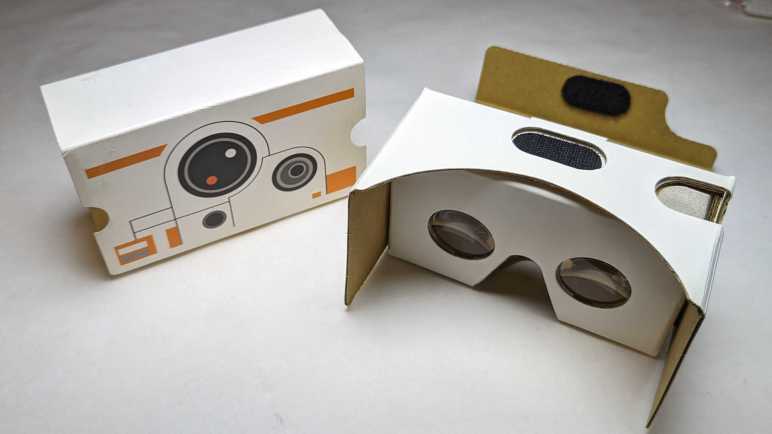
I disassembled those four headsets to see four different variations on the Google Cardboard concept. This BB-8 themed unit is an actual Google Cardboard made of cardboard. Except for the lenses, naturally, which will eventually be harvested as I did the other four.
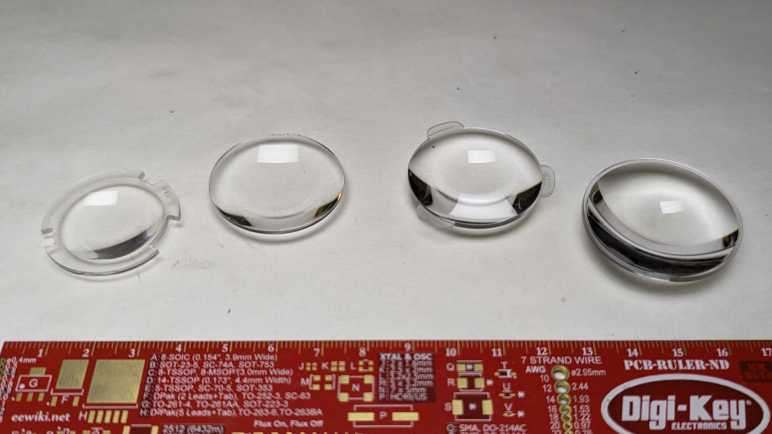
When researching in preparation for this teardown series, I read up on Google’s specification for Cardboard lenses. I had expected all of those headsets to have identical lenses, but I was wrong. These four headsets had four distinctly different lenses with different diameters and thicknesses. I salvaged them without a clear idea of what I would do with them. I think eight identical lenses would have some interesting possibilities, certainly more than four pairs of distinctly different designs which is what I have on hand now.
I don’t know enough about optics to compare similarities vs. differences of optical characteristics of these four lenses. But I know they do fundamentally similar things. These headsets place a phone screen close to our face, far closer than we can comfortably focus our eyes without presence of these lenses. Putting the phone close also lets the screen fill our field of vision. What can such a lens be repurposed for?
My first tentative idea is to build a small loupe out of one of these lenses, giving me a workbench tool to inspect details in teardowns. A quick test just by holding it up to my eye seems to support this idea. The next idea was to see if I can build it into a magnifying (“macro”) lens for my phone camera. A quick test worked only to a very limited extent. I see a few magnified details within a tiny cone of clarity in the center of the camera’s field of view, leaving the rest of the image unusable. I need to learn more about optics before I can diagnose what went wrong with that idea. In the meantime, I return to tearing down stuff I do understand.
There were many different variations on the Google Cardboard VR viewer concept. The Utopia 360 tried to fill out a long list of features but could not ultimately deliver. On the opposite end of the spectrum was View-Master VR. Functionally this headset is just a basic viewer, but well-implemented in sturdy plastic instead of cardboard. (Mattel has some expertise with making sturdy plastic toys, to put it mildly.) Like the rest of the Google Cardboard ecosystem, this product has been retired but its support page is still online for the moment.
This was my favorite headset for basic Google Cardboard experiences. Its phone holder mechanism worked well, and the screen-tapping mechanism was reliable. But its time has passed so it is teardown time.
There is no head strap with this headset: this was intended only for short handheld experiences just like the original View-Master was. Such intentions also meant there were no provisions for a USB power cable nor for headphone wires. No matter, I had cut my own slots for power and sound.
Removing four screws freed the phone holding mechanism.
A few more screws and it comes completely apart. I didn’t notice anything that made me say “A-ha, that’s why this holder worked so well!” The reasons must be more subtle or in details that I lack the knowledge to recognize.
A few more easily accessed screws freed the front panel.
Going further was a challenge. I removed all the fasteners I could access but nothing budged. I decided three important screws were hiding under plastic caps. Prying at them didn’t accomplish anything, they were either a precise friction fit or glued in place.
Taking the destructive route, I pulled out the drill. It turned out they weren’t just thin caps — they were long plugs that go all the way down to the screw. The tricky part is stopping the drill before it destroyed the Philips head because I need that to loosen the screw.
That process got a little messy, but it accomplished the objective.
After I cleaned up the mess, I could get a good look at the screen tapping mechanism. It translated the trademark up-down View-Master lever arm motion into a front-back screen tap. I was surprised there’s no pivot point for the fake lever arm motion. That path was purely dictated by a curved slot molded into orange plastic. This is a clever bit of mechanical design.
Electrically, there’s a wire connecting the black squishy screen-tapping nub and a small piece of black plastic in the middle of the lever. Both of these black plastic pieces had a small amount of electrical conductivity: my multimeter measured several thousand Ohms of resistance across a distance of 2-3 millimeters. Apparently, this is enough to conduct user finger to trigger capacitive touch screen. The rest of the plastic are electrical insulators or at least show up as open circuit in the multimeter.
Looking at this design, I wonder why the long black L-shaped arm isn’t made of the same marginally conductive plastic. Surely that would be cheaper than adding the parts and cost of that wire? Perhaps it is not conductive enough to trigger capacitive touch, or perhaps that material lacks mechanical strength required.
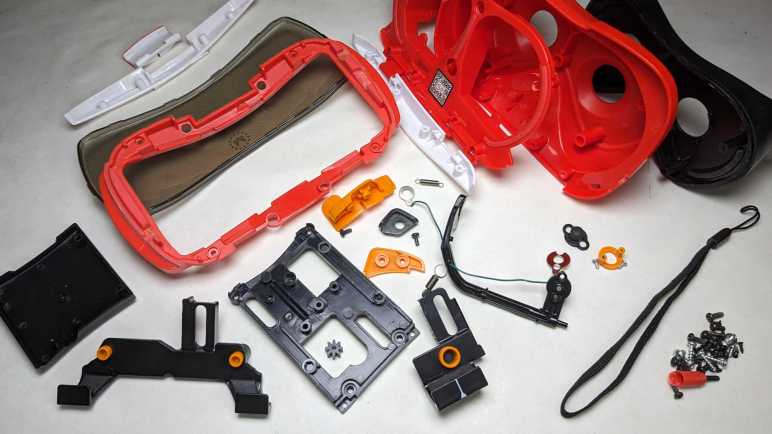
Removing the final few screws allowed the red main plastic body to separate from black soft plastic of the rear section. Plastic lenses were held between these two parts.
I’m sad I didn’t really learn anything from the phone holder as I have project ideas that would benefit from an effective phone holding mechanism. Seeing another implementation of capacitive touch is also informative, but I don’t know if I can turn any of it into applicable skill. Still, I had fun seeing how this sturdy viewer was put together and (aside from those three caps I drilled out) relatively easy to take apart.
Despite being the largest and sturdiest of my four disassembled phone VR headsets, this Mattel unit actually had the smallest and thinnest lenses of them all. I’m not quite sure what that means yet.
Out of all the phone-based VR headsets I’ve tried, this Utopia 360 has the best spec sheet. It’s got variable focal distance adjustment like Samsung Gear VR. It’s got a Bluetooth remote control like Google Daydream. It even has interpupillary distance (IPD) adjustment, an appreciated but rare feature that I didn’t get again until recently with my Valve Index. But spec sheet bullet points aren’t everything. Lack of software support for many of those features, combined with a weak mechanical design, sabotaged this ReTrak Utopia 360 Virtual Reality Headset with Bluetooth Controller (Model ECVRC)
The generic phone holder mechanism didn’t work for my phone, so I replaced it with a more reliable phone-specific bracket as one of my earliest 3D printing projects.
Now that I am retiring the headset, I’m going to remove my old project on my way to taking everything apart.
With my custom holder removed, I can access the clips holding this front panel together.
Taking the front panel apart, I finally have confirmation that those ventilation holes we can see in the front are just useless, as they were blocked by the next layer.
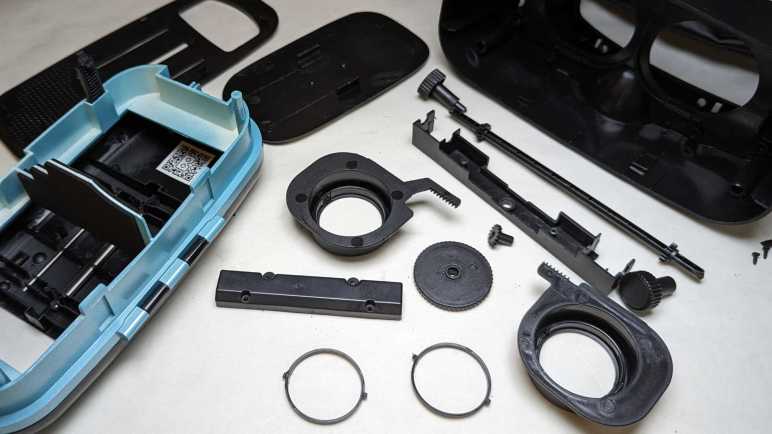
Implementation of focal distance adjustment is far simpler than Gear VR’s implementation, with a single axle rotating a pair of rack and pinion mechanisms. But this is a finicky thing that didn’t work as smoothly as Gear VR’s implementation.
Removing the center cover did not free the rotating axle: it is still held by either side.
But it did allow the axle to flex enough for me to pull off the front. I still couldn’t get to all of the remaining fasteners, though. The focal distance adjustment axle remained stubbornly in the way. My search for fasteners or retention mechanisms came up empty, I concluded it was glued in place.
Two snips with a diagonal cutter and the axle is no longer in my way. I could access all of the remaining fasteners now.
One set of fasteners held the rear of the headset in place.
The other set of fasteners held down the IPD adjustment mechanism: a single pinion gear moving the two eyepieces in opposite directions.
Both eyepieces were removed so I could salvage the lens, held by a retaining ring with two tabs.
With the headset disassembled, I turn my attention to the controller. Which also looked great on the spec sheet but would frequently lose connection to my phone and felt cheaply made in the hand. (I suppose because it was.)
It runs off a pair of AAA batteries, which I forgot about and left them in this controller and now it is damaged from battery leakage. What matters today for disassembly is the pair of fasteners visible in the battery compartment.
The top piece came free easily, uncovering the button array and a two-axis joystick mounted on the mainboard’s top. A few screws held the mainboard in place.
Removing them freed the mainboard, so we can see the trigger switches board held by another pair of screws.
Removing the trigger button board for a closer look, I see a very straightforward implementation.
Mainboard backside. The biggest chip has the following markings:
This controller was easier to take apart than Google’s Daydream controller, with no glue holding things in. If it had a piece of weight like Daydream did it might feel more substantial in the hand, but that would not have improved the tactile feedback of its buttons.
Mechanically speaking, this headset was more complex than Daydream headset and simpler than Gear VR. Too bad it didn’t work as well as its spec sheet suggested. I think it’s because it tried to do too much. In contrast, Mattel View-Master VR keeps its feature scope constrained and does its job well.
While Google specified a handheld controller to their Daydream VR system, Samsung chose a different solution to Google Cardboard’s limited interactivity: they added controls to the side of their Gear VR headset. Reading that description, I thought they just added a single circuit board with a few buttons. The reality was far more mechanically complex, resulting in a far higher parts count than I had expected.
This is a Samsung Gear VR SM-R322, compatible with a half dozen Samsung devices including the Galaxy S7 phone. I bought this as a present for a friend who had a Galaxy S7. Years later, he retired that phone and donated it to my electronics tinkering. (After resetting and wiping his personal data, of course.) He also returned my present, still unopened.
Since Samsung has already shut down their Gear VR experiment, there wasn’t much I could do with it except to take it apart to see what’s inside. I plan to keep the lenses and nothing else.
Gear VR side controls are dominated by what looks like a four-direction pad but is actually a capacitive touchpad. Off to the side are physical tactile up/down buttons (feels like volume control?) and a back button.
An adjustment wheel at the top changes the distance between its lenses and the device screen. (Focal length.) I estimate its range of motion to be roughly one centimeter. Its implementation turned out to be more complex than I had expected.
The face gasket was held with hook-and-loop fasteners. Peeling it off didn’t reveal any fasteners or likely hiding places for them.
Pop off the front cover for a look the device holding mechanism.
Headset-to-device communication is done via this micro-USB plug, which can slide between two positions indicated by a green dot over either A or B. Most of device holding force is supplied between this clamp and its opposite number, which didn’t have a USB plug. Helping to keep the device in place are small bumpers at each corner.
A thin rubber pad adjacent to those bumpers hid fasteners, one for each corner. That hole next to the Philips-head screw is a part of the focal length adjustment mechanism.
Two additional fasteners were in the middle, hidden under a sticker.
Once undone, the device holder tray can be flipped open though it is still connected to the headset by this cable for USB connection and two of the side buttons. A flexible cable is required to bridge a gap whose size varies based on the focal length adjustment.
Freeing the USB cable required removing a cover to access all electrical connections to the mainboard.
Then the spring-loaded USB connector assembly could be freed and disassembled.
Looking inside the device holding tray, I realized the corner bumpers were more sophisticated than I had expected. I thought each corner was a single piece of squishy rubber, but it’s actually three distinct and individually spring-loaded piece of plastic. Multiply this out to all four corners and we end up with twelve sets of bumpers and springs.
Back to the headset main body, removing its mainboard allowed us to open it up to see the focal length adjustment mechanism.
Rotational motion from the top adjustment knob is transmitted via a series of gears and shafts to all four corners.
A close-up look at a corner mechanism translating rotational motion to linear motion.
Under the mainboard is a piece of black plastic that I had expected to host the capacitive touch pad, but it only had the back button. I can see four wires in this cable, which is double the amount I expected. A simple switch should only need two?
The capacitive touchpad is actually glued to the inside of the enclosure. Its control chip has the following markings:
The glue was tenacious and thus touchpad was damaged during removal. I don’t recall ever seeing this pattern in a capacitive touchpad before.
The final bit of electronics is a sensor that sits looking at the user’s forehead. Its location implies an optical proximity sensor to see if it is being held up to the user’s face.
The lens retention mechanism has three little clips that need a little push to release the lens.
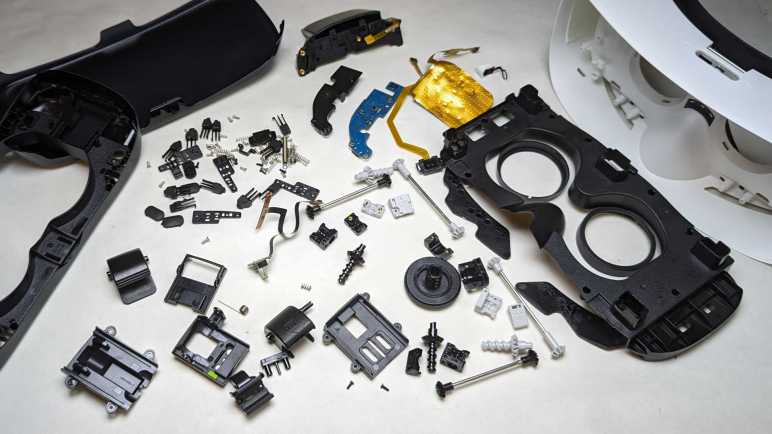
There’s nothing fundamentally complex about adding side controls to a Google Cardboard-style headset. But when we add mechanisms to securely hold phones in a range of sizes plus the ability to adjust distance between lens and screen, we end up with a mechanically complex device with a high parts count. It worked really smoothly, though, perhaps all those parts were necessary for proper operation and going with a low part count design hurts functionality.
User interactivity in Google Cardboard was limited to a single button tapping anywhere on screen. Google decided to address that limitation with their follow up Daydream VR by adding the requirement of a handheld controller to go with the Daydream headset as a complete system.
The small text imprinted on the back of the controller included an FCC ID because this is a Bluetooth device operating over airwaves. Curiously, a search for A4R-D9SCA came up empty on the FCC ID search site. Looking around the internet for other resources, I found a teardown posted by SlashGear. I was disappointed (but not surprised) this device is largely glued together and will be more difficult than the headset to disassemble.
Fortunately, I have the freedom of not caring if I break it, so I started prying. Half of the controller (the palm end) was indeed held by glue. The other half (touchpad end) is designed to flex and so we can click the touchpad, thus it was only held by two clips that allowed a small range of motion.
Focusing on the top panel circuit board, I see a small white tactile button in the middle for clicking, and a chip with the following markings:
Curious what the other side looked like, I used my flush cutters to cut away melted plastic rivets holding the circuit board in place.
We see a grid of diamond-shaped metal pads for the IQS525 to sense our finger position.
The mainboard is held very securely. Not just by several screws, but also by glue. While the glue is brittle and easily cracked, it still put up quite a fight.
By the time I freed the mainboard, it was very bent.
Under that board is the battery and a small piece of metal that couldn’t be a heat sink as it doesn’t touch any of the chips. It’s probably just to add heft to the controller right in the middle of where our palm would be. It is mainly held by some double-sided tape, but it is also in contact with that glue. It takes a bit of effort to pry it free.
The battery is held by a stretch-release adhesive strip, but I have yet to develop the fine touch needed to make those strips work for me. I pulled too hard on this one and it broke. Fortunately, it released enough for the battery to come free. Aided by the fact the enclosure designed a bunch of ribs in the battery tray for a much smaller contact surface than if the enclosure had a smooth flat base. It’s curious we have these ribs and stretch-release adhesive features for easy battery removal, yet it is trapped under a circuit board that was glued in place. Some design criteria must have changed partway through development.
Since this small battery saw barely any actual use or much abuse during removal, I am willing to consider repurposing it in a future project.
Due to the copious amounts of adhesives and glue, this controller was annoying to take apart. In practice it is likely to be impossible to repair as well. The battery was far more difficult to remove than it really needed to be. I expect very few of them have been properly disposed or recycled after retirement.
I’ve decided to dispose all of my 3DoF VR headsets, which I haven’t touched since upgrading to 6DoF VR equipment. They will be taken apart to see how each manufacturer approaches building such a headset and extract their lenses for potential future projects. First up: a Google Daydream VR headset.
Daydream was Google’s effort to evolve from Cardboard. One major difference is the addition of a handheld controller. It has an accelerometer within for 3DoF tracking, a small round touchpad, and four buttons: two on the face and two on the side. Making it a required component means Daydream apps can take advantage of far more interactivity than Cardboard’s single tap.
Another evolution for user-friendliness were the two black nubs towards the center. They make contact with phone screen and register as two touch points. The Daydream app will read their position and adjust display image for proper alignment with the headset, using software smarts to eliminate one user headache. Pretty clever!
The easiest item to remove was the face gasket, held with hook-and-loop fasteners for cleaning or replacement.
Once removed, seven small Torx (T5) fasteners are accessible for removal.
The retaining mechanism for the front panel is also now accessible. To release them, disconnect the spring and press retaining hooks inward.
Front panel hinges can then be slid free.
I thought there might be fasteners underneath rubber nubs in the front panel. I was wrong.
Brute force prying released the extensive set of plastic clips holding two halves together. Not all of the clips survived this process.
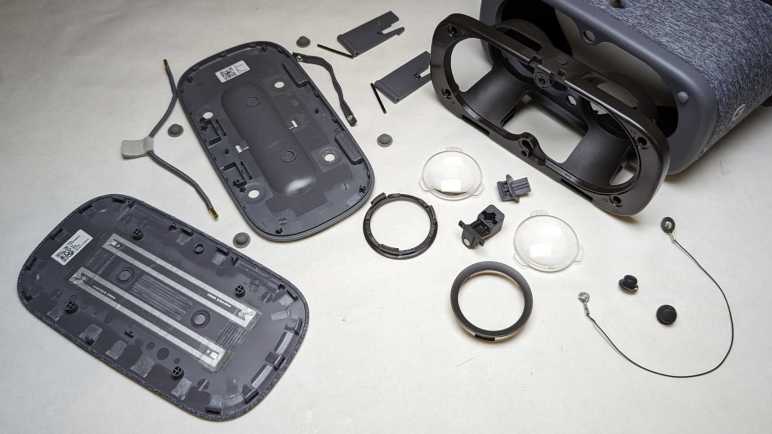
Once those two halves were separated, everything else inside the panel came away freely. Hinge pins, elastic holding straps, etc.
As soon as the phone was inserted into this Daydream headset, it knew to go to Google Play store and download the appropriate Google app. (Another user-friendliness advancement.) I wondered how that was accomplished and the answer are these RFID strips made by Identiv.
Back to the headset, there was one more Torx fastener hiding in a different place and orientation from all the others, up near the top of our nose.
Its removal frees the hook at the top of the headset.
Which then frees up the optical frame. I was surprised to see a length of wire for electrically connecting the two screen alignment nubs.
I’ll keep the wire — and the two nubs — in case I want to play with capacitive touchscreens.
The lenses are clipped in at three points with a simple mechanism.
Tearing down a relatively simple AR beacon was the final step (after the headset and the lightsaber) of dismantling Lenovo’s disappointingStar Wars: Jedi Challenges game for disposal. Since I was still in a teardown mood, I decided to continue dismantling my collection of phone-based headsets. I have quite a collection and, in hindsight, they’ve all been money wasted. Those devices could only react to motion in three degrees of freedom and never approached the immersion of real VR headsets that can track six degrees of freedom. I packed them away after getting my first 6DoF headset, thinking I might find a way to do something creative with the phone-based headsets.
I never got around to devising interesting projects with Google Cardboard (and derivatives) and it’s not going to get any easier in the future. Google officially killed Cardboard in 2021, but by then it was merely a formality. Derivatives (and wannabe successors) like Samsung Gear VR and Google Daydream were abandoned even earlier. With official support discontinued, software support for any potential project ideas also faded away. The first-party SDKs have either gone stale or have disappeared. Third-party support is no better, being removed from tools like Unity and Unreal. And finally, infrastructure support like Samsung Gear VR Store and Google Daydream app have been taken offline. If I want to write code for Google Cardboard/Daydream/Gear VR I would almost have to work on my own scratch, like another long-past-its-prime hardware platform Windows Phone. But this would actually be even more difficult, because I don’t know how to work with these lenses in software in terms of 3D rendering projection math.
Therefore, using them as VR headsets would require more effort than I’m likely to spend. Keeping them intact as VR headsets consume a lot of space with no good payoff I can foresee. Looking at this very simple design, the only reuse possibility I can imagine are those lenses in a non-VR application. At the very least, a bag of salvaged lenses would occupy less space than a bag of obsolete and abandoned VR headsets. With this line of thinking, my phone-based VR headset purge begins. First on the workbench: Google Daydream VR Headset.
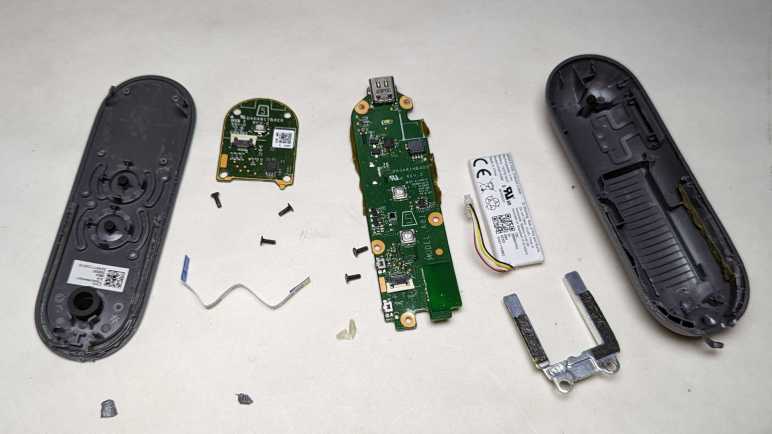
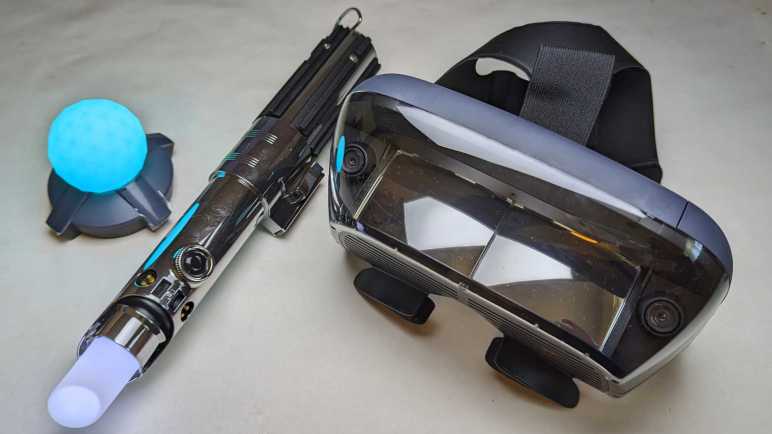
A shiny plastic “lightsaber” is the main peripheral of Star Wars: Jedi Challenges and it was fun to take apart. There was another peripheral in the box, a glowing ball beacon to support certain scenarios.
In this beacon’s base is a three-position switch. Center position is off, and moving to either side would illuminate the soft white translucent sphere. One position gives us cyan, the other position magenta. Given this behavior, I guessed the lowest-cost implementation would be a strictly analog system with LEDs connected to a resistor network. Time to open it up and see if my guess is correct.
This beacon uses AA batteries instead of lithium-ion rechargeable.
Product labels live in the AA battery tray.
Unlike the lightsaber, there is no FCC ID here meaning it doesn’t communicate with the phone or the lightsaber over radio waves. There is no USB port or any other hardwired communication. There might possibly be some kind of communication via lights or sound.
Two Philips-head fasteners live under those stickers. Remove those stickers, then two screws, followed by a few plastic clips to separate top and bottom halves.
Wow, my guess of “a few LEDs and a few resistors” was very wrong. This is a surprisingly complex mainboard. I’ve already ruled out radio wave or hardwired data communication. Looking on the board, I couldn’t find anything I recognized as a light sensor for optical communication or a microphone/speaker for audio communication. If this is completely passive, why all this hardware?
Instead of a cyan LED and a magenta LED, in the middle was a full RGB LED capable of arbitrary colors. The surface mount component itself appears identical to the unit illuminating the tip of the lightsaber. Full color capability is not a huge surprise in itself. But in the absence of external communication, how would it know to display another color?
I can see the following markings on the chip in the corner:
S033
PHVG
725Y
Searching on these designations, my first hit was a question about an electronic cigarette. I know nothing about vaping hardware, but I had not expected them to require microcontroller smarts, either. (I’m surprised twice within a short span.) The chip was identified as the STM8S003F3 and a look in its datasheet confirmed the device marking for UFQFPN20 packaging has a first line of S033 matching what I see here.
The STM8S003F3 is a relatively simple 8-bit microcontroller with eight kilobytes of flash program storage and a single kilobyte of working memory. These are modest specs, a fraction of the ATmega328P at the heart of an Arduino Uno, but it is still overkill for a device that just shines a LED in one of two colors.
This beacon must be capable of far more than what I’ve seen it do. Which is highly likely, given my short time spent actually playing Star Wars: Jedi Challenges. But looking at the hardware in front of me here, I don’t see how it could interact with the rest of the system to unleash said capability. Still, it was an interesting look inside. I’m enjoying this particular streak of teardowns so I will continue with the rest of my phone-based headsets.
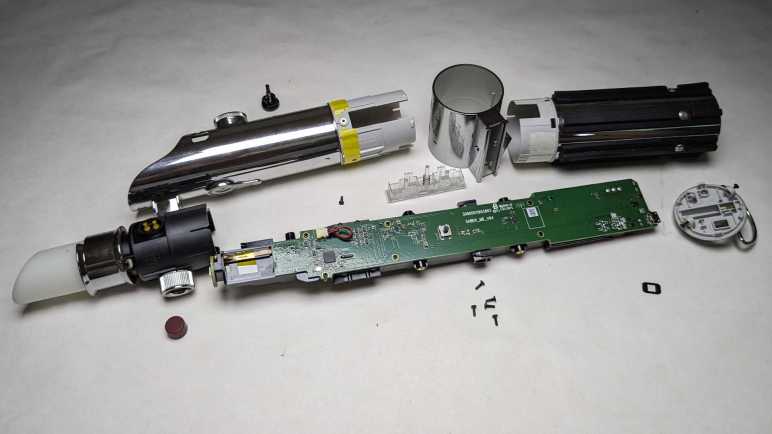
I was disappointed by Star Wars: Jedi Challenges as a product, thankful I only paid clearance price for it but that also meant I couldn’t demand a refund for a lackluster experience. No matter, I still got enjoyment by taking apart its Lenovo Mirage AR headset to learn how it worked. And now I will take apart the main peripheral: Rey’s Lightsaber.
Production promotion proclaimed this to be a “collectible-grade” lightsaber. I have no idea what that is supposed to mean. Perhaps Disney licensing department has defined categories for their merchandise, but as far as I’m concerned, it’s just marketing fluff.
Fluff aside, I will give it credit for being far more detailed than I had expected. A high-quality shiny chrome finish throughout the device gave it a much more premium look than cheap Halloween costume lightsabers made out of dull gray plastic pretending to be metal. Chrome finish aside, though, this is sadly still just plastic pretending to be metal.
This saber talks to the phone inside the Mirage AR headset via Bluetooth. (When powered on, my phone can see it as a Bluetooth device named “Rey’s Saber”.) FCC paperwork is required for all consumer products sold in the United States that transmit and receive data over any kind of radio frequency including Bluetooth. Such data is public record so armed with an FCC ID (O57AR7651N in this case: O57 is Lenovo, and AR7651N is the Jedi Challenges product) we can go to FCC’s ID search page and see what has been filed for a product. This frequently includes photos of the product in disassembled form, a very useful guide for teardowns. Nothing like a detailed iFixit teardown guide, but we can see the major pieces and look for fastener locations. It cuts down on the fruitless hunting, especially when the fasteners are well hidden, which they were for this saber.
Thanks to the filing document “TempConfidential_Internal Photos_Rev1” PDF, I could see a fastener lined up exactly at the location of a nonfunctional button. It was held with double-sided tape and could be removed to access the Philips-head screw underneath.
Freeing that single screwed allowed the tip to slide out.
If somebody wanted to repurpose this lightsaber as a costume prop, it should be easy to replace the soft translucent white tip with something more appropriately mechanical in appearance.
That translucent white tip is illuminated by this surface mount component.
Backside of this small circuit board indicates it is a trio of LEDs in a single surface mount package, controlled by four wires: one each for green, red, and blue and a common ground.
Returning to the FCC filing PDF, I saw the base had two heat-set inserts to accommodate machine screws and the picture quickly guided me to where they were hidden underneath glued-on rubber pads.
Remove those two to release the base.
Rubber pads hid two more screws.
Removing them allowed the grip to slide off.
Things got trickier from here. Looking at filing pictures I could see a screw is hidden underneath this button, but I couldn’t see a graceful way to access it.
I ended up prying against the four little claws inside the saber in order to release the button, then I could access that screw.
Then I could slide off the center ring section, exposing three final screws holding the exterior in place. Once removed the exterior could slide a fraction of a millimeter but it is not yet completely freed.
A bit of wiggling pointed to this button as the culprit. This is a functional button and that knurled surround hints at a ring I could remove, but that was an illusion. I saw little plastic pieces inside and thought I should pry them free just like I did the previous button.
That was a mistake. Prying the button free damaged both it and the socket it resided in. Now that I could look at its distorted shape, it appears to be designed to be uninstalled with a quarter-turn counterclockwise. I have no idea how I would grip this button (while installed) solidly enough to perform that quarter turn overcoming the little nub designed to resist accidental turning. Maybe a suction cup? I don’t know. What I do know is that it’s now too damaged to be reinstalled with a quarter turn clockwise. I had hoped to tear down this saber nondestructively in case I have an idea for repurposing it, but I have passed that point of no return. Ah well.
Setting that disappointment aside, I can look at saber internals. It is a very thinly populated board with few components.
The black plastic backbone securely holds an electric motor with an eccentric weight on its shaft. This would be good for shaking the saber in our hands to signify battle action.
The black plastic frame also holds this piece of metal that does nothing except add heft to the saber so it feels appropriately substantial when picked up.
Given its weight, I had expected a chunky array of NiMH or even NiCad rechargeable batteries inside, but it’s actually a slab of metal and this thin little lithium-polymer pouch. I would have said it was undersized to drive the tactile feedback motor but I’m no battery engineer.
Several test points are visible adjacent to the battery directly behind the microcontroller. I assume Lenovo/Disney locked down the nRF52832 so we can’t flash our own firmware. Maybe a skilled ARM security researcher could find a way in via glitching the power supply for fault injection, but I don’t know how to do that. The locked-down nRF52832 can be unsoldered and replaced with an unlocked chip, but such tiny BGA chips are also beyond my current skill level.
I didn’t expect to find much in the way of reusable components, and I didn’t. I was surprised at the robustness of the mechanical construction. I had expected to find a single screw and have it fall apart in two halves. I’m glad I found the FCC filing PDF, which made this teardown go smoother and almost nondestructively. Now for a change of pace, I’ll take apart the final hardware component of Star Wars: Jedi Challenges, a simple illuminated AR beacon.
The Lenovo Mirage AR Headset (bundled with Star Wars: Jedi Challenges) was a huge disappointment, now I’m going to extract what entertainment I can from tearing it down. From a mechanical engineering perspective, I was very impressed by what I saw. Unfortunately, robust mechanical design could not overcome fundamental product weaknesses.
Before I started the teardown, though, I was curious how it would enumerate as a USB device. I plugged it into a computer running Ubuntu and here’s what got dumped out via dmesg:
usb 3-1: new full-speed USB device number 3 using xhci_hcd
usb 3-1: New USB device found, idVendor=1f3b, idProduct=1000, bcdDevice= 2.00
usb 3-1: New USB device strings: Mfr=1, Product=2, SerialNumber=3
usb 3-1: Product: AR Head Mounted Device
usb 3-1: Manufacturer: Lenovo
usb 3-1: SerialNumber: 101215-0073
hid: raw HID events driver (C) Jiri Kosina
usbcore: registered new interface driver usbhid
usbhid: USB HID core driver
hid-generic 0003:1F3B:1000.0001: hiddev1,hidraw0: USB HID v1.11 Device [Lenovo AR Head Mounted Device] on usb-0000:00:14.0-1/input0
Looks like it conforms to USB HID standards, but as a “raw” device not obligated to conform to any common peripheral. Since it doesn’t try to pretend to be something common (say, a mouse) we have to know its raw USB communication format in order to communicate with this device. If I still had the app installed on my phone, I could peek at its control schema using a USB reverse engineering tool like Cynthion (formerly LUNA). But I had neither. With my skill level and what I have on hand, I can’t do much except take it apart.
I started with the easiest removal: the head strap which was held by hook-and-loop fasteners.
Next was the phone caddy, the only other user-removable part in this system. Visible in this picture is the short USB cable for the headset electronics to communicate with the phone. I used this headset with a Google Pixel so this is the USB-C cable. The headset came with two other cables: micro-B for other Android phones, and a Lightning for Apple iPhones.
The caddy had to accommodate over a dozen different phones and thus had mechanisms to adjust for different width, height, and thickness.
Working to meet those requirements were a lot of intricate details in the design of these injection-molded parts. (Aided by a few inserts made of stamped sheet metal.)
Next to the caddy slot (and USB port) is a product information sticker.
Reaching the end of user-serviceable parts, I pulled out my iFixit Mako screwdriver kit and started removing fasteners visible on the bottom. (Center fastener was hidden under a sticker.) There were multiple different lengths of fasteners. Some were machine screws and some self-tap into plastic. But with one minor exception, I only needed a single screwdriver bit to drive them all. That must have been a conscientious decision by the mechanical engineering team and I appreciate their effort.
First plastic piece to be removed was the clear front piece, whose removal exposed several more fasteners.
Fasteners were also hidden under dark plastics on the sides, though these wouldn’t be important until a little later.
After removing every fastener I could find, the headset remains stubbornly sturdy. Flexing it in my hands failed to highlight any promising seams to pry against, so I started prying at every seam between different materials. The first clips to release were next to the side buttons.
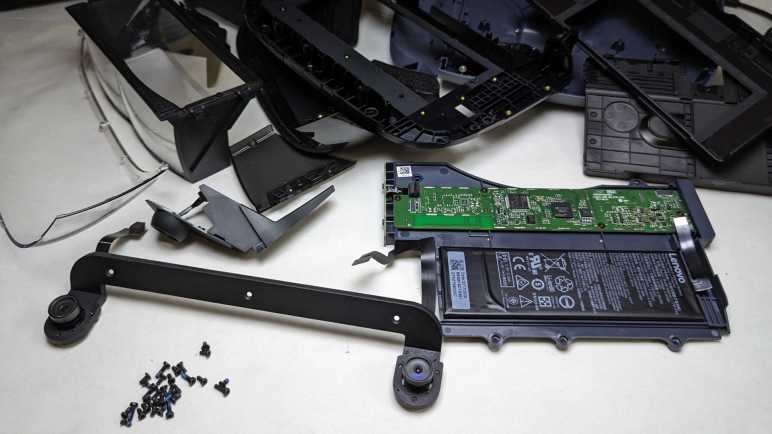
Following those clips around the perimeter allowed the top to be released and unveil a circuit board and a battery. The circuit board is labeled with Legend_HMD_MB_PCB_V05 2017.08.10. I interpret this to mean: Legend = project code name, HMD = head-mounted display,. MB = motherboard, PCB = printed circuit board, V05 = fifth revision. Followed by date of August 10th, 2017.
Biggest chip on the circuit board is an STM32F205RE microcontroller, built around an ARM Cortex-M3. The next biggest chip is a LFE5U-45F 6MG285C Lattice Semiconductor FPGA. I assume the camera-based object tracking algorithm is implemented in this FPGA. I couldn’t find that specific part number on Lattice web site, perhaps it is an obsolete part? I was redirected to the page for Lattice ECP5 family so I guess it’s one of those. Most of the left third of this board is unpopulated, with footprint for at least one nontrivial BGA part. I wonder what they had planned for that area? That is near the trio of side buttons, perhaps they had plans for other headset designs with different side controls? One possibility is a touchpad and if so that BGA footprint might be a capacitive touch processor.
The bottom of the phone tray caddy area turned out to be a sticker I needed to peel off in order to expose more fasteners.
Once released, we could remove the louvered bottom as well as dark smoke colored side pieces.
Optical reflector assembly fasteners are now accessible.
The optical reflector assembly (laying upside-down in this picture) consisted of three pieces of clear plastic with semi-reflective coatings. One flat sheet spans the entire width, and two curved half-width pieces one for each eye. Looking at the geometry, I now understand how this works and I’m not impressed. I don’t know how much light the coating reflects and how much is transmitted, but using 50% as an example, this is what we would end up with:
Image from phone screen shines down to the flat sheet. 50% of the light is transmitted straight through and lost out the louvers in the bottom of the headset.
The remaining 50% is reflected to the two curved pieces. Of that original 50%, 25% is transmitted through and forwards, lost to the environment. The remaining 25% of that original light is reflected back towards the flat sheet.
The flat sheet reflects 12.5% of original light right back into the phone, where we can’t see it.
That leaves 12.5% of original phone screen light transmitted through the flat sheet into our eyes.
Only a small fraction of light makes it all the way to our eyes, no wonder everything was so dim! This reflector assembly is part of a recurring theme: it is mechanically sound with sturdy mounting, but robust mechanical engineering could not overcome a fundamentally inefficient optical path design.
Now that I understand how it works, I’m not terribly interested in keeping this optical assembly for homebrew AR headset adventures. Also, for accurate projection I need to know the curvature of those two half-width pieces and I don’t have that data. Reverse engineering that information takes knowledge of optics that I currently lack. Can I do something with this (or pieces of it) with the skills I have now? I’ll set this reflector assembly aside for a little bit longer while I think.
Resuming the teardown, I couldn’t find any fasteners holding down plastic pieces surrounding the camera. A little exploratory prying popped them loose: they were held with double-side tape.
Now I could remove the camera assembly. Two cameras are held at a precise distance apart by a metal frame, the only metal structure in the entire headset. Metal rigidity would be useful to maintain distance, but it also serves as heat sink for the pair of cameras.
A trio of Philips-head fasteners hold the camera to the frame. I had hoped for some identifying marks on the back of these cameras, but no luck. The only markers were on the thin ribbon cable. A QR code that scanned out to 8SSC28C19780AXYY7A55567 (no clue) and human readable text as follows:
MDG001-200
SUNNY
B1734
94V-0
2PE
E310562
Searching the web for that information, I learned 94V-0 is an UL standard for flame resistance and probably refers to the FPC (flexible printed circuit) substrate. “Sunny” probably refers to Sunny Optical, a Chinese company for camera modules. Lots of camera modules are listed on their website but I didn’t find a match for any of these numbers. The site had a section for VR/AR products, but the only listing is for an eyepiece lens. Sunny E310562 got a few hits on eBay for camera modules corresponding to other Lenovo products, which makes me feel like I’m on the right track, but they look very different. Not sure what’s going on there. I think I struck out.
The lens is removable. I don’t know enough about small cameras to recognize if it this was a standardized lens mount form factor or something proprietary. I removed the lens hoping to see some identifying markers inside. I saw the imaging sensor array, but no identifiers. This camera was significantly larger than OV2640 popular with electronics hobbyist kits and much larger than what I’ve pulled from phones and tablets. I expect this to be a very capable camera and it’s a shame I can’t repurpose it for robot vision or something.
That was a fun teardown and I learned more than I had expected, including an understanding of this optical reflector’s fundamentally flawed design. But I’m not done yet: this is part of Star Wars: Jedi Challenges and a Jedi needs a lightsaber.
I’m fascinated by the significant promise and potential of Apple Vision Pro, but I’m waiting to see real-world feedback. They would have to be very positive for multiple product generations (at the very least, a more affordable non-Pro edition) before I would consider pulling out my own credit card. The last time I paid money for an AR experience, it was on the opposite end of the spectrum that was barely more than an old school Pepper’s Ghost illusion.
This was the Star Wars: Jedi Challenges product, with a Lenovo Mirage AR headset as the main hardware component. With all hype and no substance, there was no follow-up to this now-retired product. The promised third-party software development kit never materialized. The lone app has been removed from app stores. Its main URL now redirects to Lenovo’s general website, though its product support page still exists for the moment.
My first experience with an AR headset were automaker promotions with Microsoft’s Hololens and I was impressed. Sometime after that, Star Wars: Jedi Challenges promotion hype machine started spinning. I was intrigued but skeptical. It cost a tiny fraction of a Microsoft Hololens so I knew there were compromises involved. It is built around a cell phone like all lackluster 3DOF VR headsets, but this headset adds a pair of onboard cameras with onboard processing hardware that sends data to the phone via a USB cable. Based on that description, it was possible there is enough hardware for a rudimentary AR experience.
The reality was disappointing. While we did have 6DoF tracking, it was restricted to the lightsaber peripheral, just barely good enough to draw a virtual lightsaber blade on the AR headset at a rate of (unscientific guess) 30fps. There was a clearly perceptible lag between our lightsaber movement and the glowing line onscreen. In addition to the lightsaber, the cameras could also track an external beacon. A squishy rubber ball with a colorful LED inside. Since it is a sphere, there was no meaningful orientation tracking as with the lightsaber, just position relative to the headset.
There was no further understanding of our environment and no tracking of the AR headset itself. Not even 3DoF tracking like in Google Cardboard. Kylo Ren is directly in front of us regardless of which way we are looking. If we are looking down, Kylo Ren is in the floor. If we look up, Kylo Ren is in the ceiling. As far as I can tell, the only reality this headset augmented was the lightsaber, drawing a lightsaber blade over a fixed and scripted experience projected Pepper’s Ghost-style in front of my face. As far as an immersive experience goes, this rated even lower than what we can get from Google ARCore.
The good news was that I didn’t waste too much money on this disappointment, as I had waited until these things were heavily discounted just so stores could clear them out of inventory. If I had paid full MSRP I would have definitely demanded a refund! The bad news is that, since I got them on clearance, there was no refund and no return. They sat gathering dust until recently as I decided to write up my VR/AR/XR experiences here. There’s no reason to keeping taking up space with this garbage, meaning now is a good time to take it apart before disposing of it.
I’ve had a lot of fun the past few years exploring virtual realities and I have my favorites. While researching buying a new headset I came across rumors that Apple might be entering this space. Those rumors have recently proven to be true and announced as Vision Pro. As is typical of Apple, they are focused on doing their own thing. In this initial set of announcements and carefully chaperoned press experiences, there has been no overlap between Vision Pro capabilities and any of the VR experiences I’ve enjoyed so far. In fact, out of all the press about this new thing, the one I found most informative is a CNet piece about what Apple has not expressed interest in doing with the Vision Pro.
What has been disclosed about Vision Pro hardware is extremely impressive, following many examples of Apple’s past hardware innovations. It was not a surprise the company that touted “Retina Display” would give us high resolution displays covering a wide field of view. Apple silicon’s power/performance leadership should easily outpace Oculus Quest while still maintaining power efficiency superior to PC hardware. And their Airpod experience should help engineer high quality integrated audio.
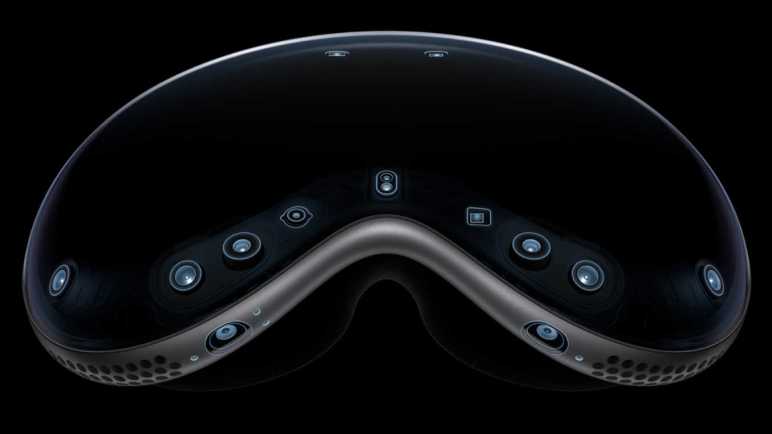
What I did not expect was the extensive sensor array built into the device highlighted in this image from Apple. The advertisement pitch is “precise head and hand tracking and real-time 3D mapping“. I expected some variation of the iPad Pro LIDAR scanner for Apple’s ARKit type capability, but Vision Pro goes far beyond baseline ARKit type functionality. I suspect there’s some headroom built-in for developers to explore usage scenarios Apple hasn’t even thought of yet. If some of these capabilities don’t pan out, they can be trimmed back in a hypothetical future affordable Vision non-Pro model.
Apple has clearly thought of a lot, though. One peripheral not mentioned is any type of handheld controller. All the hype is about how that sensor array can precisely track the user’s hands. Our eyes come into this as well, with gaze tracking inside the headset. Combining these capabilities, Apple has designed their own of interaction semantics free of handheld controllers. I’d be curious how well this works outside of Apple’s carefully curated introductory experience.
One design detail I appreciated was Vision Pro doesn’t try to accommodate eyeglasses. Every other VR/AR headset had to be larger and bulkier than they strictly needed to be, just so they can enclose a large space around potential eyeglasses worn by the user. For people without perfect vision (or unwilling to wear contact lenses) using Vision Pro means an additional financial commitment of buying lenses matching their prescription for installation inside the Vision Pro. Unfortunately, this also means I’m unlikely to get a quick trial experience of somebody else’s headset like I got with the Oculus DK2. I would have to find someone (1) willing to let me try their expensive Vision Pro, (2) have vision prescription close to mine, and (3) have similar spacing between their eyes. Not impossible, but I’m not counting on it.
Seeing how Apple’s Vision Pro doesn’t even try to compete directly against existing products, I’m happy to see Apple continuing to do their “Think Different” thing trying out new ideas. I eagerly await more information once Vision Pro gets in the hands of actual users and away from scripted Apple chaperones. That’ll give us a much better idea whether it is the initial groundbreaking product of a new category or a noble but ultimately doomed experiment. It wouldn’t be the first time an AR product ended in disappointment.
I’ve just upgraded my VR system to a Valve Index headset backed by a Dell XPS 8950, displaying graphics generated by a RTX 3080 and a Core i7-12700 feeding it data. I thought this was a good checkpoint to pause and write down a few of my personal VR highlights in the years since I entered the world of 6DoF PC VR with a HP Windows Mixed Reality headset.
A simple concept executed brilliantly, Beat Saber is an easily understood pick-up-and-play VR experience that showcases 6DoF headset tracking integrating video with audio. There may have been predecessors I don’t know about, but the success of Beat Saber made way for an entire genre of VR rhythm games that followed.
Gameplay perspective only moves as the player moves, minimizing chances of motion sickness. Graphically simple blocks meant this title was a great fit for computationally limited hardware like the Oculus Quest. If Beat Saber was the only thing I played in VR, I wouldn’t need to upgrade my PC: it was fine running Beat Saber at 120Hz with a Valve Index.
Valve Index controllers felt much more secure in my hand than the old controllers, letting me focus more on swinging my arms and less worry on gripping tightly to ensure my controllers don’t go flying.
I loved this experience of stepping into a fairytale storybook. Our gameplay perspective is of a human sized entity looking around the mouse-sized world of our protagonist. Like Beat Saber, our perspective only moves as we move. Though not much movement were required, as these games were designed to be compatible with a seated experience.
This game would stutter on my previous PC even with graphic level set to low. While Moss is more graphically demanding than Beat Saber, it was far short of the level of Half-Life: Alyx yet felt similarly demanding of hardware. I suspect they have not been fully optimized for PC as they were built first for PlayStation VR and ported to PC afterwards. I read these titles are also available on Oculus Quest. If true, those ports must have required some pretty significant performance optimization work.
The original Half-Life was a groundbreaking title that raised the bar on what a PC FPS shooter could be. Now Half-Life: Alyx has done the same for VR. It is an incredibly immersive experience to feel like I’m standing in the middle of City 17, what’s left of a human city on a planet Earth under brutal alien occupation.
Unlike the previous two titles, the gameplay perspective needs to move for us to adventure through City 17. The game designers have done an admirable job implementing traversal while minimizing risks of motion sickness, but it still isn’t as comfortable for me as the fixed positions of Beat Saber or Moss. Despite the occasional discomfort I would frequently revisit Half-Life: Alyx and have played through the campaign multiple times. Frequently pausing to just drink in the atmosphere.
My previous PC could almost run Alyx at 120Hz with graphics set on low fidelity, but a stutter once every 10-15 seconds was nauseating. My new PC runs stutter-free on high fidelity settings.
My big “a-ha” moment in VR came while I was sitting in a virtual cockpit of Elite: Dangerous feeling like I’m actually at the controls of a spaceship. Now I have a much better choice: Star Wars: Squadrons optional VR mode. The game can be played without VR on a monitor, but that doesn’t make me feel like I’m at the controls of a starfighter. My big VR moment in this game was sitting in an X-Wing looking over my shoulder to see my R2 unit chirping away. Hell yeah.
The game designers must have known people would love to just cruise through a fleet looking at all the ships we recognize from the movies. Before the action starts on our first New Republic mission, we can fly our X-Wing around a Mon Calamari cruiser task group. Extra bonus: this game lets us fly for both sides, so there’s a counterpart Imperial mission where we launch a TIE Fighter right out of the belly of an Imperial Star Destroyer and can circle around to admire its assault force through our viewports.
That alone was worth the price of admission, which is good because the actual gameplay is disorienting on two levels. First is the expected motion sickness issue: maneuvering a starfighter while I’m actually seated at my computer quickly made me uncomfortable. But I also struggled to maintain situational awareness during missions. Where is my objective? Where are other members of my squadron? Where are my threats in surrounding space? It takes me a few seconds to get oriented and, in that time, an enemy gets on my tail and starts shooting. I go into evasive maneuvers to fight for my life. If I survive, I have to get reoriented, and the cycle starts again.
I only got a handful of missions into the single-player campaign before my skill fell short of the required skill level, and I never bothered to try online multiplayer squadron assaults. But I have launched the game many times just to replay those first missions. $40 is a lot for Star Wars: Fly Around the Fleet but I paid it willingly.
Honorable Mention: the opening menu for Star Trek: Bridge Crew is shown as pretense of a Starfleet shuttlecraft control panel. We’re seated in the shuttlecraft as it flies around Stardock waiting for us to choose what to do. I would load up the game just to admire USS Enterprise docked outside.





















 New Screwdriver