About ten years ago Ars Technica published a long article titled “OneCore to rule them all: How Windows Everywhere finally happened” chronicling a long and expensive push within Microsoft to consolidate operating system code across the company into a single Windows core. One that can serve every purpose from an inexpensive power-efficient Raspberry Pi all the way up to massive compute data centers. I was skeptical of the concept as it reminded me too much of the old adage “Jack of all trades, master of none” but I tried to keep an open mind. Ars Technica chose to publish at that time as an overview for their audience to make sense of various pieces of the strategy, some of which were facing imminent release later 2016.
So, how did things turn out?
Part of the motivation was to eliminate engineering redundancies across these products. The example given in this article cited things like WiFi drivers. A common operating system core meant a WiFi chip only needs a single driver to be usable across a wide range of products. From outside the company, without visibility to internal engineering work, it’s hard to judge if this effort panned out.
The other part of the motivation was to enable a wide-ranging app ecosystem whose breadth of coverage would be an advantage over Apple and Google’s respective deeply entrenched app stores. Unlikely the engineering efficiency angle, it’s easy to see this part failed. The touted coverage failed to become dominant and promised breadth has not materialized.
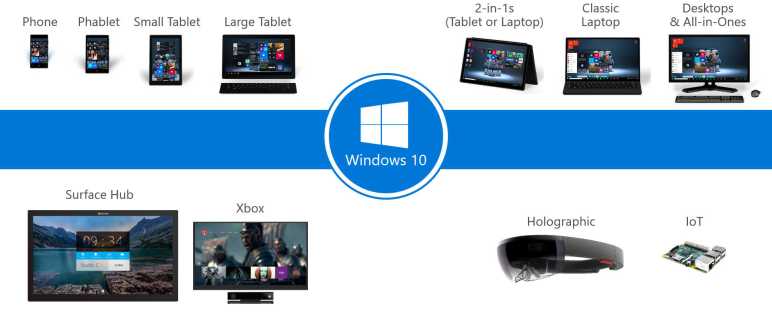
Onward to more details: starting with the upper left corner of Microsoft’s graphic, “phones” referred to Windows Phone which stopped development only two years after Ars Technica‘s article in 2017 and support phased out by 2020.
I don’t think the next three categories “Phablet”, “Small Tablet”, and “Large Tablet” ever reached market in significant volume. Maybe a product or two actually showed up at Best Buy but I certainly can’t think of any examples off the top of my head today.
The upper-right quadrant represented the foundation for Windows: desktops, laptops, and close cousins thereof. Windows convertible machines that can act as both laptop and tablet are still being made and have their audience, but they’re not the majority. This may be the only marginal success tracing back to the time Windows 8 decided to focus on touchscreens and alienated existing user base, whose feedback was loud enough to make Microsoft course correct in Windows 10. And as far as I know, the “Universal Windows Platform” App Store failed to take over, crippling the whole “one app runs everywhere” story of application platform breadth.
The classic laptop is still around and still important, and some of them even have touchscreens. Are the software design compromises worth the utility of touchscreen support? I don’t think so but I can believe there’s a niche audience that doesn’t want a full 2-in-1 convertible for whatever reason. But as tablets and phones become ever more capable (without needing to run Windows core) laptop market share will only continue to erode, and within that market Window has to fight for their share against MacBooks on the high end and Chromebooks on the low end.
Desktops and all-in-one computers still exist, and Windows is still a dominant force. While Apple offers desktop machines from Mac Mini on up, their share isn’t as big as Windows. Chromebox never really took off in this section.
Moving onwards to the lower left of the graphic, we have something called “Surface Hub” and I have no idea what’s going on there. It was always a business product and not a consumer product, with a corresponding big price tag. Somebody else will have to judge whether the product category is successful but I can guarantee you the Windows App Store has nothing to do with it.
Similarly, while Xbox is still around and running on a Windows core, it is very focused on platform specific titles and Universal Windows Platform is not where advertising is focused. Xbox success or failure will not be decided by “Windows Everywhere”, it will be on its own to live or die.
And finally we reach the lower-right quadrant of the graphic, and the story here is short and grim. The Windows Mixed Reality platform was axed and components removed from Windows in 2024. While the flagship product of that platform Windows HoloLens didn’t seem to have an official death sentence, neither has it received any news or updates.
And finally we have the “IoT” category which has gone absolutely nowhere. Microsoft only produced Windows builds for the Raspberry Pi platform for a short time. Windows 11 for ARM microprocessors like those on the Pi exist, but they are targeting laptop class hardware and not single board computers. I’m curious why the Pi was even on Microsoft’s graphic, as I don’t see how the UWP app store could meaningfully cater to the IoT device market. Well, I wasn’t paid to figure that out, so that’s not my problem.
Looking at this list, it seems pretty clear to me the grand “Windows Everywhere” strategy was a bust. As far as consumers are concerned, Windows runs on laptops and desktops and nowhere else. And with the Windows app store failing to gain traction as a major software distribution platform, it also failed to act as a lever to use the laptop/desktop market dominance to pry open an entry point into all these other markets.
But don’t feel bad, I’m sure all the executives responsible for this massively expensive engineering and marketing effort landed softly on their golden parachutes. Floated by Microsoft stock price which has gone way up thanks to AI hype. Ten years from now, maybe I’ll write a similar retrospective on how Microsoft Copilot has panned out.
 New Screwdriver