LED Backlight of LG LP133WH2 (TL)(M2) Laptop LCD Panel

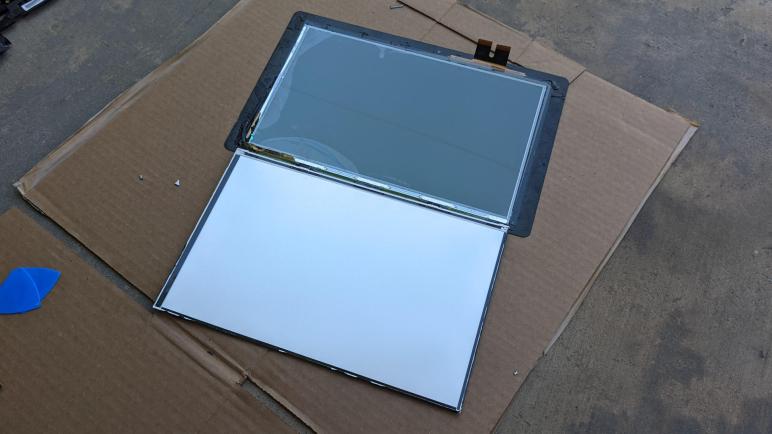
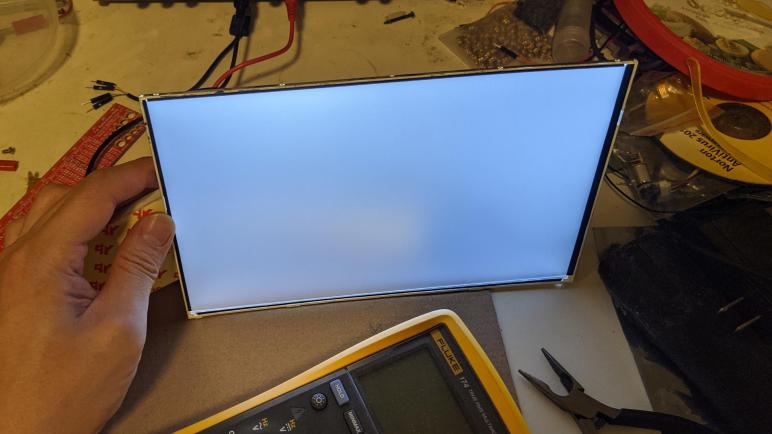
I’m pulling apart some retired laptop LCD panels. For the latest panel, I decided to work on the polarizer film first and I was encouraged by those results. I’ll probably try the polarizer first for future panels. But before I move on to the next panel, I want to get a closer look at the LED backlight from this panel I pulled from a retired Dell laptop. The label says it is a LG Display LP133WH2 (TL)(M2) module. A quick internet search says its pixel resolution is 1366×768, which is pretty low by today’s standards and not worth the effort to bring back online as a computer display.

Like many previous modules, it had tape all around. Unlike some previous modules, there are several different types of tape involved.

Peeling back the tape, I could see the backlight connector in the center. The previous few panels had them to the side. I’m not sure what design tradeoffs are involved in the different placements.

The chip footprint closest to the backlight connector is unpopulated. This is usually a sign there’s another version of the device with enhanced features, but I’m not sure how that works for a display module like this. Whatever it may be, the absent chip is certainly not the backlight LED controller.

The other chip on this side of the circuit board is labeled LG SW0641A. I’m amused that my not-helpful search results included a LG clothes washer with that model number. I’m not sure what this is, but it is definitely not a clothes washer. It is probably the main display controller that talks to the rest of the laptop.

Flipping the panel over, high density data connectors for the LCD array are visible as well as two chips.

Searching for information on a SiW SW5024, I came across vendors willing to sell them but not much else.

But that doesn’t matter, because a search for ADD 5201 written on the other chip resulted in a pointer to a “High Efficiency, Eight-String White LED Driver for LCD Backlight Applications” by Analog Devices. Jackpot!

While the chip can drive up to eight strings, it appears we only have four on this panel. I see a VOUT_LED test point that fans out to four conductors on this connector. And I also see test points corresponding to four strings. FB1 is to the left, below VOUT_LED. FB2, FB3, and FB4 are to the right. If it follows convention of other panels, VOUT_LED would be the current source and FB1 through FB4 are sinks for each of four parallel strings of LEDs.

Probing those points with a LED tester confirmed the hypothesis, and highlighted another difference on this panel. Previous panels with parallel strings of LEDs would interleave them across the bottom. With an interleaved design a single failed string would still leave most of the display illuminated. But in this panel, each of these four strings are assigned a quarter of the panel area. So if one string failed, one quarter of the display would be darkened and difficult to read. My guess is this method is easier (and cheaper) to wire as a tradeoff for fault tolerance.

With the LED strings verified to illuminate, I set this aside and started working on the final disembodied laptop display panels currently in my possession: a Chunghwa CLAA133UA01 from a Sony VAIO laptop.

Start with Polarizer Film Transfer

I’ve been interested in salvaging the polarizer film from a LCD panel but I’ve had problems removing the glue without destroying the film. I had the idea to leave the glue in place but transfer it to something else that is clear, like a sheet of acrylic. I wouldn’t call my first experiment a success, but it was encouraging enough for me to start with the film for my next salvaged laptop LCD panel.

There were two advantage I hoped to gain by pulling that sheet while the LCD module is still intact. First is physical strength, as the glass still has all of its reinforcements and I hope it will be less likely to break as I pull on the polarizer film. Second is thermal inertia, I’ve learned that a thin sheet of glass cools too quickly. By leaving the module intact I hoped it would stay hot longer.

The next LCD panel was salvaged from a Dell laptop whose model number I no longer remember. (Possibly a Vostro 3350?) It had a lovely bronze surface finish so I also kept the mounting frame for this panel.

Just like before, I left it out in the Southern California summer sun to soften the glue.

A razor blade got me started in a corner.

A ruler was used to give me a flat edge to hold against the glass, which along with keeping the module intact meant I didn’t break this LCD glass during polarizer film removal.

And just my luck, the glue for this particular sheet isn’t particularly tenacious and didn’t want to stick to the acrylic. And where it did stick, it wasn’t as optically clear as previous films.

A little bit of mineral spirits helped the glue settle against the acrylic. Still not optically clear, but I’m pleased with my progress on reducing surface imperfections.

Polarizer Film Transfer Experiment

I’ve got a collection of old LCD panels that I want to turn into LED lights by salvaging their backlight. In the course of doing so, I also get some auxiliary pieces like a rigid metal frame. Another common piece that I’ve been working to salvage is the polarizer film. A sheet of polarizer film is a part of every LCD panel, interacting with the liquid crystals within to block or allow light as needed to create the picture on screen. Because it is directly on the optical path, it’s important for it to be held against the screen in a way that minimizes optical distortion.

In practice this means a very thin layer of very tough clear glue that keeps the film flat against the glass. I’ve been struggling with how to best salvage the polarizer film. While I could peel it off the glass, that leaves a layer of glue that I have yet to figure out how to remove. I worked my way from isopropyl alcohol to mineral spirits up to acetone. I found that acetone would dissolve these glues very well, but using enough to dissolve the glue also damages the film. I have yet to successfully clean off a sheet of polarizer film.

As an experiment, I want to see if I can sidestep the problem of removing the glue. Instead of trying to clean it off, keep the glue and instead transfer the polarizer film along with its glue onto something more durable and clear than the glass layers of a LCD panel. I decided to start with a sheet of acrylic I had bought for laser cutting. The pandemic cut me off from the laser cutter I had planned to use with it, so it is now fair game for use in this project.

As I did before, I left the LCD assembly in the hot Southern California summer sun to soften the glue. It didn’t take much heating, two thin layers of glass and a sheet of plastic film had very little thermal inertia. So little, in fact, that the glue solidified and cooled within a few minutes after being taken into the shade. This is disappointing, because it meant I need to move back outdoors and perform this work under the sun.

I’m still learning to work with such fragile sheets of glass, so it wasn’t a surprise when I cracked it (further) making this polarizer film project difficult. Annoying, but not a surprise.

Thankfully a LCD panel had multiple edges, so rather than give up I turned the panel 180 degrees and started peeling the other side for practice.

I was able to peel the remainder without further cracking glass, and transferred to my acrylic sheet for a quick test.

There are a lot of air bubbles in there so the result is pretty bad, but there are portions where the glue happily sucked back down to the sheet of acrylic leaving an optically clear path. If I can figure out how to increase the percentage of area that shows this clear path, I think this approach can work. This particular example, however, is pretty screwed. Any attempt to make that adhere optically clear will be continually foiled by tiny bits of broken glass.

But even though I think it’s doomed to failure, I see a learning and practicing opportunity before me so I pulled out a razor blade and started trying to remove the broken glass pieces. This is a terrible idea. I’m dealing using a sharp piece of steel to deal with with sharp pieces of glass. Not only does the blade scratch and damage the film surface, it can’t get all the little glass pieces. I have not set myself up for success with this test, but at least I managed to avoid cutting myself open in this exercise.

The results were completely unusable. That said, it actually turned out far better than I had expected. In this picture the glass shards I had removed are sitting on the keyboard beyond the polarizer film and acrylic sheet. They are several centimeters away and there’s enough clarity for us to see them. I think there is promise in this transfer approach and I intend to practice it on the next few panel salvage projects. In fact, the very next panel salvage started with the polarizer.

Laptop Lid Becomes Lighting Frame

I think I’m going to have a lot of fun repurposing LED backlight modules salvaged from obsolete LCD panels. I just verified I had successfully salvaged a backlight from the Toshiba LTD133EWDD panel of a Dell XPS M1330 laptop. But the airy thin nature of these backlights also have a downside: there’s very little to hold them in place. For my first experiment I had a bulky cardboard contraption, but I know I want to do better for future projects.
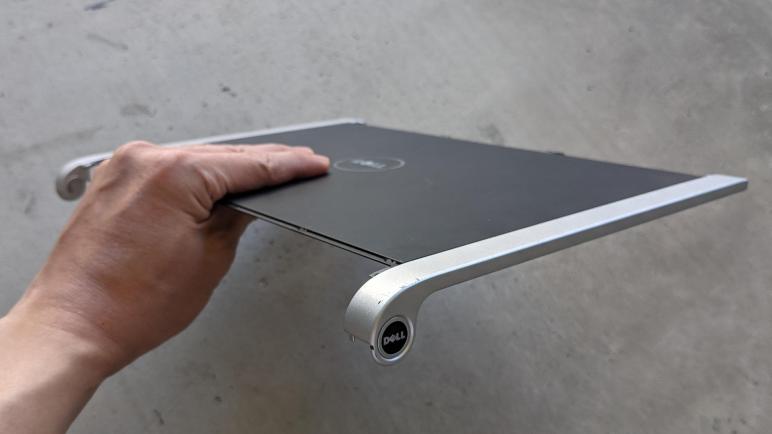
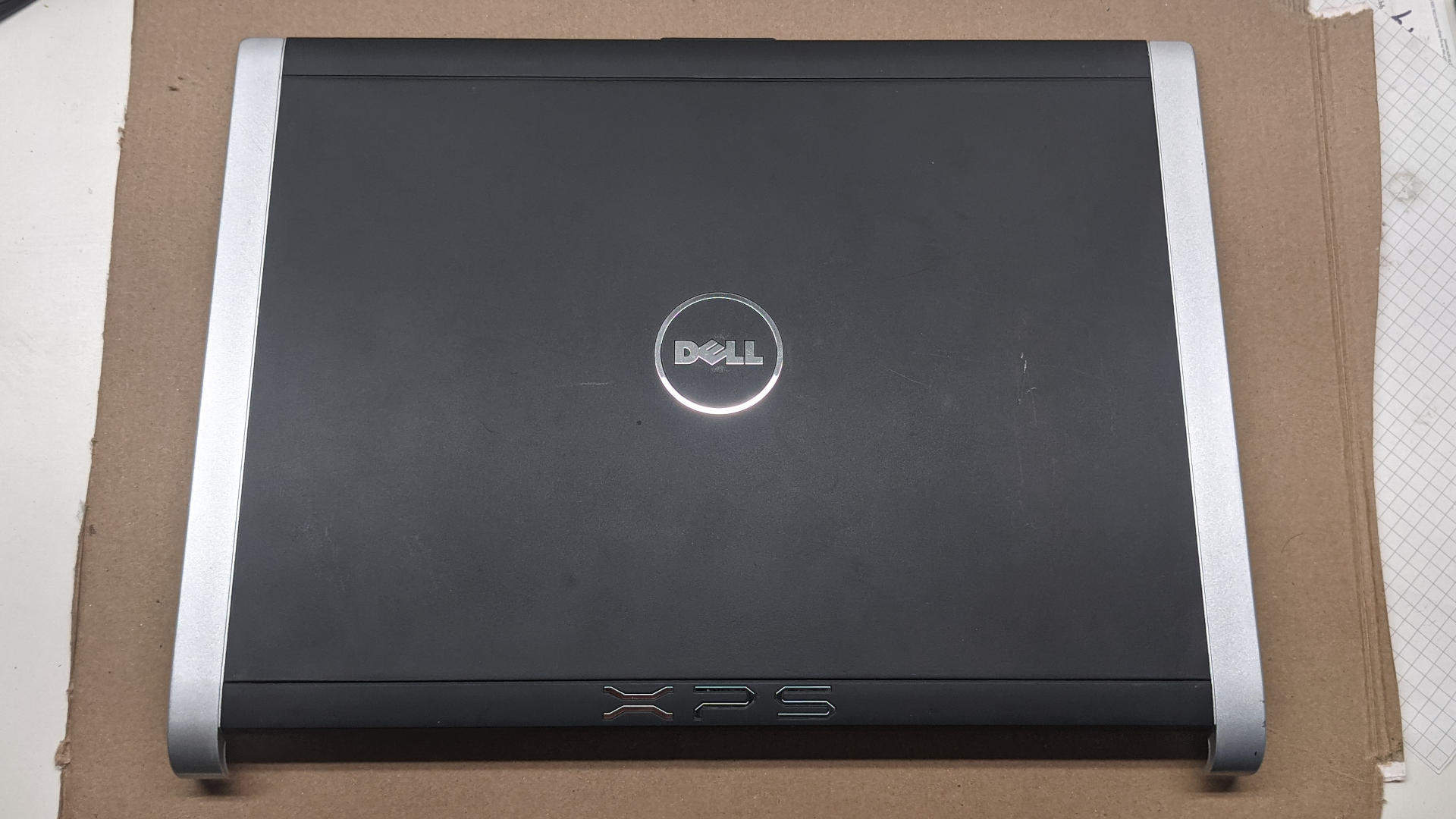
For this backlight module I pulled from a Dell laptop screen, I had the foresight to also keep the laptop lid and all the mounting hardware to fasten this screen to the lid. This gave me a ready-made metal frame I could drill mounting holes into. I don’t know enough metallurgy to identify the metal used to make this lid, but it is darker than what I associate with aluminum. Perhaps magnesium is involved? Whatever the metal, it was cast into shape then machined and surface finished for this application.

The cast included metal covers for what used to be this laptop’s hinge. The graceful arc added a styling flair to this laptop, but I don’t foresee this arc being very useful for my future endeavors. Furthermore, the arc has proven to be annoying because its presence meant I couldn’t stack this lid flat with other flat salvaged components. In preparation for this module’s return to storage (awaiting appropriate project idea) I’m going to remove the arched portion of this laptop lid for better flat stacking.

I was able to cut this pretty cleanly with a Dremel cutting wheel. Some gummy materials would leave melted edges abound, but this one was cooperative and easy to cut. I hope I don’t regret cutting these off later, but in the meantime at least they will stack well.

Next on the panel auxiliary items list is its polarizer film, and I want to try a different tactic than my past efforts.

Toshiba LTD133EWDD Backlight

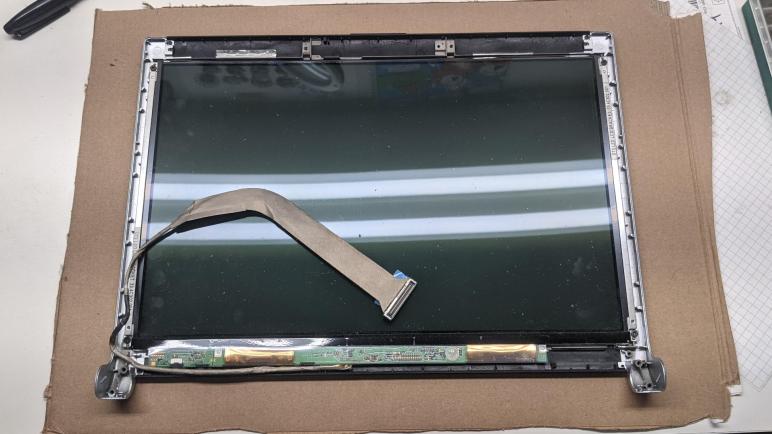
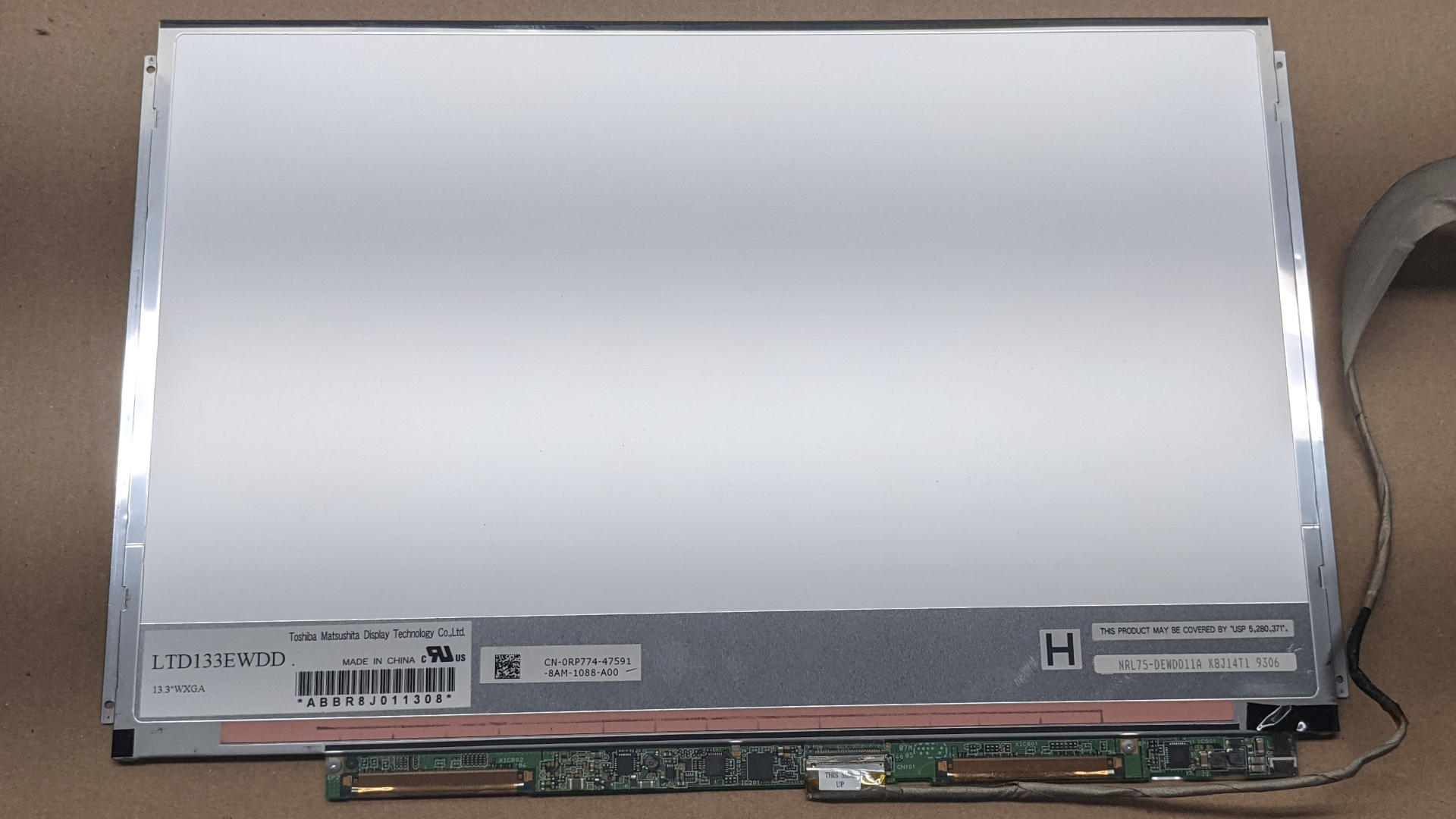
Examining the integrated control board on a Toshiba LTD133EWDD panel I had pulled out of a Dell XPS M1330 laptop, I found no information on communicating with its integrated LED driver chip so I’m going ahead with the backup plan of seeing if I could drive the LEDs directly. [NOTE: This was written before Randy commented with a link to the datasheet.] First order of business was to remove the LCD pixel array in front of the backlight. A marvel of miniaturization in its day, now I am no longer interested in its 1280×800 pixel resolution.

A thin strip of black tape around all four edges held the glass sheets in the frame. I admire how it precisely mated up against the edge of the polarizer film. It was either applied by a machine or hands of great skill.

Once the tape was removed, the glass LCD array was held only by the high density data connectors. Before I peeled them off, I noticed one item of interest: I see alignment marks that I don’t recall seeing on previous LCD arrays I had peeled off in this way.

While peeling off the high density pixel data connectors, I was reminded that glass is fragile and easily crack when abused.

Once the LCD pixel array was removed, I returned to examining the LED backlight connection. I see an eight-conductor connector, but only seven wires in the flexible cable. One of which is thicker than the rest. Based on the experience so far, my first guess are six LED strings in parallel sharing a common current supply but with six individual current sinks.

Flipping the circuit board over, I found several sets of six pads on the board. The circular pads look like they were designed for pogo pins on a test rig. The rectangular pads look like they are provisions for decoupling capacitors that were never installed. We could see the top row of six are all connected, consistent with a common supply. The bottom six each correspond to the six current sinks on the connector.

One interesting novelty was that while the leftmost four connectors are strictly in order, the fifth and six conductors were swapped. So if we count the small vias connecting to the connector on the other side in left-to-right order as 1,2,3,4,5,6. The rectangular pads are in the order of 1,2,3,4,6,5. Perhaps this was merely done to make PCB routing easier, but I’m curious if there’s a more profound reason.

Another interesting item of note is the surface mounted switch immediately to the right and below these pads. This switch would not have been user-accessible in the laptop. Even a servicing technician would have to peel off a plastic protective layer before this switch could be flipped. What does it do, and why is it important enough to take the hit of manufacturing parts cost and complexity? I can smell a story here but not enough interest to chase it down.

In my past LED backlight salvage operations, my next step would be to solder some wires to these points and determine the electrical properties of this string. But now I am armed with a dedicated LED backlight tester, and I could put it to work and probe these points directly. There are indeed six parallel strings of 10 LEDs per string. They each drop approximately 32V at 20mA. This is information I could have determined without the dedicated tester, but having the right tool made the job quick and easy.

Once I had these backlight details identified, I could store it away for future project. But it also had some auxiliary items I should take care of first, like a nice metal frame.

Dell XPS M1330 LED Backlight

My detour into laundry machine repair pushed back my LED backlight adventures for a bit, but I’m back on the topic now armed with my new dedicated backlight tester. The next backlight I shall attempt to salvage came from a Dell XPS M1330. This particular Dell product line offered an optional NVIDIA GPU packed into its lightweight chassis. Some engineering tradeoffs had to be made and history has deemed those tradeoffs to be poor as these laptops had a short life expectancy. In the absence of an official story from Dell, the internet consensus is that heat management was insufficient and these laptops cooked themselves after a few years. I was given one such failed unit which I tore down some years ago. I kept its screen and the laptop’s metal lid in case I wanted a rigid metal framework to go with the screen.

The display module itself was a Toshiba LTD133EWDD which had a native resolution of 1280×800 pixels. Not terribly interesting in today’s 1080p world. Certainly not enough motivation for me to buy an adapter to turn it into an external monitor, and hence a good candidate for backlight extraction.

Unlike the previous LCD modules I’ve taken apart, this one doesn’t cover its integrated control board in opaque black tape. Clear plastic is used instead, and I could immediately pick out the characteristic connection to the rest of the display. At the bottom are two of those high density data connections for the LCD pixel array, and towards the right is an 8-conductor connector for the LED backlight. The IC in closest proximity is my candidate for LED backlight controller.

Despite being clear plastic, it was still a little difficult to read the fine print on that chip. But after the plastic was removed I could clearly read “TOKO 61224 A33X” which failed to return any relevant results in a web search. [UPDATE: Randy has better search Kung Fu than I do, and found a datasheet.] Absent documentation I’m not optimistic I could drive the chip as I could a Texas Instruments TPS 61187. So I’ll probably end up trying to power the LEDs in the backlight directly.
Maytag Dryer MDG9206AWA Motor Replacement

After verifying my clothes dryer’s motor couldn’t even turn its own shaft in the absence of load, I was confident replacing the motor assembly will restore my dryer to working condition. I started looking online for this motor part number and came up empty, and soon realized this was due to an obfuscated ecosystem of appliance repair parts. There is a wide variety of part numbers, and certain ones are supposed to replace certain other parts. I’m not in favor or such an opaque system and realized I need some kind of help to navigate it.

That’s when I snapped out of my online shopping indoctrination and started searching for a local resource. After all, washers and dryers have been around (and been failing) long before the advent of online shopping, surely I could find a local vendor of appliance parts. I expect them to mostly cater to local repair experts as they do their house calls, but a subset of these vendors should also be willing to sell at retail to DIY consumers like myself. I found Coast Appliance Parts Co. with a location near me and decided to visit them first.

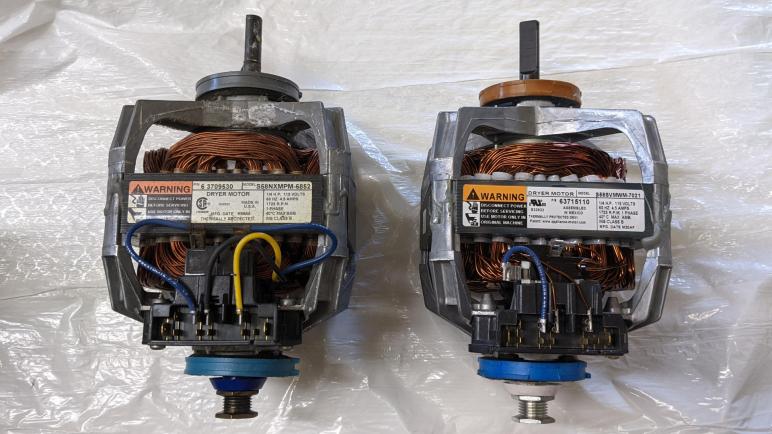
At the service counter, I gave my dryer model number MDG9206AWA and the store employee was able to put that into their computer system to retrieve some part numbers as replacements. Thankfully they were in stock so I bought a replacement motor assembly plus a replacement belt. Neither of which had a model number that matched the original item on my dryer, even though they were packaged in a way consistent with official replacement parts. Why appliance manufacturers use such a convoluted system I don’t know, but at least I have a way to deal with it.

Fortunately, mismatching part number aside, both the motor and the belt seem to be straightforward replacements for their original counterparts. Once I installed the motor by itself I verified it could at least spin itself in the absence of a load, confirming the old motor assembly was indeed faulty. From there I could put everything back together in the reverse order of assembly, and my dryer was back up and running!

Now I can resume doing laundry at home, and also resume my quest to salvage LED backlights from old LCD panels.

Maytag Dryer MDG9206AWA Mechanical Base

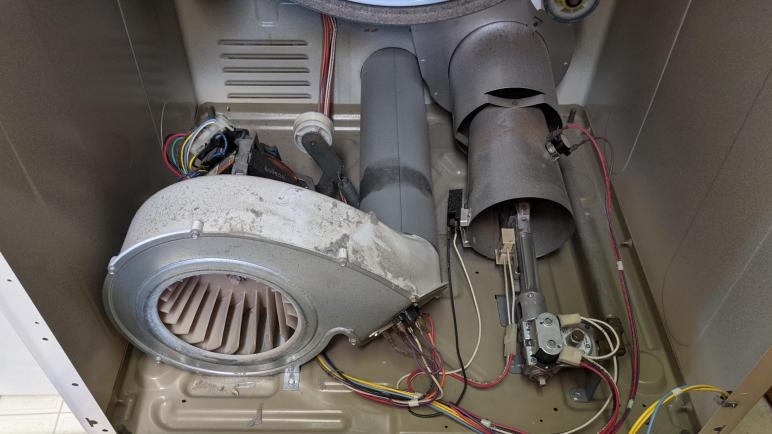
I’m trying to fix my broken clothes dryer and I’ve successfully opened up the sheet metal enclosure. Once I removed the dryer drum, I could access all of the mechanical core mounted on its base. The right half of the base is occupied by natural gas ignition and combustion equipment. Since my hypothesis is that motor capacitor(s) have failed, I’ll start by ignoring that half of the base and focus on the left half.

My first test is to try to spin up this motor by itself, without the dryer drum. It failed to start rotating with the same awful buzzing noise even without the dryer drum or drive belt, thus confirming that the root failure has nothing to do with mechanical obstruction with the dryer drum.

More convinced now that the motor capacitor(s) are at fault, I was dismayed to find that they are integrated into the motor assembly and could not be replaced separately. I have to replace the entire motor assembly. This is possibly intentional. If the motor capacitor have failed due to age, it can be argued that other parts of the motor assembly are nearing the end of their life as well. If this is true, it makes sense to replace everything together, so I’ll optimistically (naively?) believe that hypothesis.

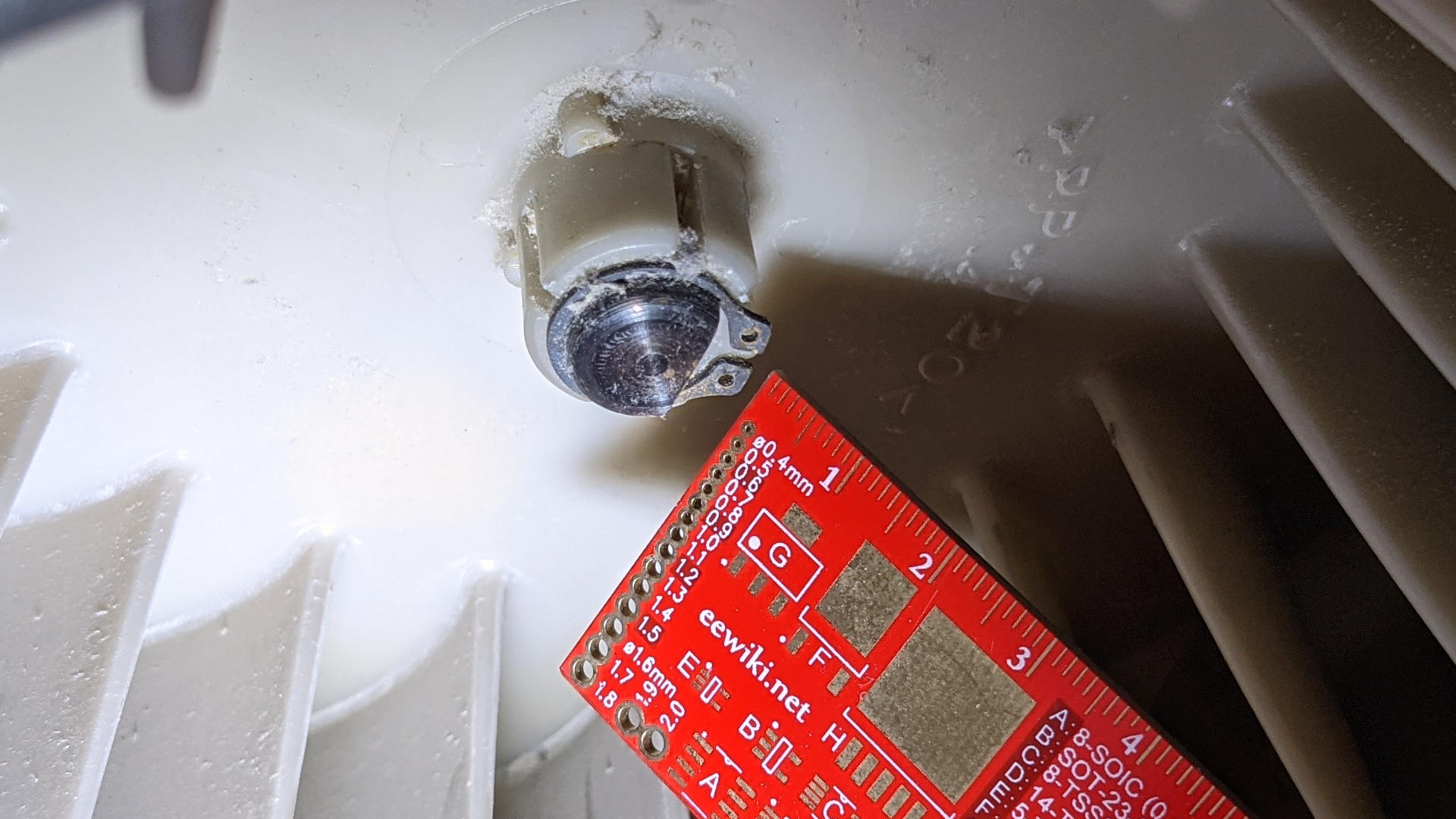
But that also meant I have to figure out how to remove the motor assembly. The motor shaft is connected on both ends. On the shaft facing me, it is connected to the air blower fan via a few retaining rings.

Retaining rings are a wonderful invention, holding tightly when installed and easily manipulated with the right tools. My problem? I don’t have a set of retaining ring pliers. That’s a tool I’ll have to buy for this project, which is fine as I always look forward to adding tools to my toolbox in both metaphorical and literal senses.

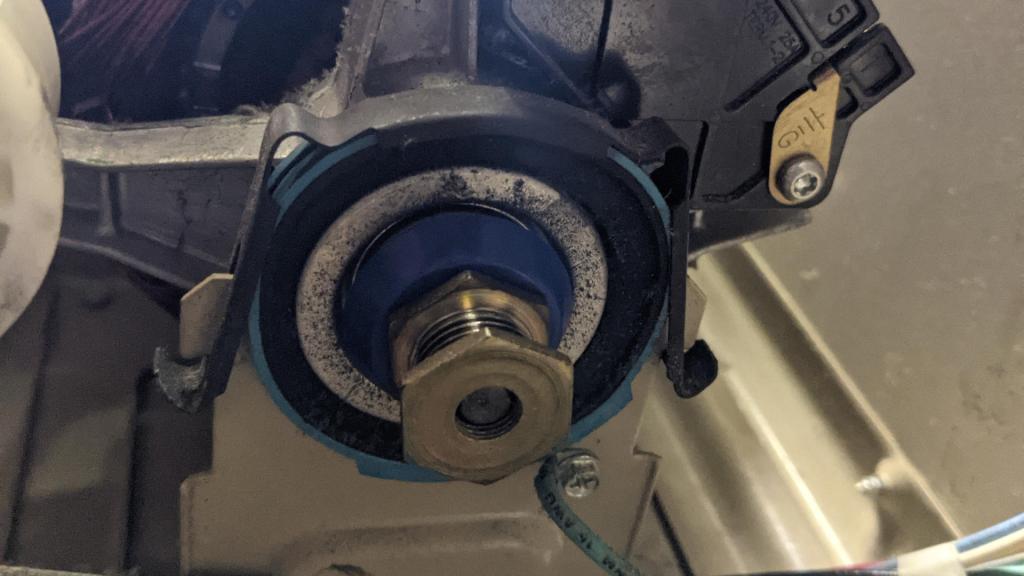
The far end of the motor shaft hosts the pulley which will turn the driver belt to spin the drum. Mounting this motor to the base plate are two sheet metal brackets. One just behind this pulley and the other one just behind the blower fan. Typically I could decipher how to install or remove a bracket by examining its shape, but I don’t recognize this particular bracket design.

I struggled with this bracket for some time, trying to figure out the magic touch to gently persuade it to release its grip on the motor. After some time of continuously failing I decided to seek help and found this YouTube video by RepairClinic.com. This video demonstrated no magic touch for gentle persuasion: I merely had to apply FAR more brute force than I had been willing to use. (“Be aware this may require some effort.“) I shrugged, applied a big whack as demonstrated in the video, and the bracket came loose. That works. Good enough for me to proceed with motor assembly replacement.

Maytag Dryer MDG9206AWA Disassembly

I’ve got a malfunctioning clothes dryer at home and I’ve decided to take a stab at fixing it myself. If I couldn’t fix it, I will have to hire a professional repair person. And if that should fail, I might have to replace the entire machine. But I am optimistic. Based on symptoms, I have a guess that the motor capacitors have failed. If that is true, it is a common age-related failure of motor appliances and thus I expected replacement parts to be available. But before that, I need to get inside the machine to validate my hypothesis.

Making my way to the dryer motor was an educational course in how Maytag engineers designed with sheet metal. I saw several signs that this machine was designed to be easy to service but without adding a lot of manufacturing cost to do so. My first lesson was that I wasted effort sliding the dryer out of its usual spot. All the parts I need to reach for this project was actually accessible from the front without moving the machine!

First I had to remove the door, whose fasteners held the lower front metal façade in place. Once that was removed I could access the assembly holding the front of the dryer drum, and the lint filter portion, of the air path. I noticed that several different fasteners were used and originally thought they served different purposes. But they were all used for fastening sheet metal together, which is fairly accommodating of loose tolerances. (Both a plus and a minus.) I eventually decided that the different screws were there to demarcate different stages of disassembly: it helps us see that only a subset was needed to remove a particular part. This way we don’t accidentally remove too many fasteners and have the machine completely fall apart on us.

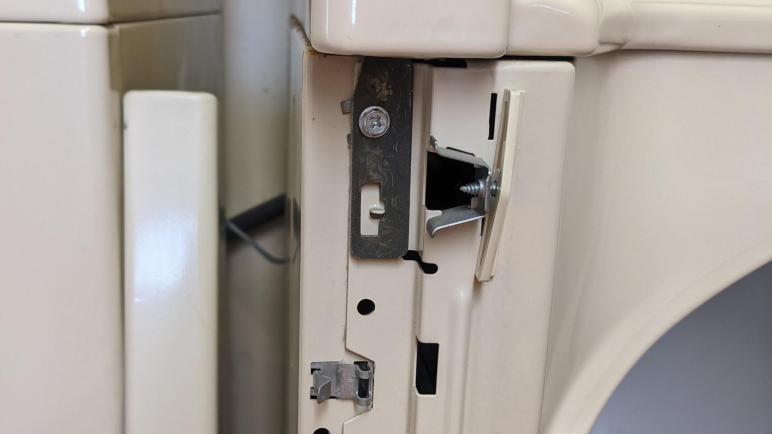
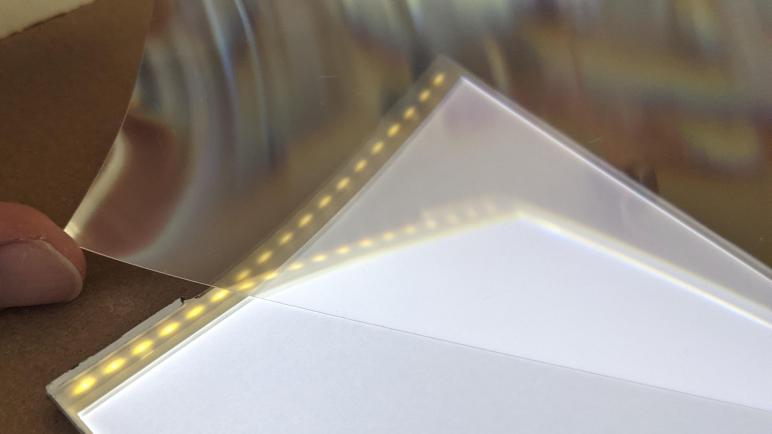
In addition to self-tapping sheet metal screws, there were also a few stamped sheet metal hooks (dark metal in title image) that were used to hold large sections of sheet metal together. I was impressed at how much this design could accommodate loose tolerances yet still allow us to fasten top front corners of the machine together so it makes for a solid cube.

I had to remove the dryer drum on my way to access the motor, which also involved removing the belt that rotated the dryer drum. I took a close look at this decades-old belt and saw it was cracked with age with a fraying substrate. The belt is another common age-related failure. While it hasn’t failed yet, I plan to go ahead and replace it as well. It’s something I had to remove anyway on my way to the mechanical components of this machine.

Maytag Dryer MDG9206AWA Troubleshooting

I had made plans to pull LED backlights out of old LCD screens, and even bought a dedicated LED backlight tester to aid in my adventure. But before I could embark, daily life interrupted in the form of a clothes dryer that would no longer spin up. Since this problem has a very immediate effect on my life, it has priority over salvaging LED backlights. While I am not an experienced appliance repairperson, this is not my first time poking into my laundry machine. A few years ago I dug into the washing machine that paired with this dryer.

Symptom

When I press the Start button, I hear an electrical buzz that I associate with the dryer motor startup sequence. Typically this buzz would only last about one to two seconds before it fades and sounds transition to mechanical noises of the dryer drum spinning up. Once the drum starts spinning up, I could release the Start button and let the machine execute its selected drying cycle.

But now the buzz continues for as long as I hold down the start button, and the dryer does not transition to mechanical spinup noises. This is intermittent. Occasionally the drum would start as normal, but most of the time it would just buzz for as long as I hold the start button.

Process of Elimination

Electrical Power: since the dryer would occasionally spin up, I decided this was not a power failure issue. One of the more common reasons for the dryer to not start is a thermal fuse. But if that thermal fuse has blown, I would expect no buzzing noise and certainly no occasional spin-up.

Electrical Control: Due to the occasional spin-up, I also decided the control system is probably OK.

Mechanical: One hypothesis is that I have a mechanical obstruction somewhere, and depending on the position of the drum relative to the obstruction, the motor would have a harder time starting up. I spun the dryer drum by hand and detected no such obstruction.

Natural Gas: The heat source for the dryer is natural gas, but since the machine never makes as far as flame ignition I doubt that subsystem had anything to do with my problem.

Electromechanical: That left the motor as the prime candidate for this problem. Specifically, I suspect one or more of the motor capacitors have failed with age. They are critical to the motor startup sequence. The buzzing noise and inability to spin up hints at the starting capacitor.


I like the starting capacitor hypothesis, a target to look for as I open up this machine.

Backlight LED Tester

I have successfully salvaged LED backlight diffuser assemblies from three different LCD screens. It gave me the confidence to attempt pulling the backlight out of other LCD screens in my pile of less-used and broken electronics, in the expectation that diffuse white light sources will be more useful than low resolution displays. But before I start merrily tear more panels apart, I wanted to address one particular pain point: deciphering mystery LED strings.

Only one of the three examples so far gave me an easy time, where the LED backlight power planes were clearly marked with + and -. The other two had multi-conductor cables that required a little decoding to find a common anode and cathodes for individual strings, and sometimes a few conductors remained mysterious. I had been doing this work by spending a lot of time probing with a multimeter, then soldering wires to test points, and cautiously putting power on those lines with a bench power supply. This has worked so far, but I knew there was room to make this process faster for future panels.

Enter the dedicated LED backlight tester.

I wanted something that could put current-limited power over a set of probes. This would let me probe LED strings directly in a single-step versus my current multi-step workflow of multimeter, then soldered wires, then bench power supply. I considered buying a set of probes that I can connect directly to my bench power supply, but a quick search for dedicated LED testers found them quite affordable and I made the jump to try one.

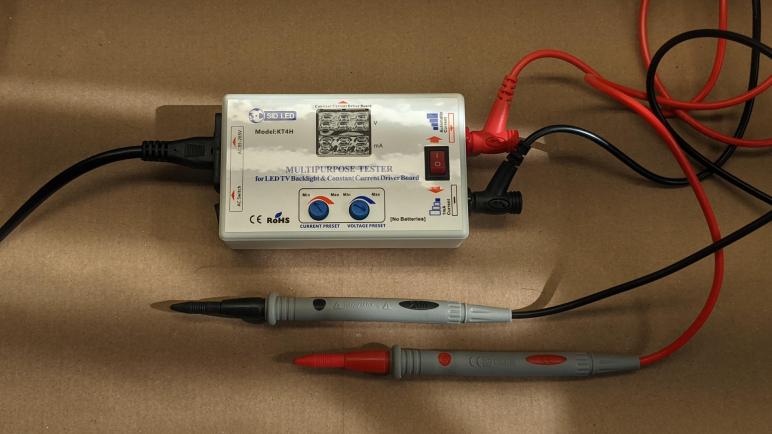
Looking over several options on Amazon, I decided to try a SID LED KT4H(*) because it advertised a few extra features I thought might be useful enough to worth the extra cost. It has household AC input so I don’t have to worry about a separate power supply or batteries. Separate numerical displays for voltage and amperage allows me to read both metrics simultaneously. Simple dials for current and voltage limits make the user interface simpler than designs that use infuriating combinations of unintuitive button presses. There’s a switch to toggle between two current limits: the one set by the dial, and 1mA for testing purposes. This is much better than turning the current limit knob back and forth. And finally, it can also test the other side of the system: whether the device’s constant current supply is putting out any power at all.

The package also included a convenient carrying case, in the form of a generic First Aid Kit zippered fabric bag. Not the fanciest branding, it gave me a chuckle, but it should be quite sufficient.

The probes had sharp tips more than precise enough to hit the kind of test points I had been probing with my meter.

For a quick familiarization run, I used this tester on a single 5mm through-hole LED and saw it light up dimly in the 1mA test mode and brightly with current limit set at 20mA. Then I moved on to illuminate the recently-liberated backlight from an AU Optronics B101EAN01.5. A nice feature is that the current limit ramps up gradually: there is a slow (2-4 seconds) ramp-up as the device seeks the correct voltage level to deliver 20mA. In comparison to my bench power supply which will snap to a voltage almost instantly. I’m optimistic the slower ramp-up will prove valuable.

Before I could put this tester to work, though, life threw me a curveball and I had a broken clothes dryer to fix. The LED backlights will have to wait a bit.


(*) Disclosure: As an Amazon Associate I earn from qualifying purchases.

The Great Backlight Liberation Begins

There’s a small market in LCD panel controller boards. When we salvage a panel from a retired laptop, we can enter its model number into eBay. If the panel is used in a high-volume laptop (for example, one of Dell’s consumer Inspiron laptops. Or most Apple MacBooks) then someone is likely selling a driver board that accepts HDMI input and translates it into the signal to control a panel’s integrated electronics.

I had salvaged the panel from one of my old Dell Inspiron laptops and, buying one of these adapter boards for $50, converted it to an external monitor. Eventually it became the onboard screen for Luggable PC Mark I. (Mark II used a commercially available monitor, and stories on both are available here.) A few months after that adventure, I received another retired Inspiron laptop and used its screen for the Portable External Monitor project.

I have several more LCD panels salvaged from retired laptops, but I don’t need very many external monitors. Furthermore, resolutions on these panels were lower than 1920×1080 limiting their utility. It’s hard to justify spending $50 for a circuit board to hack-up converted laptop screens when a Full HD 1920×1080 desktop monitor can be had for about $100.

I had thought it might be interesting to build my own LCD interface boards, but there are several obstacles. One is the requirement to build connectors to carry high-speed raw pixel information, which is tricky to do correctly given the high bandwidth translating to low tolerance for sloppy work. The LVDS (low voltage differential signaling) system doesn’t connect directly to typical microcontroller output pins, but translator chips are available and some task-specific microcontrollers have integrated LVDS output.

But the biggest hurdle against building my own boards is documentation. The protocol carrying that high-speed raw pixel information is a mystery. Counter to popular electronics convention, datasheets for panels aren’t distributed freely online. Many of them are proprietary and difficult to get, others lie behind paywalls. It makes sense to pay if I’m designing a device using millions of panels, but it doesn’t make sense if I’m fiddling with a single panel.

So those salvaged LCD panels have sat in my workshop, gathering dust waiting for a new purpose in life. Now that I’ve successfully extracted and illuminated the backlight module from three different LCD panels, I believe I have found that new purpose. Utility of extra monitors quickly pass a point of diminishing returns, but gentle diffuse white light sources are far more useful in wider variety of settings. No need to buy $50 driver board makes this a lower cost project, combined with higher utility of diffuse white light sources means the great backlight liberation begins.

AU Optronics B101EAN01.5 Backlight Power

I’ve pulled the LED backlight illumination panel out of an AU Optronics B101EAN01.5 LCD panel, which was in turn salvaged from an Acer Aspire Switch 10 (SW5-012) tablet/laptop convertible. I want to see if I can get it to light up. Using my multimeter I found test points corresponding to all six control lines on the backlight, and soldered wires to all of them. The next task is to determine what these wires are.

The other end of those wires were crimped and assembled into a six-pin connector with 0.1″ spacing. I first arranged them in whatever happened to be convenient, but then I changed my mind and rearranged them to be in the same order as that on the backlight cable. From top to bottom: Power, ground, FB1, FB2, FB3, and FB4.

This gave me something suitable for breadboard exploration. I have two hypothesis about what the FB connectors are. Since power and ground were already identified, I thought maybe these are control lines (gates) for MOSFETs in line with each string, which implies I could turn on a LED string by pulling its signal high. But if I look at precedence set by the LG LP133WF2(SP)(A1) panel I took apart earlier, these could be four current sinks for four LED strings.

To test both concepts simultaneously, my breadboard exploration wired one string to a pull-up resistor in case FB is a MOSFET gate, and another string to a pull-down resistor in case it is LED current sink.

I started seeing a dim glow when I turned the power supply up to 17V. To determine which hypothesis was correct, I removed the pull-down resistor and it went dark. So FB1 through FB4 are current sinks for four strings. As a double-check, I calculated voltage drop across the pull-down resistor and calculated the current flow to be 1.4mA. This is far too high for a MOSFET gate but completely consistent with current-limiting resistor for a dimly lit LED.

Hooking up a current-limiting resistor to each of FB1 through FB4, the backlight has dim but usable illumination starting at about a 15.6V drop across an individual LED string. Whenever I find a project for this light, I will need to either solder more permanent current-limiting resistors, or find an intelligent LED controller with a more efficient current-limiting control scheme.

There is one remaining mystery: If the VOUT wire is voltage source, and FB1 through FB4 are current sinks, why is there a line connected to the ground plane on the control circuit board? It feels like there’s another aspect of this backlight I have yet to discover. Or possibly destroyed by clumsy overvoltage on my part. Either way, it doesn’t seem to be critical for illuminating this backlight, so I’ll leave that mystery for another day.

AU Optronics B101EAN01.5 Backlight Wiring

I have a broken Acer Aspire Switch 10 (SW5-012) that I have taken apart. Among the pieces I salvaged was the screen, an AU Optronics B101EAN01.5 whose 1280×800 resolution is not terribly interesting in this era when even cell phones have higher resolution displays. So I decided the most interesting thing to do is to liberate its LED backlight for potential future projects.

The backlight connector has six visible conductors. Two conductors are wider than the rest, which imply power and ground to me. There is a test point labeled VOUT adjacent to this connector, and my meter confirms it corresponds to the topmost wide conductor. The meter also confirmed the second wide conductor has continuity to the ground plane of this circuit board, so power and ground confirmed.

What does that mean for the four remaining thin conductors? Looking around the backlight control IC, I looked for a likely group of four test points and found FB1, FB2, FB3 and FB4. Meter confirms they correspond to the remaining four conductors on the backlight cable. “FB” probably doesn’t mean Facebook in this context, but I’m not sure what it would represent. I’m just glad they were numbered.

As for the backlight control IC itself, the large AUO letters say it is something AU Optronics produced for internal consumption. The earlier LG panel project found a TI TPS61187 chip with publicly available documentation, but here I found no documentation for an AUO L10716 controller. Since the chip is so tiny it’s pretty probable I’ve misread the numbers, but no search hits on the variations I could think of either: LI0718, L10216, etc. If I had found a test point labeled PWM I would be tempted to see if I can get it running with an Arduino PWM signal, but I saw test points labeled SCL and SDA telling me this is an I2C peripheral and my skill level today isn’t good enough to reverse engineer it without official documentation of its I2C protocol.

So instead of trying to interface with the existing backlight control chip as I did on the LG backlight, here I will interface with the backlight LEDs directly. I found test points corresponding to all six wires on the backlight connector and soldered wires to all of them. Then I used hot glue to help hold them down and relieve strain, as I don’t want to lift a pad again!

With the wires securely attached, I need to figure out what they actually do.