MX340 Main Circuit Board

I’ve learned a lot from taking apart my retired Canon Pixma MX340 multi-function inkjet, and there are many more potential lessons that I’ve chosen not to pursue. The paper-handling details of its ADF is one, its main circuit board is another. There are a lot of electronics design lessons on this intricate board, but they’re beyond my current skill level to understand. (In comparison, the control panel was a much simpler single-sided circuit board and I enjoyed tracing through it.) But I’ll still take a cursory look at the main board.

So far, I’ve kept everything plugged in so I could keep it running and probe component interactions. Now I will unplug everything so I can take a look at the board itself. I took many pictures as reference as I went, to increase the odds I can put it back together, but I would later learn it was unnecessary.

Unplugging everything left a large plastic shield.

Removing the shield uncovered the fact that landline phone jacks (for its fax functionality) are on a separate circuit board. I’ve reused salvaged jacks before so these may yet find another use.

Finally I have the main board by itself. As already stated it’s much more complex than my skill level can reverse-engineer, and I have no motivation to do so anyway.

The circuit board as a minimum of two layers, possibly more but I don’t know enough to tell.

Apparently production volume of mainstream Canon inkjets are high enough to amortize up-front cost of custom electronic components. I picked a few large pieces and tried searching for them based on their markings, coming up empty handed across the board. An example is IC702 here marked with a Texas Instruments logo. It should have been a slam dunk but all I got were chip vendors promising to sell me a TI OACC3TTC 81024 without having any idea what it is. The same story repeated for three other chips before I threw my hands up and quit trying.

There were many unpopulated footprints on the main board, presumably to support features of other models in the product line. I can speculate on two of them. This looks like an Ethernet port, something I would have appreciated as its WiFi module is now out of date due to its WPS dependency.

This unpopulated footprint for connector CN502 is labeled “Card” and has nine pins, matching nine contacts on a SD card. MX340 have a feature for scanning a document directly to PDF file on a USB memory stick. Looks like a sibling model could write out to a SD card.

There were a few other unpopulated footprints but I had no speculation on what they might be. Bringing to a conclusion all I had expected to get out of looking over this circuit board. I plugged everything back in and was mildly surprised it still ran.


This teardown ran far longer than I originally thought it would. Click here to rewind back to where this adventure started.
MX340 Automatic Document Feeder (ADF) Disassembled

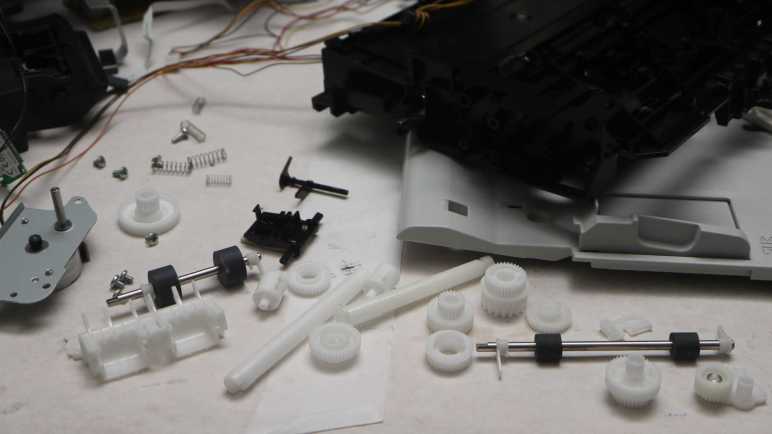
I’m finishing up the teardown of my old Canon Pixma MX340 multi-function inkjet. After completing my exploration of the print carriage encoder, I looked over my workbench and saw: Hey, the automatic document feeder (ADF) gearbox is still intact! I’ll take it apart now.

Since I don’t expect to need to know how to mass-produce a paper feeding mechanism, I’m not going to spend too much time to understand exactly how all the mechanisms work together.

Mechanically, a stepper motor drives at least three shafts, each turning a set of soft rubber rollers. I wonder if these gears are all specifically designed for this device or if they might be standard parts from a catalog. If the latter, I would love to browse through that catalog.

As with the rest of the device, everything came apart nicely now that I recognize the system of clips Canon engineers use to ease disassembly and repair.

The ADF lid is likewise an assembly of injection-molded parts held together with easily disassembled mechanisms. Within this assembly I noticed several freewheel mechanisms implemented with a coil of metal, now that I understand what I’m looking at.

I appreciate precision ground metal shafts, much more satisfying in the hand than an injection-molded plastic shaft. I keep thinking it would be cool to reuse them in another project, but due to their precision nature they’re typically tailored to a specific purpose and not easily reused elsewhere. They usually end up just as toys for me, roughly analogous to fidget toys but with no moving parts. When my projects need metal shafts, I end up having to cut new ones tailored for my project. My shafts are not as precise as these mass-produced units, but good enough for their own respective purposes.

Next up: the original finish line of my teardown, the main circuit board itself.


This teardown ran far longer than I originally thought it would. Click here to rewind back to where this adventure started.

MX340 Print Carriage Encoder Delivers 600 Counts Per Inch

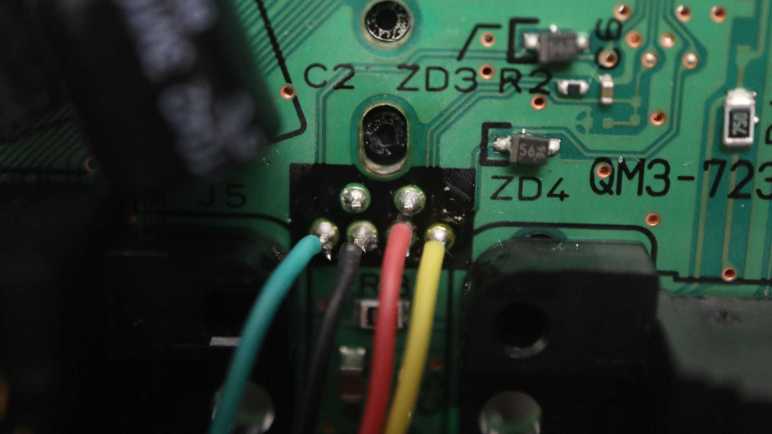
After taking apart the print carriage of my old Canon Pixma MX340 multi-function inkjet, I figured out the pinout for its quadrature encoder. Sadly, it didn’t look very easy to tap into those signals on the printer mainboard.

So I soldered wires to the print carriage instead.

I routed these wires through the front with nice long flexible wires, to my Arduino Nano running a quadrature decoding library. Providing 3.3V power and manually moving the carriage back and forth across its entire range, I saw ~7637 counts. I divided it by centimeters but didn’t get a very nice number. I tried Imperial measurements, and it worked out to 600 counts per inch.

Earlier I decided the paper feed encoder delivered 8640 counts per revolution. Trying to correlate the two measurements, I went back to measure the diameter of the paper feed shaft at 9.75mm. That works out to a circumference of 30.615mm or roughly 1.2 inch. 8640/1.2 = 7200 counts per inch. That’s 12 times the horizontal axis resolution!

Such a huge discrepancy in resolution between horizontal and vertical axes can be explained by how this print engine moves. The paper feed motor needs to advance paper with high accuracy to make sure one print head pass lines up exactly against the next pass with no gaps or overlaps in between. The print carriage motor then moves the print head across the page at a controlled rate, which is the key here: the steady rate of motion means the printer control system can interpolate between those 600 counts per inch to synthesize virtual steps in between real hardware steps. Doubling to 1200 or quadrupling to 2400 (or more) are valid options when print carriage motor moves at a known controlled speed.

Now that I have my answer, I no longer need these wire taps. At first I was ready to disassemble the print carriage again so I could unsolder these wires, and I wasn’t trilled about the risk of damage and losing springs when I take it apart again. Then I decided to not take that risk, save myself the time of disassembly, and just cut off those wires today. I’ll unsolder the remaining stump later, if ever. Right now I would rather spend my time disassembling the ADF gearbox instead.


This teardown ran far longer than I originally thought it would. Click here to rewind back to where this adventure started.

MX340 Print Carriage Encoder Pinout

It took some digging, but I finally reached the circuit board inside the print carriage of my old Canon Pixma MX340 multi-function inkjet. Most of it is dedicated to print cartridge connectivity (or more specifically, their integrated print heads) but I don’t care about that.

I wanted to know which (of many) wires connect to the optical quadrature encoder buried in its center.

It is not identical to the optical quadrature encoder used on the paper feed roller, but they look closely related. Potentially upright (reads encoder disc perpendicular to the circuit board) vs. flat (reads encoder strip parallel to the circuit board) versions of the same device.

More relevant is the fact they seem to share the same circuit board footprint with their arrangement of six pins. Trying the easy thing first, I pulled out my multimeter and used the paper feed encoder as a guide to probe the pins on the print carriage encoder. I quickly confirmed they have the exact same pinout.

One pin is connected to incoming power supply, and onward through some resistance to another pin. I measured the resistance at a little over 80 Ohms which is not a typical resistor value. I suspect it’s actually a higher common value (maybe 100 Ohm) but some components in parallel brought down the effective value. The A/B phase signal wires are out at the ends, and the remaining two pins are grounded.

I traced the two signal wires and the power supply wire to the rightmost three pins of the ribbon connector. I didn’t put a number on ground because multiple pins (like pin 15) are connected to ground.

The pin numbers were taken from the system main board, which labeled pin 1 with a number and an arrow (the end closer to camera) and for this cable the other end gets a “22” label (far end, circled in red.)

I had hoped finding these pins would tell me how to tap into its communication on the mainboard side, but they turned out to be the wires most buried and difficult to access. Ah well, I’ll solder my probe wires to the print carriage circuit board instead.


This teardown ran far longer than I originally thought it would. Click here to rewind back to where this adventure started.

MX340 Print Carriage Internals

There’s one final sensor I’m trying to access as I tear down my old Canon Pixma MX340 multi-function inkjet: its print carriage linear quadrature encoder. Removing the lower rail allowed the print carriage to slide free, but I first tried to see if I can keep it on the rail. I was afraid sliding it off the rail would unpredictably release the spring-loaded tension mechanisms I can partially see. (White plastic below the belt and behind sheet metal in picture below.)

Without sliding it off the rail, I could access the two fasteners I couldn’t access before. Removing them allowed two separate pieces of black plastic to move apart slightly, but they were both within the lower rail. The carriage has to slide off before I could pull those pieces apart.

As I slid the carriage off the lower rail, my fear came to pass: I heard a “pling” announcing a spring departing to seek new adventures. Its former home highlighted in red on the left, and its companion still in place on the right. Thankfully I managed to find this spring later, because every spring I lose decreases the odds I can repurpose the entire print carriage assembly intact for a future project.

Carefully setting down the rear cover with its many springs, I could see inside the carriage. Front and center is the encoder sensor, but its pins go through the circuit board to the other side. The flexible ribbon cables are also connected on the other side. I will have to remove four more screws before I can see how they are wired.

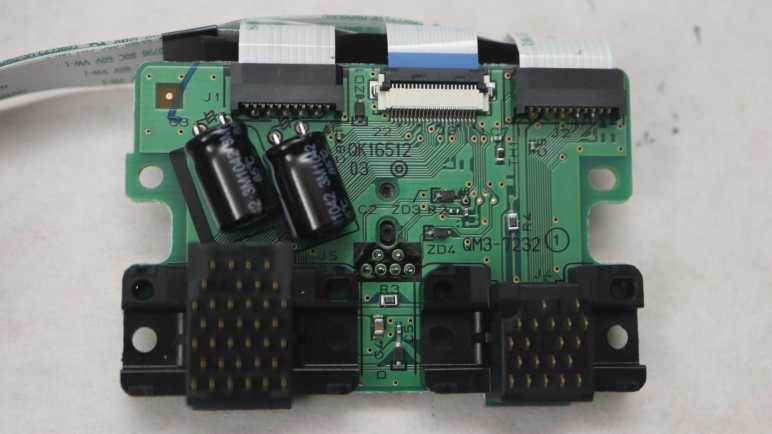
The flex cable connectors were expected, as are the ink cartridge contacts. The surprise on the front is a pair of electrolytic capacitors. I guess inkjet cartridges need small bursts of buffered power to do their thing.

I wasn’t interested in reverse-engineering the ink cartridge interface, but I was interested in how the electrical contacts are implemented. Each contact is a thin spring-loaded metal blade. (My thumb nail is pushing on one.) Unfortunately, it appears if I want to see more I would have to remove the contact assembly from the circuit board. I haven’t had a great success rate unsoldering components with this many pins, so I will save my unsoldering practice session for later. Right now I’m staying focused on the optical encoder sensor.


This teardown ran far longer than I originally thought it would. Click here to rewind back to where this adventure started.

MX340 Print Carriage Lower Rail

I’m close to the end of tearing down my Canon Pixma MX340 multi-function inkjet. After the paper feed motor was freed from the plastic base, there’s not much more I could do to that assembly because I wanted to keep the motor and encoder together. So I turned my attention to the print carriage assembly, with its own encoder I have yet to access.

Earlier disassembly saw fasteners I couldn’t access from the front. I will now take apart the print carriage rail in order to free the carriage itself and allow access to those fasteners.

Looking at the assembly I saw the backbone sheet metal was folded up top to form the upper rail, and there were folds left and right to keep the carriage constrained. The only thing that could move is the lower rail, which is a separate piece of sheet metal. (In above picture, the lower rail is visibly covered with darkened lubrication grease.)

At this point I noticed the lower rail is mounted slightly tilted from the bottom of the backbone. I measured it was raised by 2.07mm on the left but only 1.41mm on the right. This slight tilt was probably part of factory calibration to ensure the print head travels exactly parallel to the paper surface at all times.

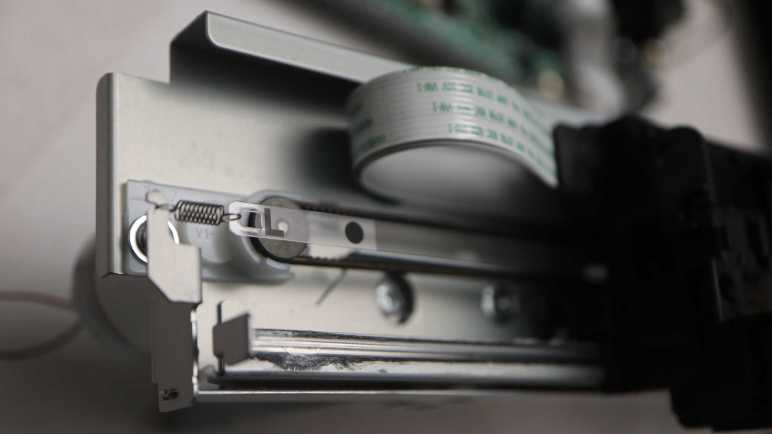
Before releasing the lower rail, I unhooked the encoder strip’s tension spring on the left.

The drive belt was also unhooked from the right side tension pulley.

An vertical alignment reference marker is visible to the left of this lower rail screw.

Removing the screw made it clear there’s allowance for a few millimeters of lower rail adjustment.

By removing the lower rail, I have destroyed its precision factory alignment. But with the rest of the printer taken apart I doubt it matters anymore. I’ll ignore that and keep digging.


This teardown ran far longer than I originally thought it would. Click here to rewind back to where this adventure started.
MX340 Paper Feed Motor And Encoder Removed

The process of taking apart my old Canon Pixma MX340 multi-function inkjet has been remarkably easy, something that took deliberate effort by Canon. I recognize their effort and I am grateful. It’s been a fun learning experience and I realized I’m a little sad to be close to the end of mechanical disassembly. But that’s not going to stop me from finishing the job!

The paper feed motor and adjacent gears (including the rotation quadrature encoder) is the final metal assembly still attached to the base. It also hosts the plastic-and-foam assembly that sits under the paper as it is printed. A typewriter platen is responsible for both feeding paper and holding it against inking impact. Here, the two tasks are handled by two separate parts. The metal shaft with a gray friction coating is responsible for feeding paper, and the rectangular black plastic-and-foam assembly holds the paper directly under the print head. I’m not sure which part technically counts as a platen here, but I’m going to call the rectangular plastic-and-foam assembly the platen.

I see several Philips-head fasteners blocked by the friction-coated feed shaft.

Turning a plastic handle allowed me to lift that shaft up and away, exposing those fasteners.

The fastener left of center is spring-loaded though it’s not clear to me what forces that spring is intended to absorb. The center of this platen is a soft porous foam discolored by a few high-traffic areas of ink absorption. I used this printer for many border-less photo prints. The printer apparently accomplishes this feat by shooting ink beyond the borders to make sure everything is covered, and that ink ends up in this foam. There is a distinct over spray pattern corresponding to 4″ x 6″ photo paper in addition to a less distinct pattern for less frequent full width 8.5″ x 11″ photo paper prints.

Removing the platen and flipping it over, I see several holes where oversaturated ink can drip down to the ink absorbent pads below. It looks like I never needed that provision as the lower pad is still pristine white.

Removing the platen also allowed me access to the remaining fasteners. I had hoped there was only a single piece of stamped sheet metal as they would make it easier to keep the paper feed motor and shaft assembly in one piece. Unfortunately they are two separate pieces. So after lifting them out of the base, things are a little loose and floppy.

Once I made sure none of the rotating pieces are in contact with my table surface, I pressed the power button. The power-up self-test sequence still runs! Things sounded weird because the print carriage was not designed to run facing upwards, and the paper feed motor is no longer driving a bunch of gears. Plus the printer complained that no ink cartridges were installed. But still, it ran! I’m glad it’s still in running condition as I still want to probe the print carriage encoder. I will start that process by disassembling its rail assembly.


This teardown ran far longer than I originally thought it would. Click here to rewind back to where this adventure started.

MX340 Was Designed For Easy Servicing

Looking at the inner workings of my retired Canon Pixma MX340 multi-function inkjet, I understood many details to be results of making very domain-specific optimizations for mass production. Such details wouldn’t be useful doing anything else, and time and effort required for such work wouldn’t make sense for hobbyist-level projects.

On the other hand, I also found the design reflected a priority for easy serviceability. Something I do aspire to in my own projects. I know serviceability hasn’t always been a design priority in my own projects and it shows. Some people who had build their own Sawppy rover got confused or encounter problems in assembly or repair. By not putting any effort into serviceability, I have implicitly assumed I’ll always have my workbench and that wasn’t always true. Fixing my Sawppy rover in the middle of Maker Faire Bay Area was a huge pain.

With that experience I now recognize effort went into making the MX340 easy to service. Every fastener is a Philips-head screw, the vast majority of which can be turned by a #2 Philips driver. Nothing is glued down, welded, or hydraulic pressed. Everything can be taken apart and reassembled.

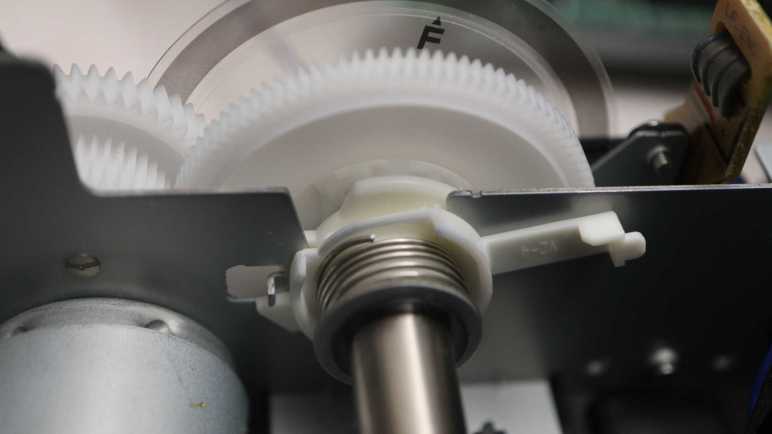
This is the result of deliberate decision by Canon and they had allocated the engineering time to improve serviceability. Some of which is quite elaborate: look at this mechanism securing the shaft that hosted the rotary quadrature encoder. This assembly could have been press fitted into the stamped sheet metal chassis. Simple, reliable, cheap. But that’s not what Canon did.

They designed this plastic bearing carrier so I could turn its arm…

… and lift the entire assembly out of its stamped sheet metal chassis. No tools required.

Why did Canon decide to invest this engineering effort? I assume there must be a monetary payoff. Perhaps this reduces their costs to service devices under warranty? Whatever their reason, my teardown experience indicate it is a very rare thing among consumer electronics manufacturers. It makes teardown projects like this one so much easier and more rewarding. I chose not to reassemble the paper tray sheet feed gearbox to see exactly how it worked, but because it was easy to non-destructively take it apart, I could have done so and that’s is a luxury I don’t take for granted. Up to this point, and as I proceed forward.


This teardown ran far longer than I originally thought it would. Click here to rewind back to where this adventure started.

MX340 Paper Tray Gearbox Details Not Generally Applicable

I’ve been having fun learning how things worked inside my retired Canon Pixma MX340 multi-function inkjet. Some lessons have direct application to personal projects, especially regarding components that I think I can repurpose in the future. Others are more general, like clever mechanical design concepts that I might be able to adapt to a 3D printed future project. Then there are lessons just for the sake of satisfying curiosity. Looking at implementation details of the paper tray sheet feeding mechanism, I’m definitely in the territory of that last category.

Designing this mechanism took skill beyond what I can comprehend today, orders of magnitude more sophisticated than my 3D printed mechanical contraptions. Part of this stems from the fact I haven’t built up the mental skill to organize knowledge of complex mechanical interactions. My software background gave me ways to think about software interactions, organizing them into API layers and partition module interactions into various levels of abstractions. Looking at a mechanical gearbox where forces can be transmitted via multiple paths to the same destination, at gears that only have teeth to transmit power partway through their circumference, at the freewheel element that turns one way but not another… my brain is overwhelmed trying to keep track of all potential interactions.

I think a good analogy is learning a new language. (The human spoken kind, not the computer programming kind.) It takes some experience to learn enough to mentally catalog and partition the sounds we hear. Knowing where one word ended and another began is an important early skill. Knowing what sounds are critical and what sounds are just person-to-person variation is another big step.

At the moment I lack the equivalent skills to understand and analyze what’s going on inside this gearbox. I also lack the motivation to understand designs optimized for mass-production, which I don’t plan on doing. In other words: if I put in the work to understand it all, I would learn some very domain specific knowledge on a cheaply mass produced mechanism to feed the top sheet of a stack of paper. I don’t foresee that knowledge as something useful to me in the near future. The cost/benefit ratio for diving deeper into this gearbox doesn’t look great, so I’m going to stop here.

Still, I’ve learned a lot of interesting things, and I’m confident this exposure will help me understand more of the next mechanical marvel I encounter in a teardown. A process I intend to repeat until that day when I can look at a complex mechanical system and not get overwhelmed. An iterative process starting with admitting that day is not today, allowing me to focus on other lessons I can more easily absorb.


This teardown ran far longer than I originally thought it would. Click here to rewind back to where this adventure started.

MX340 Paper Tray Freewheel Gears

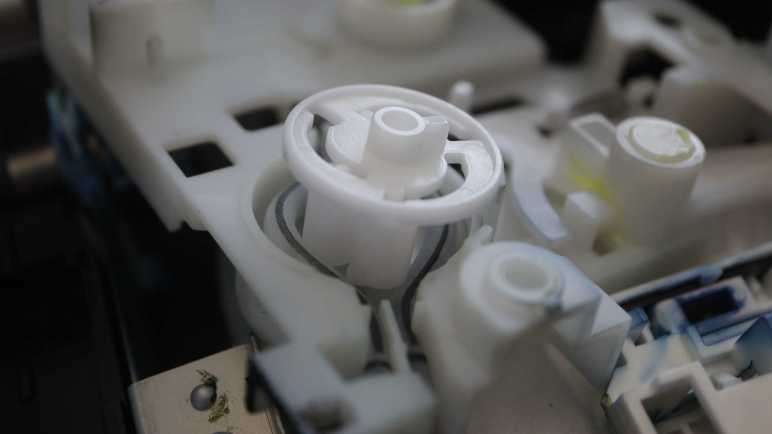
The paper sheet feeding mechanism in my retired Canon Pixma MX340 multi-function inkjet is a mechanical marvel. There are details I didn’t understand until a second or third look, like the spring that was installed on top of the big black gear driving the output cam. When I first saw it I thought it wasn’t a big deal. It looks like a spring, probably there to absorb some kind of shock to the system. No big deal, except I was wrong. The real story was actually much more interesting: it’s a freewheel mechanism.

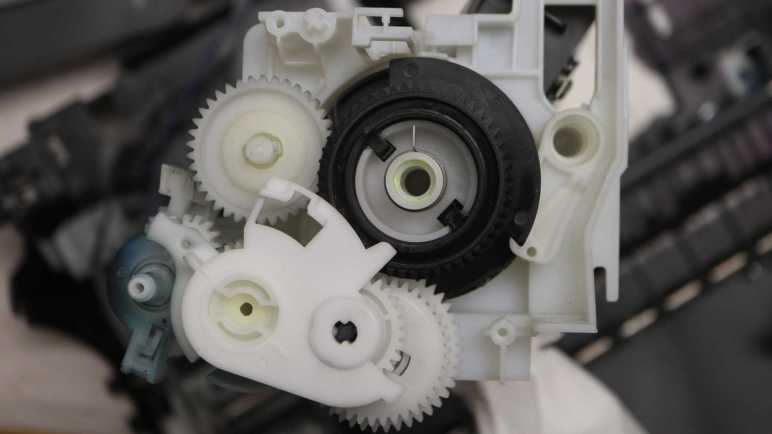
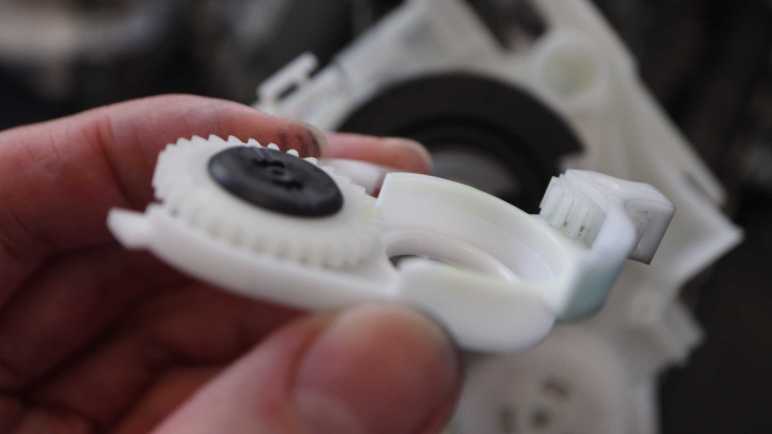
My lesson came from a different part of the gearbox. This pair of gears were mounted on a static shaft that did not turn, so this pair exists to convey rotational power from one gear to the other. But if they were a straightforward direct coupling, they could have been injection molded as a single piece. Their multi-piece assembly hinted at something more, so I picked it up and started playing with it. I quickly found that I could rotate the top gear (as viewed in picture above) counterclockwise while holding the bottom gear static, but if I try turning the top gear clockwise they would lock up and turn together.

Aha! It’s a way to ensure something only turns in one direction. A concept implemented several different ways (example) all inside this gearbox. I also knew this concept from the rear wheel of my bicycle, allowing me to coast without having to pedal in sync. I knew there had to be a term for this common concept but my search efforts came up empty. I ended up asking my friend Emily Velasco (who has bike hacking among her many talents) for help and she told me it’s called a freewheel. Unlike the rear wheel hub of my bicycle, this pair of gears didn’t make the clicky-clack noises of a ratchet mechanism. It was smooth and quiet so I had to see how they implemented it. Maybe it’s like one of the illustrations on Wikipedia, a series of spring-loaded ball bearings all around the perimeter? Maybe a clever arrangement of many layers of friction material?

I popped the two gears apart and between them I found only a single metal coil. Wow. How did this work?

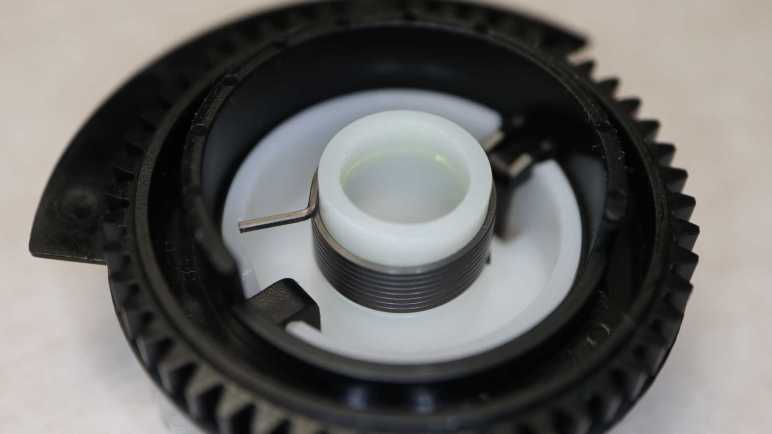
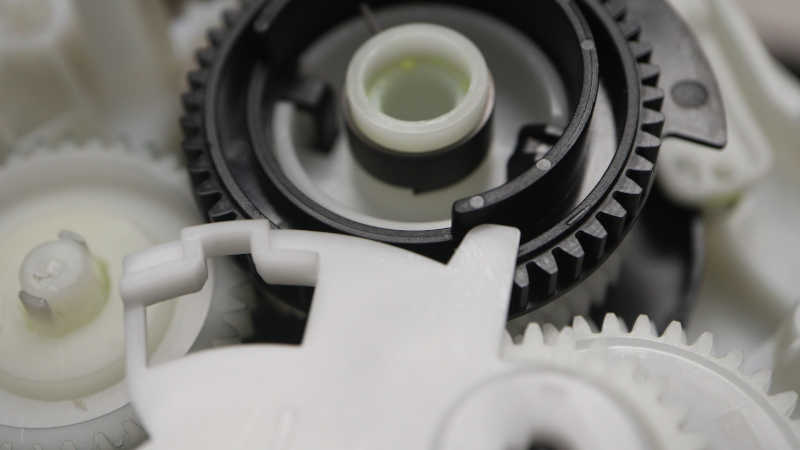
I first focused on this detail: both ends of this coil stuck out beyond the coil diameter. I believed it would allow them to smoothly coast along a surface in one direction, but dig in when moved in the opposite direction. A little bit of this dug-in force would expand the diameter for this coil, relaxing its grip on the inner cylinder (half from one gear and half from another) and allowing gears to turn independent of each other. As soon as the direction reverses, the coil contracts back down to its normal diameter and its grip keeps the two gears moving in sync. Torque transmission would have been limited by the friction of the metal coil against slick white plastic, but it’s more than enough to resist my finger strength and evidently enough for this application.

On further examination, I changed my mind. I looked inside the coil housing for any marks of surface damage from coil ends digging in, and found it completely smooth to my eyes. Also, for long-term durability, it would make sense to avoid any mechanism that destroys the surface over time. Perhaps friction against the coil interior, without any wedge dig-in action, is enough for this design to work. [UPDATE: Indeed it is! Emily Velasco told me this is an example of capstan effect.] If so, the fact that the coil ends stuck out beyond its diameter may merely be an artifact of its manufacturing process.

One data point supporting the “friction is enough” hypothesis is the fact this coil is wound from thin metal wire with a square cross section instead of the typical round wire. This would help maximize contact surface area.

Another supporting data point can be found on the big black output gear, where one end (the <1cm length of metal stub) is held static at all times and the other end has nothing to dig into. This is enough to allow counter-clockwise (as viewed in this picture) rotation but resist clockwise rotation.

I found a slot for that metal stub on the gearbox lid that holds the stub in place.

Getting this functionality from a single precision-manufactured coil of metal is a feat of mechanical engineering and manufacturing that impressed and amazed me, and I almost missed it entirely. Given that, I’m sure there are many other details in this gearbox that has gone completely over my head without me noticing, because they are designed to priorities different from mine.


This teardown ran far longer than I originally thought it would. Click here to rewind back to where this adventure started.
MX340 Paper Tray Output Gear and Cam

The paper tray in my retired Canon Pixma MX340 multi-function inkjet has a box of mechanisms to orchestrate its page-feeding sequence. Powered by the paper-feed motor, two different actions can be triggered from a gear shifting mechanism by engaging one of two gears. But there was at least one more gear interaction: The forward gear position can be inhibited by another gear, part of the largest assembly in this box.

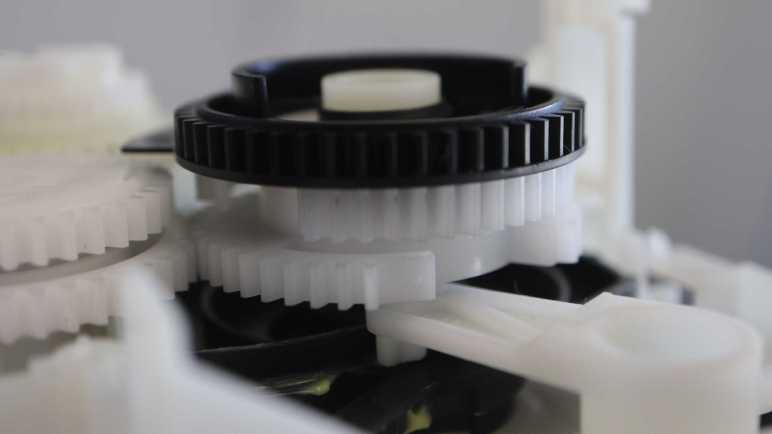
I didn’t notice this interaction at first, but as I looked at the lever in detail, I noticed a protrusion up top. Given all the design optimizations I’ve seen so far, I knew that protrusion could not have been accidental. I saw it could push against a wall on the big black gear that covered only roughly 240 degrees out of the circumference. This would inhibit engaging the forward gear.

When within that ~120 degree gap, though, it is possible to engage forward gear. I thought it was neat, but as soon as I looked at this big black gear more closely, I realized that was just the beginning. If the black gear continued turning counter-clockwise in this picture, the wall will eventually push on that protrusion and pop it out of gear.

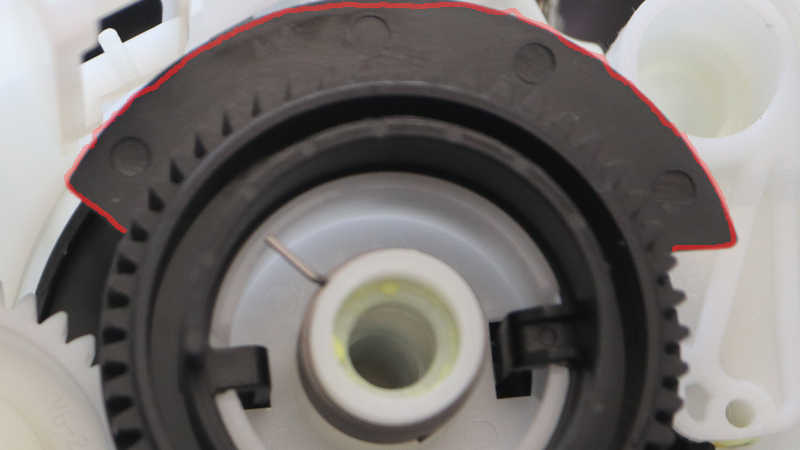
Beyond the ring of gear teeth, I see a thin piece of plastic covering a different ~120 degree arc. This slotted into a photo-interrupter sensor. Looking at the two mechanisms, it appears the beam is interrupted when we’re within the arc where forward gear engagement is allowed.

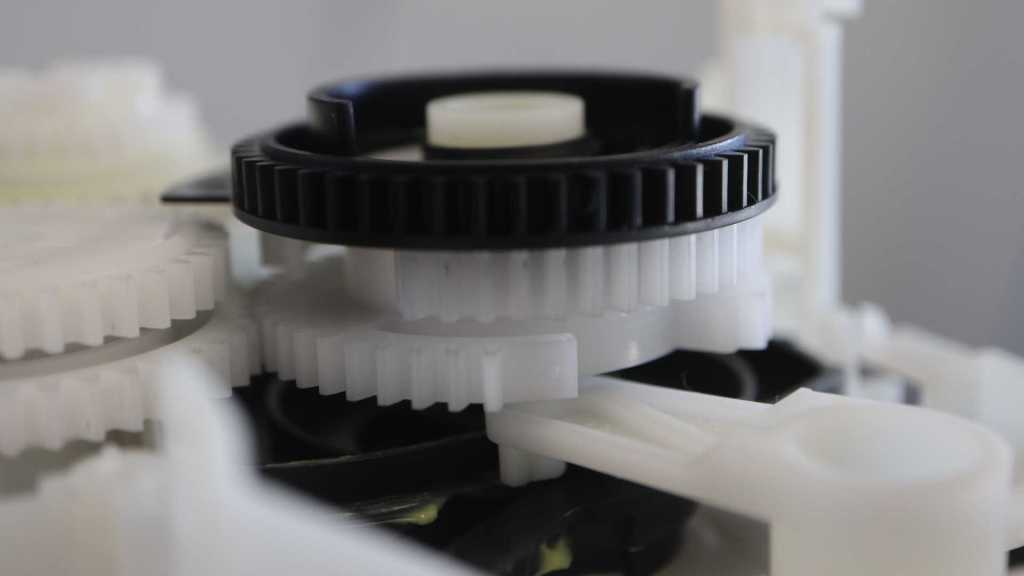
Which led me to the next question: why would the angle matter in a spinning gear? The answer can be found in layers attached below this big black gear. I saw two white plastic gears, but they didn’t have teeth all the way around. Both are missing teeth (roughly 45-60 degrees worth) at different positions. Adjacent to one side of this gap, 5 gear teeth are mounted on an unsupported arch while remaining gear teeth are mounted rigidly.

I interpret this as a mechanism that can convey motion for part of a rotation before falling into a gap. To re-engage the gears, it would have to turn in the direction of those arch-mounted teeth. Taking advantage of their slight bit of flexibility to help gears mesh back up instead of grinding like a student driver learning a manual transmission car. I never noticed any gear-grinding noises from this machine so I guess it works and reliable enough for years of service.

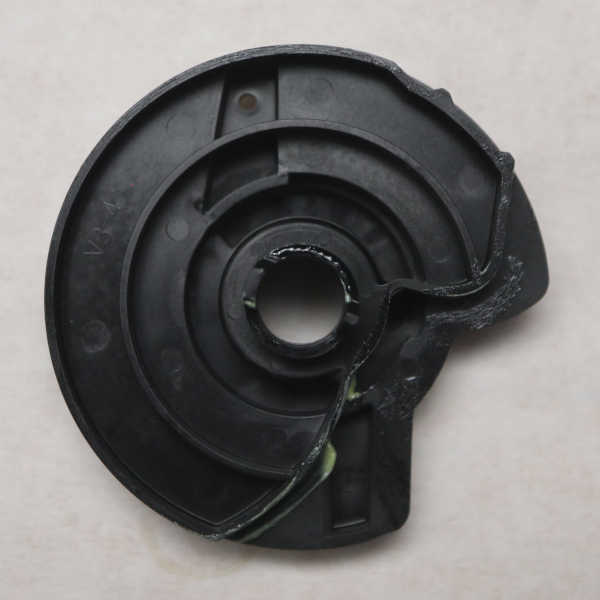
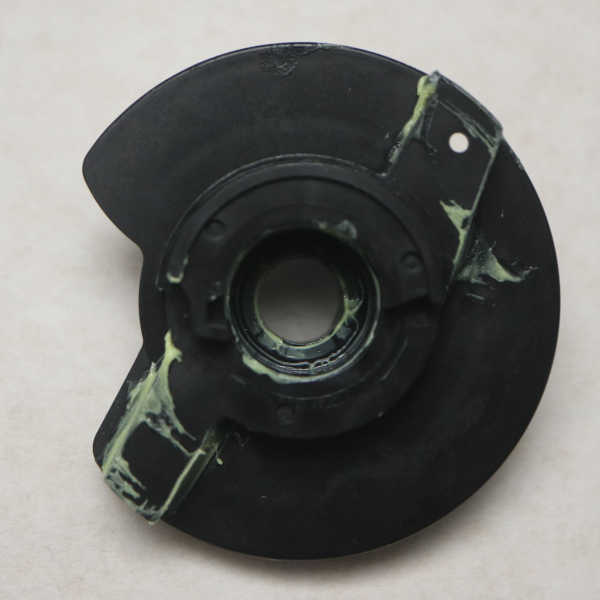
Attached below the pair of intentionally incomplete gears is another piece of black plastic. A cam mechanism with contours to move arms that actuate mechanisms in the paper tray. The “top” side visible in above picture controls the large spring-loaded flap of the paper tray (labeled “1” below) and the “bottom” side of this cam has two separate contours for manipulating two other mechanisms (“2” and “3”).

Here are some pictures of the cam by itself.

And a picture of the paper tray. with numbers labeling its moving mechanisms.

All this added up to a lot of mechanical sophistication attached below that big black gear. What I had thought was just another gear in the gear train turned out to be the output shaft for coordinating many separate actions related to feeding a sheet from the paper tray. It even incorporated a freewheel mechanism, something I overlooked at first.


This teardown ran far longer than I originally thought it would. Click here to rewind back to where this adventure started.

MX340 Paper Feed Gear Shifter

I’m getting into some very interesting mechanisms inside my retired Canon Pixma MX340 multi-function inkjet. After taking a look at its ink disposal peristaltic pump, my next focus is on a gear shift mechanism I identified earlier as the starting point to feed a single sheet of paper. With the cover removed, I can see it is a lever riding on one gear axle and with two other gears on either arm of the lever. This center gear always turns when the paper feed motor turns, driving the ink disposal pump.

When “Forward” gear is engaged (circled in red) it conveys motion to the large black gear.

When “Reverse” is engaged, power from the same driveshaft (but a different gear riding on the same shaft) is transmitted to a gear driving the paper tray large roller.

Under and to the left of that mechanism is the print carriage parking pawl, sitting on the same axis as the gear conveying power from the paper feed motor. Earlier I was curious if this pawl also played some gear-shifting role. Now I have my answer: It does not.

It wasn’t just sitting loosely on that gear, though. A length of spring steel maintained a level of tension/friction so the pawl will always move in response to a change in direction. I found a similar mechanism in its lid closing damper.

Anyway, back to the shifter. Removing it from the assembly showed that forward and reverse gears are offset from each other in order to engage adjacent gears riding on the same shaft.

I thought understanding this lever would tell me how this gearbox worked, but I underestimated the amount of mechanical wizardry I would find within. This was just the tip of the iceberg. The more I look, the more I find.


This teardown ran far longer than I originally thought it would. Click here to rewind back to where this adventure started.

MX340 Ink Disposal Peristaltic Pump

Tracing through path taken by the ink disposal system in my Canon Pixma MX340 multi-function inkjet, I noticed a circular assembly that hinted at a peristaltic pump. My guess was quickly confirmed after I opened up that assembly. I lifted up the rotor and, yep, it moves a trio of rollers across those tubes.

This thing has some interesting differences from the basic textbook design for a peristaltic pump. The most obvious difference is that, instead of a single tube, this pump is working to move fluid through two tubes on opposite sides. There are three rollers spaced 120 degrees apart, so at any given point at least one roller is in contact with each tube. But it’s rare for the third roller to have contact at the same time. There’s barely time for any two rollers to work together before one of them departs for the other tube.

What might be the tradeoffs of jamming two tubes into one pump like this? I don’t know how important it is to have multiple rollers in simultaneous contact. Always having one in contact should be enough to ensure things move along and nothing sneaks back. I guess perhaps this design would be less capable of moving thick (viscous) fluids or pushing against back pressure. But this pump is working with watery (low viscosity) ink and dumping them off into an disposal area that exerts no back pressure. So even if those tradeoffs were real, they would not cause any issues in this application.

A standard peristaltic pump works in both directions, but here we don’t want to pump ink or even air back into the maintenance tray. This pump rotor is designed so it only pumps in one direction. The trio of rollers each sit in their own spiral track. When the rotor is rotating in the pumping direction (counter-clockwise in picture above) the rollers are pushed outwards so they press on the tubes and do their thing.

When the rotor turns the other way (clockwise in picture) the spirals retract all three rollers inwards. It looks like they still make contact with the tubes, but not exerting enough pressure to pinch off tube interior and thus no pumping takes place.

I thought this is a very clever way to modify the standard peristaltic pump design so it only pumps one way. Much simpler and less prone to failure than introducing, say, a gear engagement/disengagement mechanism. This peristaltic pump rotor is always coupled to the paper feed motor. When that motor feeds paper forward during printing, these rollers retract. When the motor spins backwards relative to printing direction, the rollers extend for pumping action. This pump is a good explanation for long backwards motions performed by the printer during its various startup/prep/shutdown procedures.

OK, enough distraction with the ink pump, back to the paper sheet feeding mechanism.


This teardown ran far longer than I originally thought it would. Click here to rewind back to where this adventure started.

MX340 Ink Disposal Flow Path

I had been focused on seeing how the paper feed mechanism worked in my retired Canon Pixma MX340 multi-function inkjet, but I got distracted upon finding a large ink graveyard. Instead of ending up as ink on a page as users would prefer, a fraction of that expensive liquid was destined to be unused and instead dropped off into this absorbent diaper attached to the base.

All this ink was shot out of the cartridges while the print head was sitting in its parked position. It might have been priming the print head, maybe there was a clog that needed clearing. Whatever the reason, it was sprayed into the apparently-porous center of the ink-splattered print head maintenance assembly.

That ink was then picked up by these two tubes, one corresponding to color ink cartridge and the other for black ink.

Those tubes connect to this joint, where it’s clear the initial length of black ink tube is a different opaque material compared to remaining translucent tubes. They all feel about the same to the touch, soft and pliable despite their age. They also have the same outer diameter of about 3.8mm or possibly 0.15 inch. I suppose the difference in material is important for some reason I don’t understand. Other wise I would have expected a continuous length of tube instead of having this joint. It added parts count, assembly complexity, and risk of leaks in exchange for that unknown advantage.

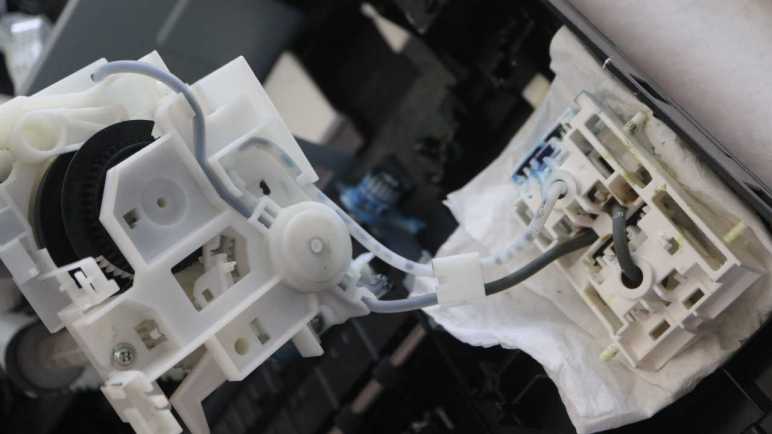
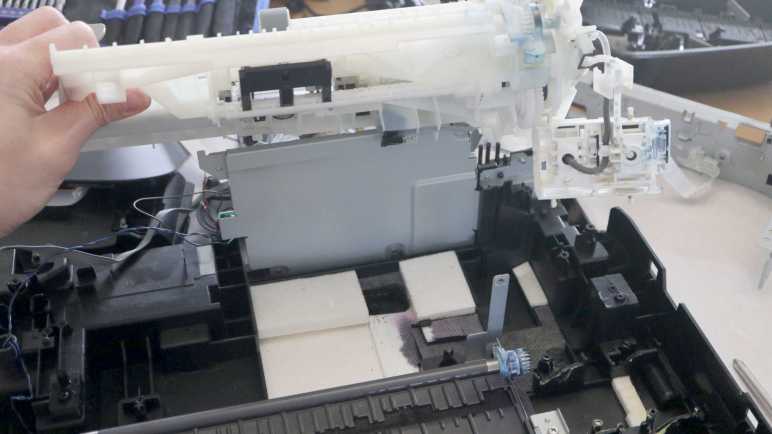
Along with the just-freed paper feed assembly, I also freed the ink maintenance assembly. Flipping it over to rest on a sheet of tissue paper to absorb stray ink, I could now see the entire routing path for both ink tubes.

The color ink tube path ended at its disposal outlet towards the front of the paper tray assembly, and the black ink tube traveled around the back to its separate disposal outlet. Both tubes traveled past a circular assembly inside the paper tray gearbox, but on opposite sides of the circle in opposite directions. This bears all the signs of a peristaltic pump making it the first thing I want to investigate when I open up that gearbox.


This teardown ran far longer than I originally thought it would. Click here to rewind back to where this adventure started.

MX340 Ink Graveyard

Inside my old retired Canon Pixma MX340 multi-function inkjet is a gearbox that choreograph a sequence of motions to feed a single sheet of paper from a stack in the paper tray. I want to see that mechanical wizardry firsthand so I removed the screws holding the paper tray assembly to the base. Once freed, I lifted the assembly and the movement felt like I was peeling something sticky. That was unexpected… what happened?

I had found the hidden ink graveyard underneath, and an explanation for the tubes that caught my interest earlier. A thick layer of absorbent material has been installed across the base of this machine. Ink jetted in the parking position during priming or other maintenance tasks are pumped through those tubes and deposited into this diaper. The sticky sensation I felt came from semi solid globs of ink sticking to the bottom of the white plastic assembly.

My cheapskate brain can’t help but think “There must be over $100 worth of ink here, wasted!” I understand it’s not realistic to expect 100% of ink to end on a page, and some consumption for maintenance is unavoidable. But when ink cartridges are the profit center, it’s easy to be suspicious if all of this was actually necessary because they certainly have a perverse financial incentive to be wasteful.

There were two distinct ink disposal areas. A smaller one for the color ink cartridge, and a larger thicker one for black ink. I’ve used up a larger fraction of color ink absorption capacity due to my usage pattern: I have a black-and-white laser printer so I only used this inkjet when I needed color. Usually photo printing. Thankfully I was nowhere close to maximum capacity. It would have been a very messy discovery! Absorption capacity limit is why even “high volume” inkjet printers fed from bottles of ink have a finite service period before they require their diapers to be changed. I wonder if this MX340 has its own “stop using me” countdown for the same concern.

Now that I see the final destination for ink that would never end up on a page, I could trace the path taken by the ink disposal system.


This teardown ran far longer than I originally thought it would. Click here to rewind back to where this adventure started.

MX340 Print Carriage Actuated Lever

Once I removed the horizontal X-axis (print carriage) actuator assembly from my Canon MX340 multi-function inkjet, I could see several mechanisms that were previously hidden. My attention first went to the lever that was pushed by the print carriage at a specific position. Now I can push on it with my thumb and turn the friction-coated paper feed shaft manually to see things move. Conclusion: this lever starts the process for feeding a sheet of paper from the stack in the paper tray into the print engine.

The other end of the lever sits within this T-shaped slot inside the gearbox. Normally it sits in this center position, which I will call “Neutral” because no rotational power is transmitted to the paper tray mechanism.

Once pressed, the T-slot can shift to one of two positions depending on which direction the paper feed motor is turning. I will call this position “Reverse” because the paper feed motor is moving opposite of the direction when printing.

In this mode, power is transmitted to the big rubber-coated roller in the paper tray, rotating it in the direction to feed paper. This is quite bizarre to me because, as already stated, this happens when the adjacent friction-coated paper feed shaft is rotating backwards, a recipe for a paper jam! I thought maybe the roller motion was just a side effect, but later gearbox teardown would confirm this is deliberate: a gear is specifically engaged in “Reverse” for this purpose, and it doesn’t move anything else. Whatever purpose this counter-intuitive motion serves, it is an intentional part of the system.

Shifting into “Forward” gear, I see a sequence of events consistent with feeding a sheet of paper from the paper tray.

Here is a closeup of the paper handling mechanism at the base of the paper tray.

  1. This is the bottom of the paper tray. A spring-loaded and cam-operated mechanism pushes it forward and upwards so the top sheet of paper in the paper tray makes contact with the rest of the mechanism.
  2. I think this pair of claws usually keeps the stack of paper separated from the feed rollers. During this paper feed sequence, the claws retract.
  3. This mechanism has a smaller roller that receives no power, but its position can change to mesh with the big powered roller, or retracted so there’s a gap.
  4. The big roller also receives rotational power in “Forward” via a different gear path, so now it turns in sync with the friction-coated paper feed shaft and there would be no paper jam.

A mechanical gear-and-cam system choreographs the timing and sequence for these actions. I look forward to seeing the details later in the teardown.

There’s nothing beyond motor rotation holding the “Forward” or “Reverse” positions. So as soon as the lever is released (by moving the print carriage out of the special engagement position) a slight bit of paper feed motor movement in the opposite direction will cause the mechanism to snap back into “Neutral”. This is a good candidate explanation for the small movement of 1800 encoder counts I saw repeatedly: the printer wants to make sure the paper feed mechanism is in “Neutral” before it does something else.

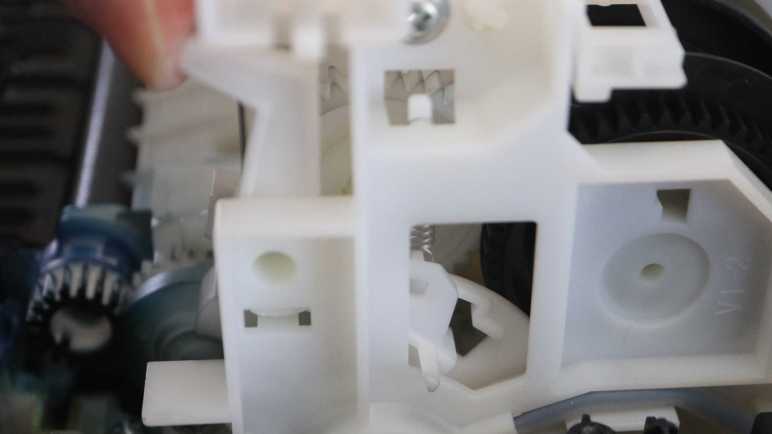
It should be fun to see how all this is implemented, so I freed the paper feed assembly to get at its gearbox… and immediately got distracted when I discovered an ink graveyard.


This teardown ran far longer than I originally thought it would. Click here to rewind back to where this adventure started.

MX340 Horizontal (Print Carriage) Actuator Removal

I had hoped to access the horizontal linear encoder sensor within the print carriage of my retired Canon Pixma MX340 multi-function inkjet, but after removing the ink cartridge mounting bracket, I found no easy path to that sensor from the front. I still want to probe it in an operational state, so I’ll remove the entire print carriage actuator assembly as one intact piece and possibly try again later.

The actuator assembly’s main structure is a sheet of stamped sheet metal, covering the entire width of the assembly and folded into the back and upper rail for the print carriage. As expected of a key structural component, there were many attachment points.

Two self-tapping plastic screws attach directly to the injection-molded base, one left and one right. The left side (close to the motor) featured a spring-loaded mechanism. Its right side counterpart lacked this feature.

Five machine screws attach the frame to three metal brackets. Two screws to each of the large brackets on the left and right, which are in turn secured to the plastic base with more self-tapping plastic screws. I removed these two large brackets from the plastic base but decided to leave them attached to the horizontal axis actuator metal frame for several reasons: (1) in the immediate term, the serve as handles or a convenient stand allowing me to sit this actuator assembly on its back without pinching any wires or getting in the way of anything that moves. (2) in the medium term, removing them won’t make accessing the linear encoder sensor any easier, and (3) in the long term, if I reuse this actuator assembly in something else, I will likely need these brackets too.

The final machine screw attached the wide metal frame to a tall metal finger rising up out of a hole in the white plastic paper tray assembly. Located width-wise between the paper printing area and the ink cartridge parking area. I’m curious if this tall finger was always planned from the start or added later in the design process when they needed more rigidity. It looks like it might be the latter.

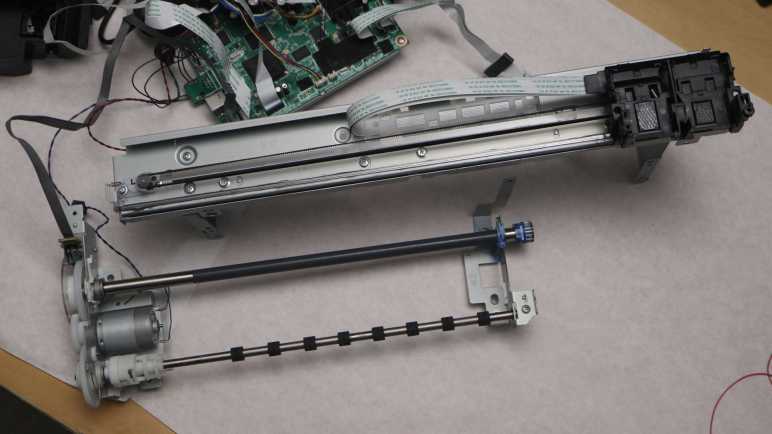
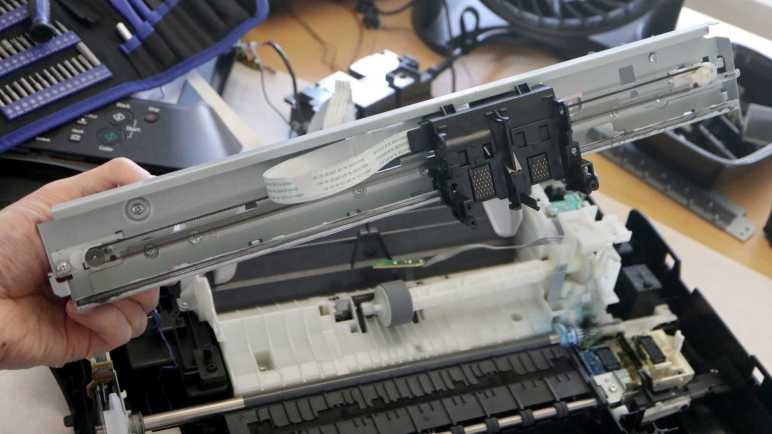
Here’s the horizontal axis removed from the plastic base. My hand is holding on to the left side bracket that I had left attached. There was a paper feed optical interrupter sensor mounted to the back of this assembly, but that could be detached and visible dangling above the large paper roller in the center of the picture above. I stuck a folded-up piece of paper in the sensor to leave it in its normal blocked state.

Electrically, there is a pair of wires to the DC motor, and three sets of flexible cable for the print head assembly. The majority of those wires are for ink cartridge communication, leaving just a few for the horizontal quadrature encoder sensor. Should I still hold out hope I could figure out those wires later?

I set the assembly down on its back on those still-attached brackets, and powered up the system. It gave me a “check ink cartridge” error which is understandable by their absence, and the startup sequence is noticeably different. But it still ran the print carriage back and forth, so I’m cautiously optimistic I haven’t broken anything relating to that horizontal encoder.

I thought about continuing focus on this assembly until I could reach that horizontal encoder, but I set it aside because I found it more interesting to look at what was uncovered by its removal.


This teardown ran far longer than I originally thought it would. Click here to rewind back to where this adventure started.

MX340 Ink Cartridge Bracket

Playing around with the print head maintenance mechanism on my old retired Canon Pixma MX340 multi-function inkjet, I got some ink on my fingers. I see this as a preview of what I expect upon further disassembly, and decided to procrastinate that dirty job. Instead, I turned my attention to a less messy part of the mechanism: the print carriage bracket for holding the two color ink cartridges.

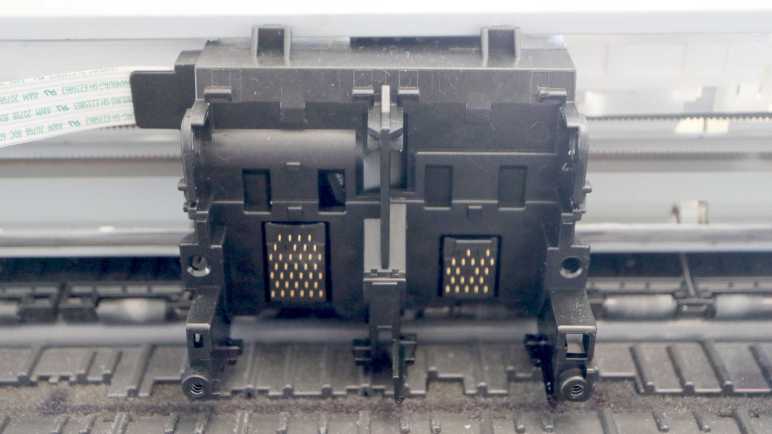
It started out simple and straightforward: there were two small Philips-head screws in the bottom corners of the carriage. Remove them, and the outer mounting rail comes off easily. And since it could no longer hold ink cartridges or their integrated print heads, this is the moment when my MX340 stopped being a printer and became just an assembly of interesting mechanisms.

Once that rail was removed, the two spring-loaded lids followed.

These lids turned out to be more complex than I had expected. I knew there was a flexture mechanism in front to latch a cartridge in place, and I expected one spring because the lid pops up when unlatched.

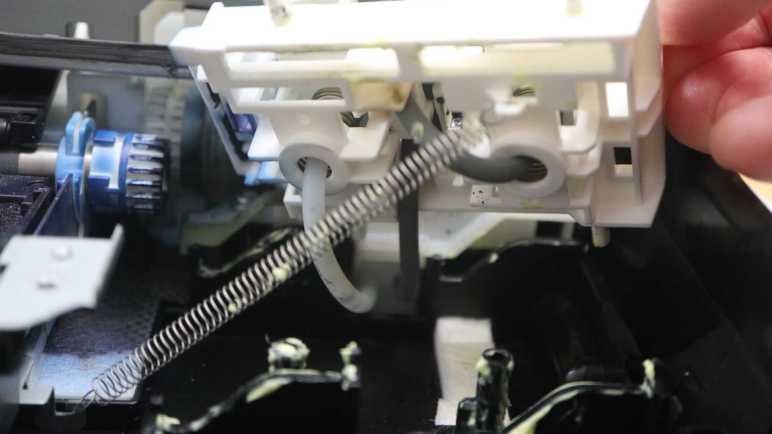
There were actually three springs. The strongest one pushes a piece of white plastic that, when closed, pushes the ink cartridge to keep it in place. I thought that was a generic enough action that a common part could be used across both lids, but they each had their own uniquely shaped part for the job and I couldn’t figure out why that was necessary. The third spring and smallest spring puts a tiny bit of tension on a small fragile (I broke it) black part whose purpose was not obvious to me. My best guess is it helps maintain proper spacing between the cartridge and its corresponding electrical contacts.

I had hoped removing rail and lids would have uncovered additional fasteners for further disassembly, but no luck. I’ve got a flat wall of ink cartridge electrical contacts and not much else. I had hoped to disassemble this carriage far enough to gain access to the linear encoder sensor, but no luck.

Looking around the side, I saw signs of additional fasteners, but they’re facing the opposite direction. I think I have to disassemble the print cartridge linear rail assembly, possibly removing the linear encoder strip and drive belt, before I could remove the carriage and access these fasteners. I will have to revisit this later and, in the hopes of preserving the “probe it while it is running” option for later, I’ll remove the whole horizontal actuator assembly as one intact unit.


This teardown ran far longer than I originally thought it would. Click here to rewind back to where this adventure started.

MX340 Print Head Maintenance Assembly Underside

I don’t know what’s involved in maintaining an inkjet cartridge, but I’m learning bits and pieces by poking around inside my retired Canon Pixma MX340 multi-function inkjet. I saw where the print head would rest when in its parked position, and thought the rectangular block of material sitting underneath the print head would be something soft and spongy to absorb excess ink. I was surprised when I poked at it with a cotton swab and found it was rigid. Interesting! Now I’m even more curious and want to see the rest of this maintenance assembly.

Looking at how its multiple parts interlocked, I came to the conclusion this one screw holds down everything on front side of this assembly. Removing the screw allowed this piece of plastic to slide aside and be removed.

This assembly hosts the latch that makes the wiper blades work, and it covers one side of the up-and-sideways track for the maintenance assembly allowing me to flip it up.

Now I can see the motion mechanism in its entirety. There are four tracks to guide this assembly as it moves 45-degrees up and then right, and in the foreground of this picture is the retraction spring pulling it down and left.

Each ink cartridges sit over a spring-loaded assembly with a tube in the middle. These springs push the pliable rubber surrounding the not-sponges to form an airtight seal that keeps the ink drying out. The tube going into the black ink assembly on the right is much longer, snaking up to the top of the assembly before coming back down. Tube for the color ink has a shorter more direct path, and also mostly translucent with only a few blotches visible. The black ink tube looks dark. From here I can’t tell if the tube is dark because it is made of a different material, or if it’s dark because its innards are covered with black ink.

If its insides are covered with ink, that would imply a porous material in the print head rest position and these tubes deliver some amount of vacuum. Sucking ink into these tubes for whatever maintenance purpose it might serve. Do these tubes lead to a reservoir? Is there a limit to their ink sucking capacity? I shall seek answers to these questions later. Right now I will hold off disassembling this ink maintenance station. It might be more useful intact as reference while I explore whatever those tubes are connected to. And it would definitely be a huge mess to disconnect ink-filled tubes, so I’ll procrastinate on that and do something else instead.


This teardown ran far longer than I originally thought it would. Click here to rewind back to where this adventure started.

MX340 Print Head Maintenance Assembly Topside

I’m taking apart my old retired Canon MX340 multi-function inkjet and learning how it worked as I go. Its print head maintenance assembly is my current focus. Tracing through its range of motion, I finally have some answers for a question I had wondered about: why does it get so messy?

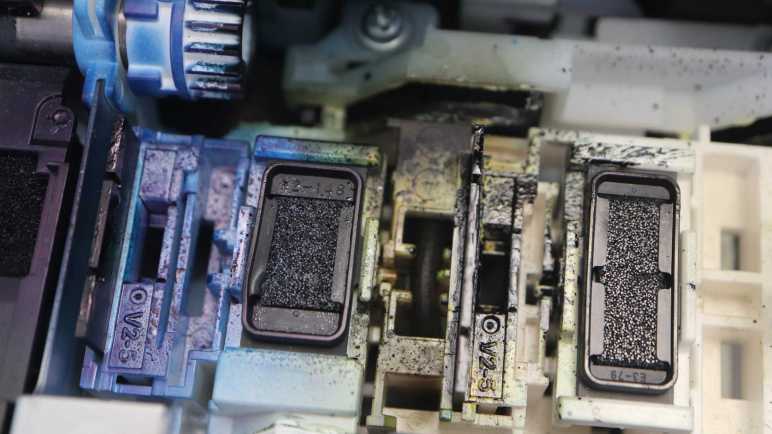
Given that inkjet printing required mechanisms that, well, jet out ink, it would be unrealistic to expect everything to stay clean and pristine. The print head needs a place to get primed and readied into a known operating state before it starts actually printing the page. A waste of expensive ink that I had grudgingly accepted as unavoidable. I had expected a sponge to absorb ink sitting below each print head, so I expected some ink splatter around maybe a 5mm perimeter around the print head outline. Once I opened the lid, I saw ink has been flung quite a bit further, up to ~40mm away.

After tracing through this assembly’s range of motion I now understand this mess was created by the wiper blades. Held up against the bottom of ink cartridges, they would have wiped off any ink from the surface of the print head. Once the cartridges moved past them, these elastic wiper blades would snap back to their vertical position. Surface tension would keep some ink on the blade, but the rest would launch for a landing elsewhere on this assembly.
There must be a slight angle between a cartridge and its wiper, as ink splatters are not symmetric: there’s visibly more ink flung towards the back of the printer (top of picture) than the front. The left-right asymmetry is more obvious and understandable, given the direction of the wiping motion. When these wiper blades snapped back vertical, that first motion would have moved left to right, with most of the energy on that first motion flinging ink to the right. Less (but not zero) ink would have been shed on the second motion to the left.

Curious about how much energy would have been involved, I took a cotton swab to poke at those wiper blades. (I didn’t want to get ink on my fingertips.) They have roughly the same flexibility as fresh automotive windshield wiper blades. I had expected them to have hardened up from age, more than a decade since their manufacture. Maybe they’ve hardened since new, but they’re still soft enough to do the job.

Since I already had soaked the tip of the cotton swab with ink, I poked at the rest of the ink-splattered components. All of the white plastic were rigid, no surprises there. There is a black rubber surround for each print head, and they are still very soft and pliable to form a good seal. Useful to keep ink from drying inside the print head.

The center, however, was a surprise. I had expected a soft spongy material to soak up ink, but the mystery material was actually quite rigid. Its surface texture implied some level of porosity like a sponge, but it had none of a sponge’s pliability. Very interesting! Maybe I can get more information about how it works by looking underneath.


This teardown ran far longer than I originally thought it would. Click here to rewind back to where this adventure started.