Final(?) Update to rxbb8.com

Moving my RXBB8 project website from AWS to GitHub Pages has another benefit: now it is trivially simple to update. I push a change, and GitHub default Action will handle publishing. Much easier than copying the files over to an AWS S3 Bucket like I had to do earlier. Which means it is a great time to make (what’s very likely) the final update to this project site.

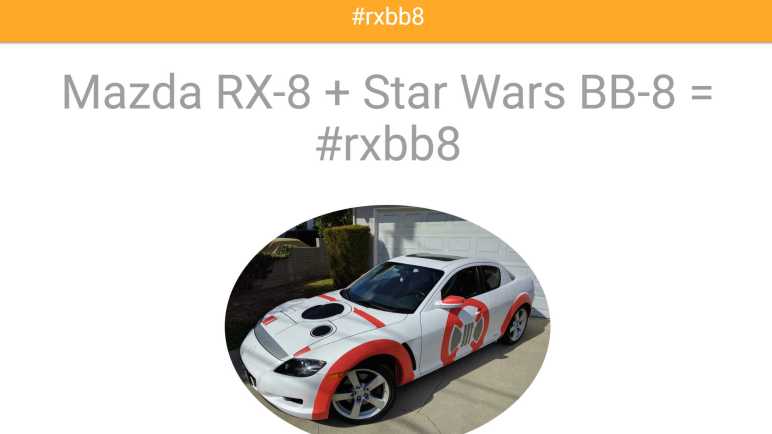
First, I updated the content of the page, adding a shorter version of what I’ve posted earlier: Why I decided to say goodbye to RXBB8, and then the process of actually doing so. Illustrated with the same image files I used here. I decided against following the precedence of providing a “web” (low resolution) and “full” (high resolution) copies of each image. For this final update, I’m providing only the web resolution image. Previous content is largely untouched except for one point: instead of link to “latest activity” on social media Facebook and Instagram, I updated it to be past tense and added Twitter as well.

After the content was updated, I updated the behind-the-scenes infrastructure as well. I had used the Materialize-CSS library for this project, and I thought I would be six years out of date. (Fortunately given it is a static site, the chances of a dangerous security flaw are quite low.) Then I looked at Materialize-CSS library releases and realized I was only about a year out of date. The library reached version 1.0.0 on September 2018 at which point activity stopped. Since it is done I thought I should download the version 1.0.0 CSS and JavaScript files for direct inclusion on my site. There’s no longer any worry of falling out of date, but now there is the worry of the project distribution site disappearing.

Since I only used some superficial capabilities of the library, I did not expect anything to break and visually everything looks fine. I did notice one advancement, though: version 1.0.0 no longer depends on jQuery, so I removed the line loading jQuery from my page.

Is this the end of my interaction with Materialize-CSS? Maybe, maybe not. There’s a potential upside of a library frozen in 2018 at version 1.0.0: It probably still works on Windows Phone browser. I will likely revisit Materialize-CSS if I want to work with Windows Phone browser again. And even if the project site disappears, I have a copy of the library CSS and JavaScript now.

And finally, I added <!DOCTYPE html> to the top of the page. Because I’ve learned that could be important.
Migrate rxbb8.com from AWS to GitHub Pages

After peeling the BB-8 inspired art from my Mazda RX-8, it seems like a good time to do some long-overdue cleanup on the project site as well. Six years ago, I wasn’t sure whether it’s better to build a website for each project or just put everything here on a single personal blog. With experience, I now know my scatterbrained nature is a better fit for the latter. Also, domain registration costs add up quick!

I had created http://rxbb8.com to be a small static web site served via Amazon Web Services, and one of the earlier entries on this blog was an outline of my experience setting it up. What I have forgotten (and did not write down) was why I chose this approach as opposed to using GitHub Pages. I already had a GitHub repository for the markup files, though without the image files. I suspect there was something about GitHub policy six years ago that made it impractical. Was there a file size limit that prevented image files? Another data point was that project predated Microsoft acquiring GitHub which changed a lot of policies. Also, a lot of features were added to GitHub over these years. Is it possible GitHub pages didn’t exist at the time? I no longer remember.

What I do know is that I would like to move it off AWS now. Hosting this site via AWS has been quite affordable. Every month I pay $0.50 USD for the Route 53 name service and a few cents for S3 bandwidth. Historically that has added up to less than half of the domain registration itself, which was $18/yr via DreamHost. However, there’s a hidden risk on that S3 expense: there is no upper bound. If someone decides to write a script to repeatedly download all of my images as quickly as possible, my bill will go up accordingly and I won’t know until I see my bill next month. Sure, it’d cost them bandwidth as well, but most bandwidth are cheaper than S3 rates and that’s assuming they aren’t doing something unethical like consuming some innocent third party’s bandwidth. Six years ago, I dismissed such worry as “Nobody would have a reason to do that.” Now I am older and more cynical. The truth is all it’d take is for one person to decide “because I can” is a good enough reason and cause me grief.

In the time I’ve been learning web development, I’ve come across horror stories of unexpected AWS bills. Always inconvenient, sometimes it leads to people getting fired from their job, and occasionally a startup has to declare bankruptcy and shut down because they can’t pay their AWS bill surprise. Thinking about that possibility has me on edge and I have enough to worry about in my life. I don’t need that stress.

Another reason is to eliminate a recurring stream of nag mail. Setting up a static web site as I have done means setting an Amazon S3 bucket to be globally readable by everyone. This wasn’t a big deal six years ago but there have been multiple cases of people finding confidential data stored in publicly accessible S3 buckets. Because of this, public buckets are now rightly treated as potentially risky. So, Amazon sends periodic email reminding me I have a public bucket and to review that I’m really, really sure I wanted it that way. This is good security practice, but I have enough email spam. I don’t need another stream.

Now that I’ve finally gotten around to moving the site, my steps are:

  1. Upload project image files to existing GitHub repository.
  2. Enable GitHub pages for the repository, which becomes available at https://roger-random.github.io/rxbb8.com/
  3. Log into DreamHost control panel and reset DNS references back to default DreamHost DNS instead of Amazon Route 53 DNS.
  4. Tell DreamHost DNS to forward http://rxbb8.com requests to https://roger-random.github.io/rxbb8.com/

After waiting a day to ensure all DNS changes have propagated, I can deactivate my AWS Route 53 hosted zone and delete my AWS S3 bucket. With the new forwarding action, browser URL bar would visibly change to https://roger-random.github.io/rxbb8.com/ as well. I’m fine with that. If I really wanted to keep the URL bar at http://rxbb8.com, I can read up on how to use a custom domain with GitHub Pages. But right now, my priority is on making what is likely to be the final update to the site.

Removing RXBB8 Plasti-Dip

My RXBB8 project is looking pretty tired after six years, and I’ve decided it’s time to say goodbye and restore my 2004 Mazda RX-8 to its original factory blue. Removing a Plasti-Dip project involved several different distinct steps.

Large Surface Removal

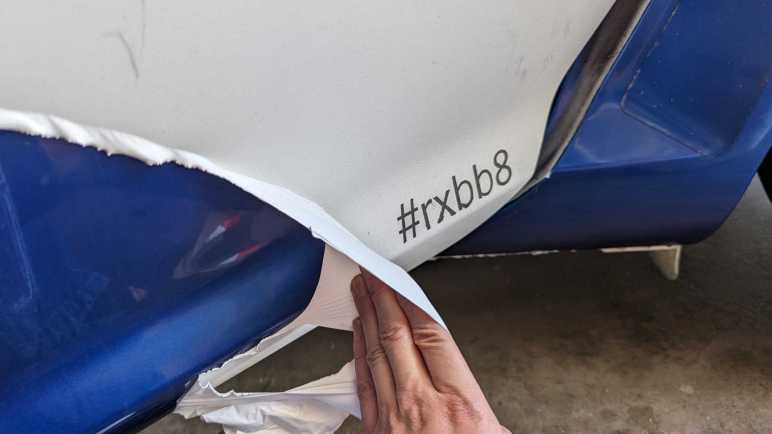
The easiest part is the headline feature of Plasti-Dip: we can peel it off automotive paint. When applied thick enough, large sheets can be peeled off intact. My first full-car Plasti-Dip project only had three coats and it was annoying to remove. RXBB8 had six coats of white plus up to three additional coats for either orange, silver, or black. The hood was easiest to peel on account of its thick layer of Plasti-Dip, followed by the roof and trunk. Those were all horizontal surfaces where I was comfortable applying thick coats. I was afraid of drips on vertical surfaces, so doors and fenders didn’t get as thick of a coat and were correspondingly more difficult to peel off intact.

Ever heard “the first 90% of a project takes 10% of the time”? Removing Plasti-Dip is like that. My car was 90% back to its original blue very quickly, but removing the rest will take a lot more effort.

Edge Cleanup

As large surfaces were removed, they tend to leave fragments of their edges behind. I probably didn’t spray the edges as thickly as the middle, causing them to break apart and be left behind. And since they were already reluctant to leave, taking them off becomes time-consuming. Each of these two fragments took about as much time to cleanup as peeling majority of the bumper.

Overspray Cleanup

Beyond edge pieces lie overspray, super thin bits of Plasti-Dip that is not thick enough to become a peelable layer. Now I need to turn to chemical removal with solvents that can remove Plasti-Dip without damaging the underlying paint. (Or at least, not damage it too much.) I used Xylene, which was the recommended cleanup solvent six years ago, but there might be a better choice now.

In this picture I temporarily removed the rear window so I could reach all of the overspray underneath window edges. Some overspray is accessible without removing any parts, like the doorsill visible through this window.

Detail Cleanup

And finally, I have to pull out the box of Q-Tips so I can remove Plast-Dip that has worked their way into tiny little details. Overspray and detail cleanup is tedious, and I have to take frequent breaks because Xylene fumes are unpleasant even when working in a well-ventilated space.

The problem with detail cleanup is that it feels like a never-ending process. I tackle the most visible things first and when that is done, I take a step back to look for the next most visible area to clean. As I make progress, the “next most visible” area becomes harder and harder to clean. I don’t think I’m going to be able to get absolutely everything, and I have to be resigned to my car having little crooks and crannies of white and orange.

Cleanup in the real world gets messy and possibly never-ending. Fortunately, cleaning up this project in the digital world is a lot more definitive.

RXBB8 Plasti-Dip After Six Years

Around six years ago I decided to use Plasti-Dip to turn my 2004 Mazda RX-8 into a fan tribute to Star Wars BB-8 droid. This project titled RXBB8 was originally intended for a few months, but I loved it enough to keep it on my car for several years. Unfortunately, it has degraded enough I am ready to say goodbye.

No Cracks

Plasti-Dip sprays on as a liquid and dries to a rubbery layer that conforms to the sheetmetal curvature but does not adhere to the paint. That’s the beauty of it: I can peel it off when I’m done. Due to its soft texture, I had expected Plasti-Dip to degrade like all soft texture materials do under relentless Southern California sunshine: turn brittle and crack apart. I was pleasantly surprised to find that it had not done so after six years. It may be a little less stretchy than new, but it was still intact.

Minor Fade

Another failure point I had expected is color fading, another typical reaction for things under sunlight exposure. Plasti-Dip exceeded expectations here as well. I thought the silver parts would hold up but the bright orange to fade. While the color did fade over the years, it did so gradually. More importantly, it faded evenly so I didn’t end up with blotches of different shades of color.

Sharpie Ink Faded

The same could not be said of Sharpie permanent marker ink. For smaller scale details like the emblem and a thumbs-up BB-8 on the trunk, that’s what I used instead of Plasti-Dip. Marker art faded significantly and also faded unevenly so colors were blotchy. This is a lesson learned and I know not to rely on markers for this purpose in the future.

Embedded Dirt

And finally, the biggest reason I’ve decided to peel off RXBB8 is because it has become very difficult to keep clean. Because it is a relatively soft material exposed to road conditions, tiny grains of dirt could embed themselves into Plasti-Dip in a way I couldn’t wash off. Over years this buildup accumulated to the point the car looks dirty even after a good scrub. It is especially noticeable on white! When I had to admit to myself the car looks dirty no matter what I did, it’s time to say goodbye to RXBB8.


Administrative side note: This is the 2000th post of this blog. I learned a lot in my first 1000 posts and adapted my style accordingly. I haven’t changed my format for the next thousand as it’s been working pretty well for me.

Inspiration From Droids of Star Wars

Today is the fourth day of the month of May, which has grown into “Star Wars day” due to “May the Fourth” sounding like that film’s popular parting line “may the Force be with you.” A quick search confirmed I’ve never explicitly said anything about Star Wars on this blog and that should be corrected.

By the time I saw Star Wars, I had already been exposed to popular science fiction concepts like space travel, interstellar commerce, and gigantic super-weapons. And the idea of a cult that promises to make their followers more special than regular people… we certainly didn’t need science fiction for that. So none of those aspects of Star Wars were especially notable. What left a lasting impression was R2-D2.

R2-D2 had its own expression of duty and loyalty. Companion to humans, and a Swiss Army knife on wheels. A character that managed to convey personality without words or a face. R2-D2 was the most novel and compelling character for me in the film. I wouldn’t go far as to say R2-D2 changed the path of my life, but there has definitely been an influence. More than once I’ve thought of “does this help me get closer to building my own R2” when deciding what to study or where to focus.

I was happy when I discovered there’s an entire community of people who also loved the astromech droid and banded together to build their own. But that turned to disappointment when I realized the dominant approach in that community was focused on the physical form. Almost all of these were remote-controlled robots under strict control of a nearby human puppeteer, and little effort was put into actually building a capable and autonomous loyal teammate.

I can’t criticize overly much, as my own robots have yet to gain any sort of autonomy, but that is still the ultimate long-term goal. I love the characters of R2-D2 and the follow-on BB-8 introduced in the newest trilogy. Not in their literal shape, but in the positive role they imagined for our lives. This distinction is sometimes confusing to others… but it’s crystal clear to me.

Oh, I thought you loved Star Wars.

Star Wars is fine, but what I actually love are the droids.

I still hope the idea becomes reality in my lifetime.

Industrial Glass Marbles

I remember playing with glass marbles as a child’s toy. I also remember mom being not terribly pleased when she would find them in various corners of the house, and definitely unhappy when some were on the floor where an adult might step on one and fall.

I also remember the swirls of color that were added to the glass to make them look prettier, and those are absent from industrial glass marbles. They have a job to do, and they don’t need to look pretty doing it. Not only do they lack the colorful swirl, they don’t even necessarily need to be perfectly spherical or have smooth exterior surfaces. I hadn’t known about these glass marbles with jobs until I learned of an overturned truck accident that was very difficult to clean up because its cargo were a full load of industrial marbles.

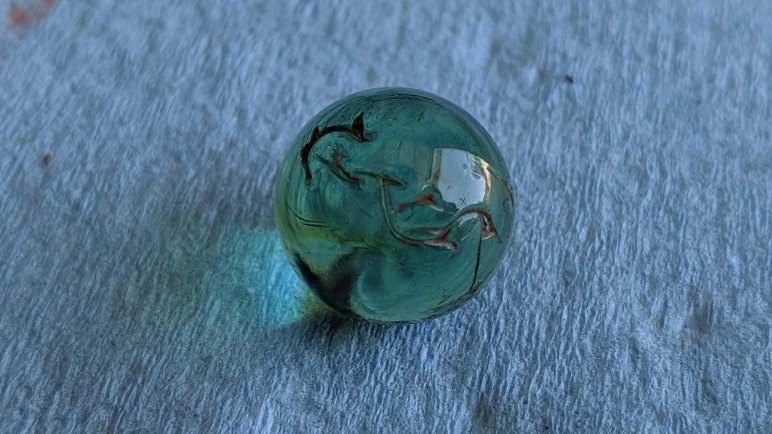
Curious, I read up on industrial glass marbles and how they are employed. I was excited when I learned that they are commonly used inside aerosol spray cans to stir its contents. They are what rattles when we shake up a can before spraying. I consumed several spray cans of Plasti-Dip for my RX-BB-8 project and saved the cans planning to cut into them to look at some industrial marbles up close. I finally got around to that particular project.

Clamp to release remaining pressure

Even though they’ve stopped delivering dip, these cans still had some propellent inside delivering pressure. It seemed wise to relieve that pressure before we cut into the can, so I used a clamp to keep the top pressed and waited until the hissing stopped.

Drill into can for industrial glass marble

A hole is then drilled in the can for a starting spot, where pliers can dig in and start tearing up the thin metal shell. It only takes a few rips to open a hole large enough for the marble to see the light of day.

Industrial glass marble extracted

A little cleanup later, I had my first look at a cosmetically imperfect but still fascinating industrial glass marble.

Industrial glass marble x3

I had several other empty spray cans which underwent the same procedure for marble extraction. I was fascinated by the surface texture of the first one I extracted, it gave the glass sphere more character than a perfectly smoothly counterpart. I plan to explore putting them in front of LEDs so their flaws can be part of a distinctive light diffuser.

I do not consider those glass imperfections of industrial glass marbles to be bug — I believe they have potential to be very unique features!

Sawppy at Brawerman East STEAM Makers Fair

Sawppy’s publicity appearance today was at Brawerman East STEAM Makers Fair, a supercharged science fair at a private elementary school. Sawppy earned this invitation by the way of January presentation at Robotics Society of Southern California. The intent is to show students that building things is more than their assignments at their on campus Innovation Lab, there are bigger projects they can strive for beyond the classroom. But the format is, indeed, just like a school science fair, where Sawppy got a display table and a poster board.

Brawerman STEAM Makers Fair - Sawppy on table

But Sawppy is not very interesting sitting on a table, it didn’t take long before the rover started roving amongst other exhibits. The school’s 3D printer is visible on the left – a Zortrax M200.

Brawerman STEAM Makers Fair - Sawppy roaming

Sawppy was not the only project from grown-ups present. I admire the ambition of this laser cutter project undertaken by one of the parents. Look at the size of that thing. It is currently a work in progress, and its incomplete wiring were completely removed for this event so little fingers are not tempted to unplug things and possibly plugging them in a wrong place.

Brawerman STEAM Makers Fair - laser cutter

The center of this tables had some old retired electronics equipment that kids will be able to take apart. This was a huge hit at the event, but by the end of the night this side of the room was a huge mess of tiny plastic pieces scattered all over.

Brawerman STEAM Makers Fair - deconstruction zone

I brought my iPad with the idea I could have Sawppy’s Onshape CAD data visible for browsing, but it turned out the iOS Onshape app required a live internet connection and refused to work from cache. As an alternate activity, I rigged it up to show live video footage from Sawppy’s onboard camera. This was surprisingly popular with the elementary school age crowd, who got a kick out of making faces at the camera and seeing their faces on the iPad. I need to remember to do this for future Sawppy outings.

Brawerman STEAM Makers Fair - Sawppy camera ipad

After Sawppy was already committed to the event, I learned that a Star Wars themed art car was also going to be present. So I mentioned my #rxbb8 project which earned me a prime parking spot on the first floor next to the far more extensively modified “Z-Wing.” Prepare to jump to hyperspace!

rxbb8zwingcropped

(Cross-posted to Hackaday.io)

SevenStock 20

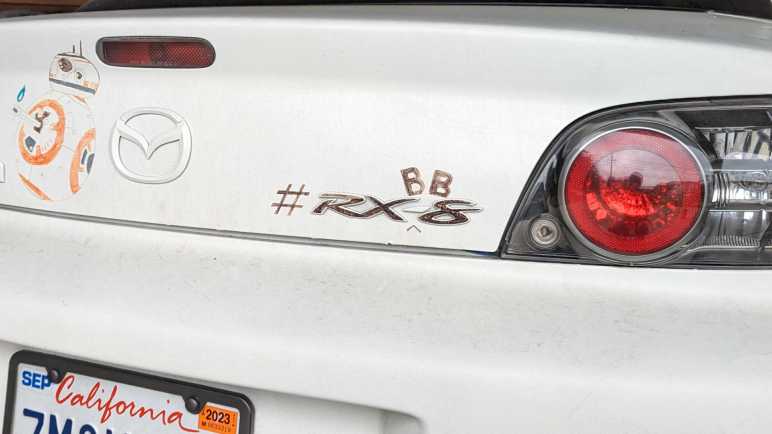
Today was SevenStock 20 and I attended with my RX-8 in her BB-8 Halloween costume. Last year I attended SevenStock with the costume only partially completed. This year it is complete but a little faded from running around over the past year under SoCal sunshine. It was still plenty distinctive in the row of RX-8 lined up in the show & display area. Many people took pictures, some even took me up on my hint and posted on Instagram tagged with #rxbb8.

Out of all the cars on display, the one that stood out to me was ironically not a rotary-powered vehicle at all. It was a Mazda R360, Mazda’s first car built in 1960. By modern standards an adorable tiny little thing. It was on display at the Mazda corporate area along with other Mazda vehicle currently on the market. Which meant the little 1960 Mazda was utterly dwarfed by the modern Mazda SUVs on display.

Mazda R360 Next To Current Mazda SUVs

There were many powerful speed machines on display, but I kept coming back to admire the little R360 that can barely reach highway speed. There are four seats in the car but I don’t see how four adults can fit in this little box. It looked closer in size to a kid’s Power Wheels car!


SevenStock takes place on the infield of the Auto Club Speedway and the track itself was open during the event for people who paid a fee and can pass safety inspection. There was a sizable contingent who love the idea of driving out on the oval but for one reason or another passed on the high-speed track time.

This year the organizers tried an experiment: a “parade lap” to get a taste of driving on a banked oval via a bit of token track time. The thundering herd was led by the trio of historical rotary-power race cars brought by Mazda, and we stopped a few times on track for the scattered pack to organize. Here’s a picture taken during one of the on-track stops.

Rotaries On Track

The price of admission for the “parade lap” was $15, and I thought it was well worth it for the novelty value of taking my car on a real high-speed track. Even if we were only going at city-street speeds.

Static Web Site Hosting with Amazon S3 and Route 53

aws_logoWeb application frameworks have the current spotlight, which is why I started learning Ruby on Rails to get an idea what the fuss was about. But a big framework isn’t always the right tool for the job. Sometimes it’s just a set of static files to be served upon request. No server-side smarts necessary.

This was where I found myself when I wanted to put up a little web site to document my #rxbb8 project. I just wanted to document the design & build process, and I already had registered the domain rxbb8.com. The HTML content was simple enough to create directly in a text editor and styled with CSS from the Materialize library.

After I got a basic 1.0 version of my hand-crafted site, I uploaded the HTML (and associated images) to an Amazon S3 bucket. It only takes a few clicks to allow files in a S3 bucket to be web-accessible via a long cumbersome URL on Amazon AWS domain http://rxbb8.com.s3-website-us-west-2.amazonaws.com. Since I wanted this content to be accessible via the rxbb8.com domain I already registered, I started reading up on the AWS service named in geek-humor style as Route 53.

Route 53 is designed to handle the challenges of huge web properties, distributing workload across many computers in many regions. (No single computer could handled all global traffic for, say, netflix.com.) The challenge for a novice like myself is to figure out how to pull out just the one tool I need from this huge complex Swiss army knife.

Fortunately this usage case is popular enough for Amazon to have written a dedicated developer guide for it. Unfortunately, the page doesn’t have all the details. The writer helpfully points the reader to other reference articles, but those pages revert back to talking about complex deployments and again it takes effort to distill the simple basics out of the big feature list.

If you get distracted or lost, stay focused on this Cliff Notes version:

  1. Go into Route 53 dashboard, create a Hosted Zone for the domain.
  2. In that Hosted Zone, AWS has created two record sets by default. One of them is the NS type, write down the name servers listed.
  3. Go to your domain registrar and tell them to point name servers for the domain to the AWS name servers listed in step 2.
  4. Create S3 storage bucket for the site, enable static website hosting.
  5. Create a new Record Set in the Route 53 Hosted Zone. Select “Alias” to “Yes” and point alias target to the S3 storage bucket in step 4.

Repeat #4 and #5 for each sub-domain that needs to be hosted. (The AWS documentation created example.com and repeated 4-5 for www.example.com.)

And then… wait.

The update in step 3 needs time to propagate to name servers across the internet. My registrar said it may take up to 24 hours. In my case, I started getting intermittent results within 2 hours, but it took more than 12 hours before everything stabilized to the new settings.

But it was worth the effort to see version 1.0 of my created-from-scratch static web site up and running on my domain! And since it’s such a small and simple site with little traffic, it will cost me only a few pennies per month to host in this manner.