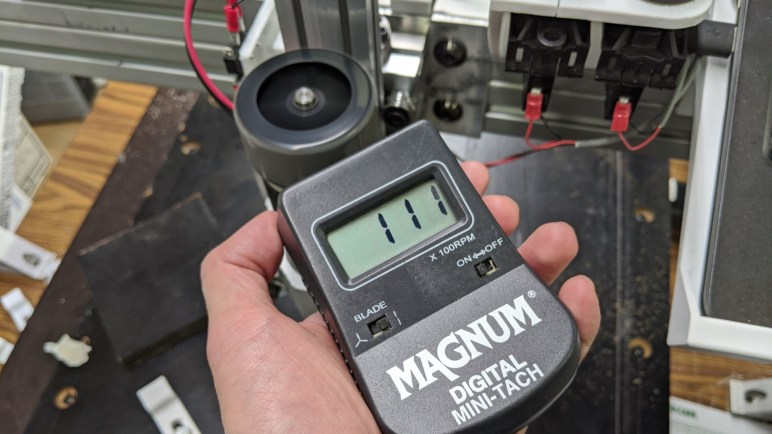
Spindle Clocks In At 11,100 RPM

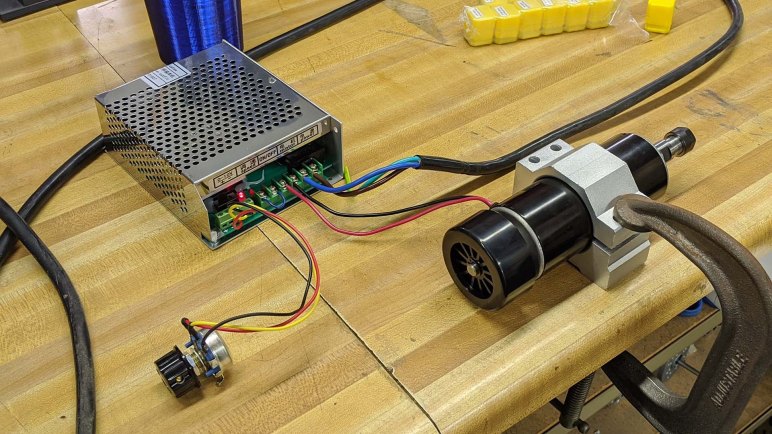
Once some convenience accessories are in hand, we return to the main business of cutting material. Our biggest unknown at this point is our spindle’s maximum speed measured in revolutions per minute (RPM). This is a critical part of calculating the “speeds and feeds” of machining. Yes, we’re cutting MDF which will be relatively forgiving, but the point of learning is to practice doing it right.

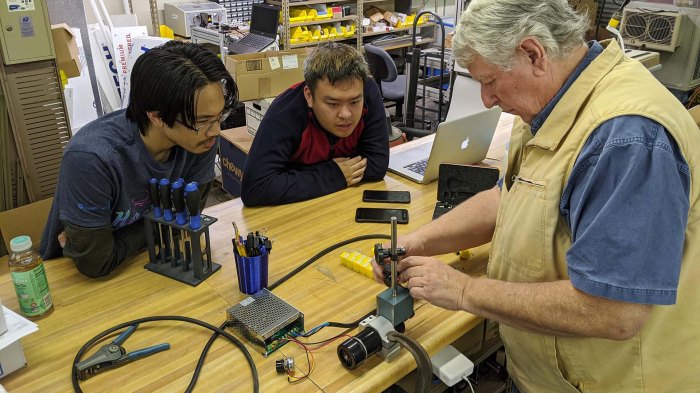
Our cheap ER11 spindle’s product page(*) claimed a maximum speed of 12,000 RPM, but we knew better than to take that at face value. To measure its actual performance, we wanted some sort of non-contact photo tachometer(*). This particular unit was on hand and originally designed for measuring remote control aircraft propeller speeds, and it measured the maximum speed at 11,100 RPM. We’ll use 11,000 RPM for our initial calculations. Later we’ll measure while it is cutting and see how much its speed drops.

Is this fast? Well, “fast” is always a relative thing. Most people’s daily experience with RPM is on their car’s dashboard tachometer. In that context it is fast as 11,000 RPM is faster than most normal car engines, though race cars and motorcycle engines can hit that speed. For machine tool purposes, though, this speed is considered on the low side. Especially for small diameter tools that we’ll be using. Physically, we are limited by the small ER11 collet for our tool diameter. Plus the machine is not rigid enough to swing a big cutting tool without flexing. And now we know the limitations of spindle speed. Which of these limitations will be the one to actually constrain what we can do with the machine? Let’s have another cutting session and find out.


(*) Disclosure: As an Amazon Associate I earn from qualifying purchases.

Hex Wrench Holder And Wire Clip For Gantry Extrusion

The first project for designing accessories to mount on the extrusion beam, a holder for ER11 collets, turned out well enough I wanted to continue. Apply some of the lessons learned to create more nice-to-have accessories for the CNC project.

One accessory is a holder for a 5mm hex wrench. This is the size used by the fasteners bolting our gantry’s extrusion beams together. There are a set of four bolts, two on the left and two on the right, that we loosen to adjust the height of the gantry. Lowering the gantry lets the cutter cut through our work surface to cut holes for threaded inserts, raising the gantry gives us more Z travel for the work piece. Or we might deliberately trade off Z travel to use a shorter and more rigid gantry for more challenging pieces. We’re not sure what the viable combinations are, but we do know we’ll need this wrench handy for experimentation.

The other accessory is a wire management clip. Wiring is a perpetual challenge on this project, from finding appropriate component placement to isolating electrical noise. I’m sure electrical challenges will continue to vex us as we proceed. We’ll figure out the problems one by one as we go, but one thing is for sure, we’ll need a lot of ways to route wires and keep them in place, hence the clips.

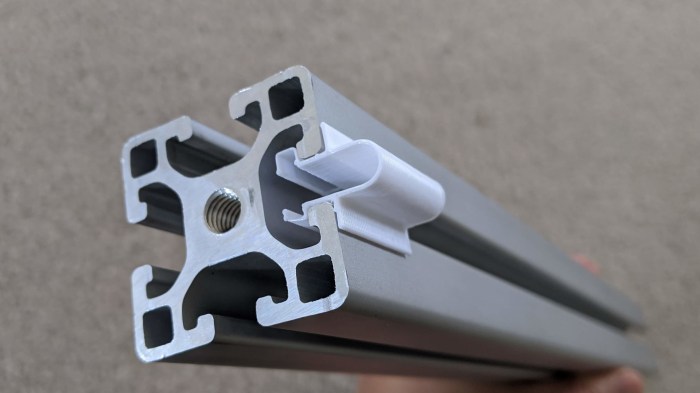
Unlike the previous accessories, the wiring clip may be mounted in any orientation. To hold themselves in place, each clip will require additional holding force. To get this force, they are printed slightly more open than their installed configuration. Installation would then require compressing the ring and this tension in the plastic will provide friction against extrusion rail to hold it in place. And while I’m not entirely sure it will be necessary, I added a small flap to keep the wire from sliding out of the ring into the rail slot.

There will be more accessories along the lines of what’s been printed so far, but I’m eager to get back to the primary exploration of cutting material.

Collet Holder Clamps To Extrusion

While I was in Onshape CAD designing our goose neck work holding clamps, I also tackled a few other to-do items on the 3D-printable accessory list. The top of the list was building a way to keep extra collets accessible on the machine. Our CNC spindle came packaged with a 1/8″ ER11 collet, which we swapped out for a 1/4″ collet when we wanted a stouter cutter. We didn’t have a good place to keep the temporarily unused 1/8″ collet and, rolling around on the tabletop, we were constantly at risk of losing it.

I thought it was a good project to practice designing plastic’s flexibility to my advantage instead of constantly seeing it as a disadvantage. I’ve had several projects along these lines before, but my interest was renewed by Amy Qian’s demo board she brought to show off at Supercon.

There are two ways I wanted to apply this concept. First, I wanted a holding mechanism that can snap into an extrusion rail and stay there without use of tools or fasteners. Second, I wanted a way to hold the collet so that it is held securely by default (not fall out or be dropped easily) but can be removed easily on demand. Again without tools or fasteners.

Here is the first draft of a flexible clip for installation into extrusion beam, this design was too flexible and fell out of the extrusion rail easily. More iterations followed, hunting for the most secure hold possible while still making it possible to insert into the rail.

Extrusion slot clip

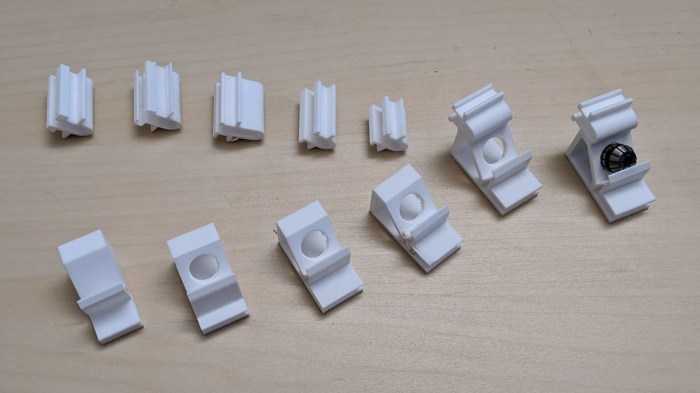
Separately, I started designing a flexible cover for the collet. The test piece for each mechanism evolved separately until I was happy with both designs, then they were integrated into a single piece incorporating both mechanisms.

Collet holder evolution

With the success of this holder, I took the lessons of a flexible extrusion beam mount and applied the concept to a few additional 3D printed accessories.

3D Printed Goose Neck Clamps For Work Holding

Once we have metal threads securely inserted into our MDF work surface, we could bolt on clamps to hold our work pieces. These clamps are 3D printed because we fully recognize our CNC beginner status and, while we’ll do our best to avoid crashing cutting bits into fixtures, it’s realistic to plan for the probability that crashes will occur despite our efforts. If we use commodity metal clamps and our carbide cutting tool makes contact it will break our tool. But if our carbide tool contacts a piece of 3D printed plastic it might survive our mistake. We have the luxury of this provision because we’re starting easy with scraps of MDF, which requires less forces to hold and to cut than cutting metal.

Clamp evolution

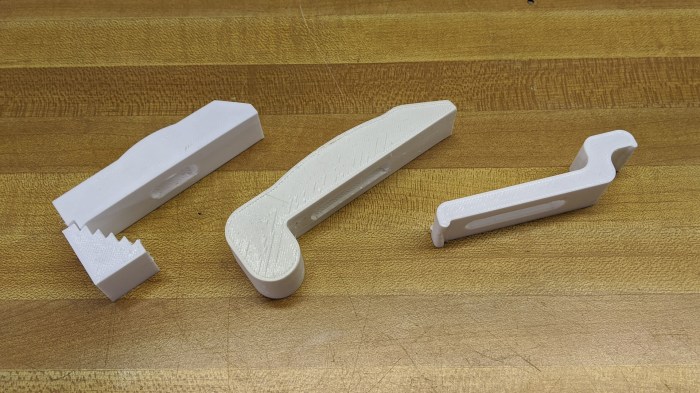
We started by copying standard step clamps. We weren’t sure if the steps could be accurately replicated with 3D printed plastic so it was worth a bit of experimentation to find out. They look very promising but we probably won’t use them, because the reason step clamps exist is to have a few set of them that can adjust to various sized work pieces. 3D printing gives us the flexibility to print project-specific fixtures that don’t have to compromise for flexibility. This advantage can make up a tiny bit of deficiency inherent in using plastic instead of metal. Hence the second iteration: a single piece clamp shaped like an L designed specifically for the thickness of our test piece of MDF.

Once that was printed and eyeballed on the work table, we moved on to the third iteration: a low profile goose neck clamp tailored for the height of our scrap MDF. Low profile design reduces chance of cutter collision, and it allows us to use shorter and stouter bolts to fasten them to the table. This is what we will use for our first real cutting experiments, alongside other 3D-printed accessories for our CNC project like a collet holder.

Threaded Insert Alignment Tool

We now have a small G-code program that we can call upon to cut holes for self-tapping threaded inserts. We’ll cut them as needed for work fixtures on our CNC work table. However, cutting the hole is only part of the process, we had to install the metal insert as well. In order for the resulting threaded hole to be vertical, the inserts have to be held perpendicular to the work surface as we install them. However, the coarse exterior thread makes it difficult to maintain the orientation, made more challenging by the fact the shallow hex socket allows the insert to rotate around the tip of a ball-end hex wrench making it even harder to hold vertical.

We originally had the hypothesis that, given the geometry of the wooden hole, our metal insert will self-align as we start turning it. This may be true for some types of wood but it didn’t work for our particular sheet of MDF. If the coarse outer self-tapping thread starts biting at a bad angle, the insert did not self adjust in our experience. It just jams partway down the hole ruining the MDF hole in the process.

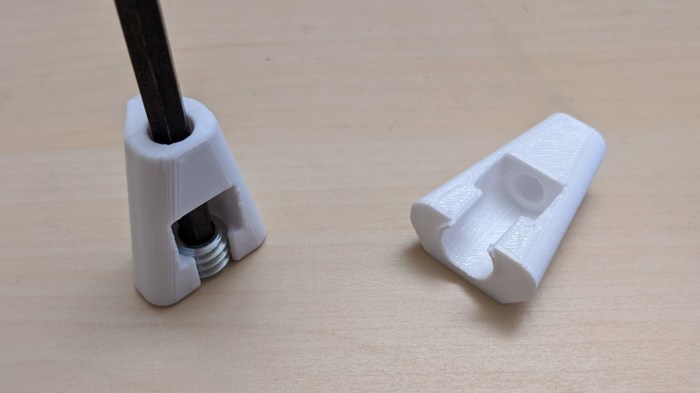
To solve this problem, we designed a small 3D-printed plastic tool to help maintain vertical alignment for installation.

Insert alignment tool printed

The bottom part of this tool helps keep the insert vertical, and the top part keeps the hex wrench vertical. The bottom is mostly flat for the work table surface. I tried adding a small lip to help with hole alignment, but that turned out to be unnecessary. These metal insert can align itself in the XY plane well enough. And once these inserts are in place, we can bolt down our pieces of scrap MDF using custom gooseneck clamps.

CNC Test Program Prepares For Fixtures

My test program exposed an electrical noise issue and helped us track it down to the spindle motor. This was an unplanned but very welcome bonus result on top of its original purpose. It was my first foray into Autodesk Fusion 360 CAM module after following tutorials. I wanted a simple program with few operations, small enough for me to fully understand the G-code output from Fusion 360 post-processor for Grbl. We had scrap pieces of MDF on hand for practice cuts so it wasn’t important for the test program to do anything useful. But as I was contemplating work holding for scrap MDF, I realized my first program could be useful after all.

The work surface we installed earlier was also laminated MDF, cut from the same retired treadmill board as the test scraps. Its smooth (well, scratched up, but still relatively flat) top surface is not conducive to any kind of work holding. The original plan was to cut holes by hand with a cordless drill and fasten work pieces using bolts from above fastened by nuts from below the sheet.

Then we had a better idea – use threaded inserts. Counterpart to the heat-set inserts I’ve been using in my 3D printed plastic(*) projects like Sawppy, there are inserts available for wood.  They have a self-tapping coarse thread appropriate for wood on the outside, and a durable machine thread on the inside. Given that our XY table used mostly 1/4″-20 thread, we will continue the trend by using these inserts from McMaster-Carr.

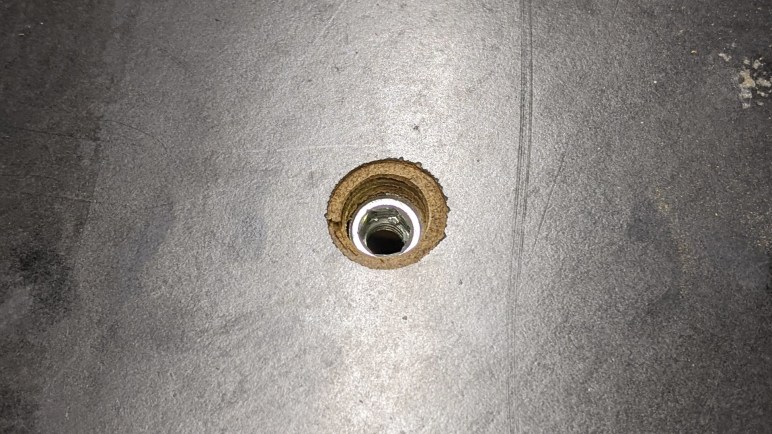
All we needed to put these in was to drill a hole of the specified diameter, and this is a task I can have the machine do for its own work table. I first started with a single hole, walking through each line in the generated G-code to understand what’s going on. The results were fine for the insert itself, but the exterior thread damaged surrounding laminate surface during installation.

Inserts with cracked laminate

This lead to extension of the test program, adding a second cutting operation. The first one cut a hole all the way through the surface for the insert, and a second shallower cut to clear surrounding laminate to avoid damage by exterior tread. Once the metal insert was installed with help of an alignment tool, we have a clean fastening point to bolt work pieces to our machine work surface.


(*) Disclosure: As an Amazon Associate I earn from qualifying purchases.

Next Challenge For CNC: Electrical Noise

With a stouter cutter installed, we can experiment with less worry about breaking it. I started generating my own G-code programs from Autodesk Fusion 360 and testing them on the machine. (More about this test program later.) A safety practice I learned in my machining class is to test run a G-code program by intentionally setting a too-high Z offset. This way, when the machine runs through the program, it runs through all the motions but is only moving around in air. This lets us verify the range of motion is as expected. Including making sure it would not exceed either the XY limits of the machine or hit any hold down fixtures that are in the work space.

This process can be repeated any number of times, each time putting the Z a little closer to the workpiece than the last. And even if we don’t expect to actually cut material, it’s a good idea to power up the spindle just in case the cutter makes contact. While unexpected cuts in the work piece is not great, ramming a non-spinning cutter into the piece is worse.

Running in air is great for finding major problems, but minor issues aren’t always visible. It wasn’t until I cut into MDF that I found our latest problem: after the test program made its cut, its final position did not match expectations. Running the program again, we expected it to run through the same motion and not remove any new material, but it did. Checking the coordinate display on bCNC, we saw the machine believed itself to have returned to the same position after each run, counter to our physical evidence on hand. What happened?

To diagnose this issue, we tried eliminating individual variables from consideration. Running down the list of possibilities, from loose wires to loose fasteners. The key experiment was running the program without powering up the spindle, at which time all motion tracked as expected. (To protect the endmill from possible impact damage, it was removed from the collet for this test.)

This tells us the source of our unreliable motion was an electrically noisy spindle. A hypothesis is that it degraded our motor controllers’ ability to distinguish signal pulses from Grbl, but the precise mechanism is not important. Whatever it was, we need to better protect the system from spindle motor noise. And since every motor will affect nearby electronics to some degree, this is probably not just a consequence of using the lowest bidder on Amazon.

In the immediate term, what we can do for our machine is to make sure the chassis is securely grounded, reroute signal wires further away from the spindle motor subsystem, and add a capacitor across the motor wire terminals to filter some noise. This was not precision tuning, as we just clamped the grounding wire to our gantry and the capacitor was chosen for its voltage tolerance rather than a specific capacitance. Still, the two measures seemed to improve the situation enough to proceed. We know “clean up wiring” is still on our list of technical debt, but this kicks the can a little further down the road and let me return to my test program – cutting holes for work fixtures.

Stouter Cutting Tool For Exploring CNC

Our vertical mill CNC project is barely far along enough for us to run a simple G-code program, so there’s a lot we don’t yet understand about the machine’s capabilities. Pieced together from mostly salvaged parts, we don’t exactly have a reference manual we can check for the machine.

What’s clear from our first test is that it’s easy to accidentally get too aggressive with the machine. The most fragile part in the system is our 1/8″ RotoZip cutting tool. While we want to make sure to wear eye protection when running the machine, we still want to avoid breaking cutters and turning them into sharp high speed projectiles.

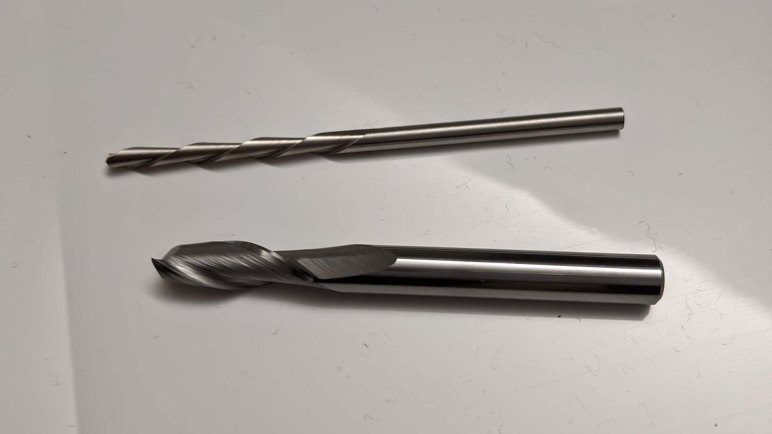
To reduce the odds of that happening, further machine testing will use the largest cutting tool we can. Quarter inch shank diameter is just about the widest we can accommodate with our ER11 collet, so I went looking for the shortest quarter inch square nose endmill I can find on Amazon with Prime delivery. (*) McMaster-Carr has higher quality cutters and a wider selection of endmills in general, but they would not have delivered in time for the next available machine work session so I traded off quality for speed.

This is a carbide tool with two flutes. Out of the box, all cutting surfaces looked satisfactorily sharp. Used properly, it should have no problem cutting into our scrap test pieces of MDF. And when used improperly, it should be far less likely to break than our 1/8″ diameter RotoZip cutter. It will serve as the (possibly sacrificial) learning cutter while we explore the rest of our machine, starting with an electrical noise problem.


(*) Disclosure: As an Amazon Associate I earn from qualifying purchases.
Scrap MDF Sheet As CNC Working Surface

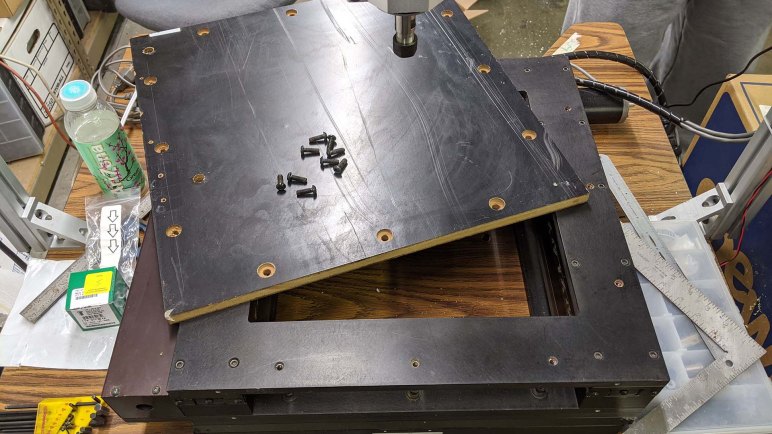
Once its homing switch was moved to the correct position, our Z-axis is ready to go to work. However, it doesn’t have a surface to work on just yet. The XY table forming the heart of this project was originally designed for the purposes of optical inspection, which meant it has a big open space in the middle for cameras and similar optical instruments to see. Big open spaces are not conducive to CNC milling operations!

Fortunately, as part of its original design, this table does have precisely placed mounting points for other equipment. These holes were, in fact, used to bolt the X and Y modules together at right angles to each other. We’ll use these mounting points to install a work surface. For precision work, we want something rigid. Ideally something just as strong as the table elements, say maybe a half inch steel plate.

But for learning purposes, we don’t need anything so fancy. We just need a reasonably flat surface we can work with. Following the theme, we’re going to re-purpose something for the task. This time, it is the main backing board for a retired home treadmill. This piece of laminated MDF had been sitting outdoors for several years and used as a ramp for moving heavy things around. The smooth laminated surface really reduced friction! But it also meant the surfaces are scratched up, and there are signs of water damage at the non-laminated surfaces. Still, it was the biggest, flattest, and most expendable thing on hand for our machine. So it was cut up with [Emily]’s table saw then 12 holes drilled on a drill press. Counter-boring those holes allows the top working surface to remain clear. We’re not worried about the cutting tool hitting one of these fasteners — they are outside of range of motion — but it allows flexibility in workplace positioning.

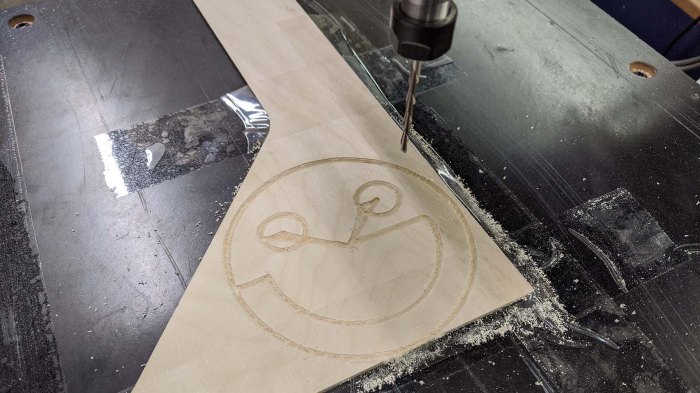
For our first test, we used a scrap piece of wood left from a laser cutter project and a RotoZip cutting bit. The first programmed operation will be the same smiley face test program we used before we even had a Z-axis. Whose G-code, we have now learned, never moved Z-axis at all! There are only spindle on/off codes, likely designed for laser engraving. Which also explained the speed, which pushed the RotoZip bit too fast, bending it quite alarmingly until we turned up the spindle speed. It did all right, but until we get the machine dialed in, what we really should use is a stouter cutting tool.

CNC first programmed cut using Rotozip bit

Reposition CNC Z-Axis Homing Switch

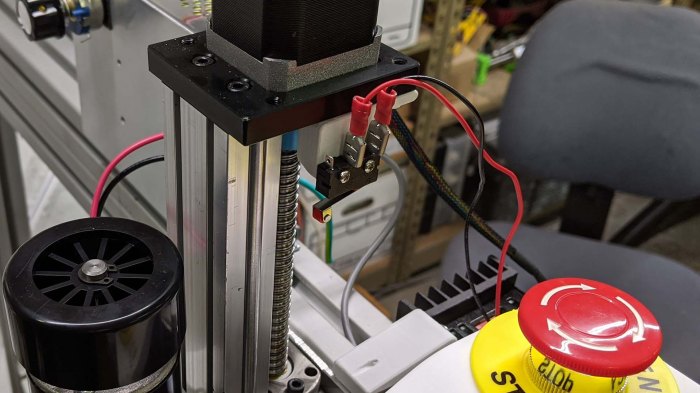
Top of the CNC mill electrical work items list was making sure it had a functioning Emergency Stop button. Once that was completed, the next work item was the Z-axis homing switch. For a vertical mill, we want the Z-axis homing operation to take it to its highest position, furthest away from workpiece. This is reverse of many 3D printers, which home against the print bed. This is because 3D printers have the luxury of  starting from an empty print bed as a characteristic of additive manufacturing. A CNC vertical mill, representing subtractive manufacturing, could not make such an assumption since the workspace would have work fixtures and material stock.

Our initial Z-axis homing switch was appropriate for our initial orientation of the mechanism, allowing it to home to the top of its travel. But once it was flipped around, the homing switch is now sensing the bottom of its travel instead. We need to find another mounting position before we could have a good Z axis.

Z homing switch wrong end

This switch had the luxury of sitting next to the motor and conveniently sensing the approach of the carriage. Its height was sized to match the length of the motor ballscrew coupler, engaging the switch just before the carriage would run into the coupler.

This linear actuator have no convenient location to sense the other end of the range of motion. Since there was no coupler on the other side, a similar mechanism would subtract from valuable range of motion. We didn’t have a good place until we installed the spindle motor mount plate, whose top edge gave us an feature we could use to trigger the homing switch.

From that point, it was a matter of running through a few 3D prints to find the correct dimensions to trigger a homing switch while maximizing useful travel distance. Now our Z-axis homes against the top of its range of travel again, let’s give it an useful surface to work on.

CNC Physical Controls Panel V2

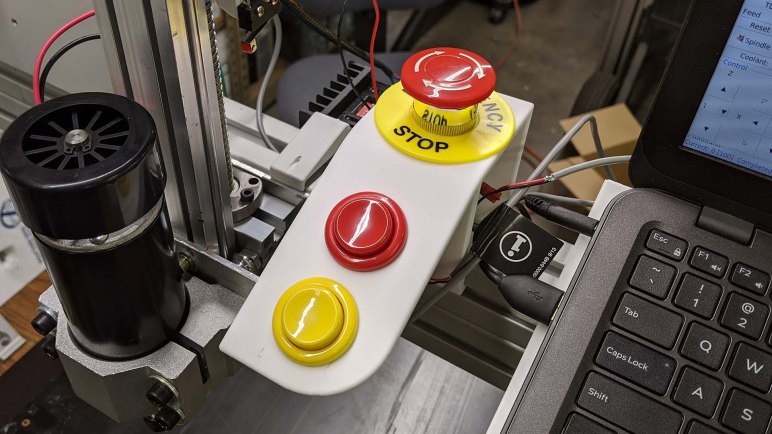
When I started to build a panel for physical control buttons, I had planned to use arcade console buttons. Big, bright, and durable, they were designed to take a punishment and I thought they would serve well. But before I finished the first version, I had switched to a more task specific button for the emergency stop. I proceeded with arcade buttons for the other two, but [Emily] had a better idea.

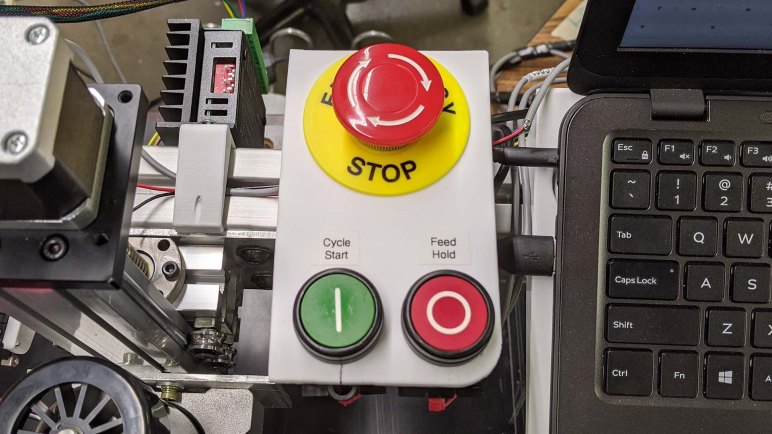
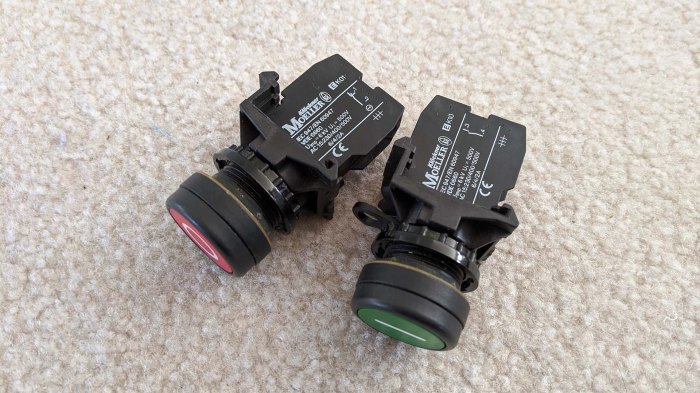
She had salvaged some control buttons from retired industrial machinery, so these would be buttons originally designed for the purpose of machinery and not controlling a video game character. They should be given a second life doing their old jobs on a new pieced-together CNC vertical mill.

Salvaged switches for hardware buttons

Using them would require designing and printing another panel. They were smaller in diameter so I thought maybe I could get away with a shim, but even though their smaller diameter required less panel front surface, their mechanism for disassembly and installation actually required more clearance under the panel. As a result I had to rearrange the buttons from forward-back to side-by-side. This is a good thing – the results more closely mimicked that seen on real industrial equipment like this Haas console. My three-button panel is a poor comparison to that full featured beast, but is a lot cheaper.

I also appreciate the black rim on these buttons, making them more difficult to press them accidentally compared to arcade buttons lacking such protection. It was also interesting to note these buttons have provision for three switches underneath, controlling three circuits at once. These, however, only have a single switch in the center slot and given these were salvaged we are unlikely to populate the remaining two slots.

I started the physical button control panel task planning to use three arcade buttons I had on hand. By the time I completed the second version of the panel, no arcade buttons were used but the panel looked better and worked closer to the way they would be on actual machinery. I call that a success, and turned my attention to the Z-axis homing switch.

CNC Physical Controls Panel V1

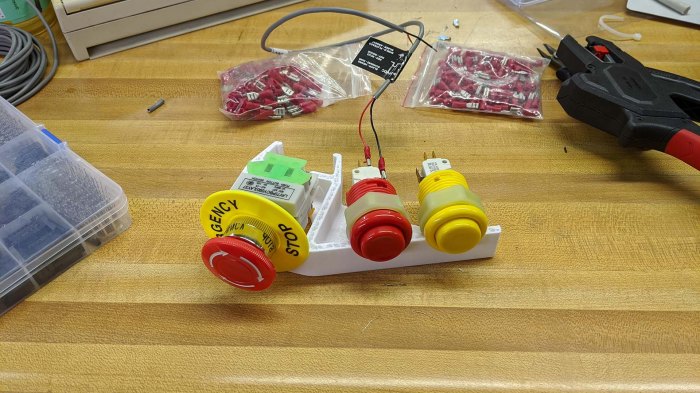
Our mini CNC vertical mill project now has almost all the basic mechanical components in place. We’ve done a quick drill test, but that was under manual control. There still several very important things to add before we let the machine run G-code, the top of the list is an “emergency stop” button for when things don’t go according to plan. It would also be nice to have physical buttons for “cycle start” and “feed hold”, but that is less critical. I soldered some headers earlier in preparation for this, now I need to connect them to physical buttons.

I originally planned to reuse some arcade console buttons I already had on hand, but then realized there is existing convention for emergency stop buttons: once pushed, they stayed pushed until twist to release. They also have a distinct appearance everyone (not just myself) would recognize, and these are things I want to have on my own machine. I bought the cheapest one I found on Amazon (*) and the tactile feel of this unit definitely reflected its low price. If I were to do this again I’d hunt for a more substantial-feeling (and more expensive) alternative. But in the meantime, it seems to work well enough electrically and the low budget nature matches the rest of the project.

For the “Cycle Start” and “Feed Hold” buttons, I continued with the original plan of reusing arcade buttons I had on hand. I have a nice red one for “Feed Hold” but I didn’t have a green one for “Cycle Start”. I used a yellow one in the meantime, maybe I’ll paint it green later.

Then I designed and started printing a panel for these buttons, paying special attention to the emergency stop button’s support structure. I want people to be able to slam on this button hard in a panic without breaking anything. Unfortunately, due to an uncooperative 3D printer, I couldn’t get a finished print of the panel in time for a work session.

Hardware buttons panel - partial

No matter, it was enough for me to begin the wiring work for this project. Obviously I couldn’t mount the buttons on the machine until I returned later with a completely printed panel in another session. However, even as I was wrapping up this panel for physical buttons, we were already talking about an upgrade.


(*) Disclosure: As an Amazon Associate I earn from qualifying purchases.
CNC Spindle Mounting Plate

Once our new CNC spindle passed initial inspection, it was time to get to work mounting it to our Z-axis linear actuator. Again, the piecemeal nature of this machine meant the parts would not bolt up directly so we’ll need to fabricate another adapter plate. This meant cutting another piece off of the same 1/8″ aluminum stock used to mount the Z-axis on our gantry and marking up the dimensions we’d need.

Four holes were drilled to line up with the actuator extrusion beam, and four more drilled to line up with the motor mounting block that was part of the spindle package. The original plans were to use bolts and nuts across the board, but there was a problem with clearance: the motor mounting holes were almost exactly the width of the Z-axis rollers, leaving insufficient clearance for either M6 nut or bolt head.

The obvious solution was to tap M6 threads into the aluminum, avoiding the need for nuts and associated clearance. Unfortunately we had no M6 taps on hand, but [Emily] the resourceful improviser had a trick up her sleeve: We had plenty of M6 steel bolts, and we wanted to tap aluminum. Steel is harder than aluminum, and so with some modifications with the grinder, she turned one of the M6 bolts into a functional M6 tap.

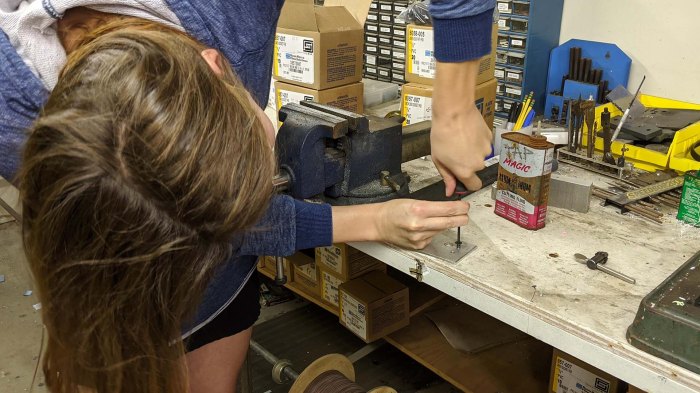
Cheap spindle mounting plate creative tapping

Bolting directly into newly tapped aluminum, our M6 bolts would still just barely scrape the Z-axis roller assembly. Switching to thicker washers gave us the spacing needed to clear the rollers, allowing the spindle to move across the entire range of motion on our Z-axis.

Cheap spindle mounting plate installed

As a quick test, we mounted an 1/8″ drill bit into the spindle and performed the ceremonial first cut of this machine. I was moving the Z-axis via manual jog controls in bCNC, we still have a few more things to take care of before running this machine under automated program control.

Examining Air Cooled ER11 CNC Spindle

Up until this point, almost everything in the home brew vertical mill CNC project has been salvaged or reused from some previous project. But we’ve come to the point where the Z-axis drive has been properly configured for a spindle motor… that we don’t have. We have smaller lighter motors that aren’t strong enough for the job, we have big beefy motors too heavy for our gantry. While we could potentially use a Dremel or a RotoZip as a stepping stone, the decision was made to buy a cheap milling/engraving spindle from Amazon (*) for the project.

The product page proclaims a maximum of 500 Watts and maximum speed of 12,000 revolutions per minute. We’ll measure power draw once we can put it to work, and we have tachometers to measure its speed range. We don’t expect it to actually hit those numbers, but they seemed reasonable. The part that we were most skeptical about was the proclaimed precision: 0.01-0.03 mm of runout. This is a very high level that we doubted was reasonable in this price range.

The first test after unpacking all components was the obvious basic test: does it spin up? Once we established that it does indeed turn, the second test was then to mount a Starrett dial test indicator (*) to measure its actual runout.

Cheap spindle on Amazon getting dial indicator

The results were… surprisingly good! When the motor is not under stress and turning freely, it actually stayed within a very tight range. This specific dial test indicator was in Imperial units, measuring a range within +/- 0.0005 inch. This is in the ballpark of +/- 0.0127 mm, so the product listing was not a complete lie.

For practical purposes, though, we’ll never have that level of accuracy. There is a lot of flex in the system — from the motor output shaft to ER11 collet — to take us out of that range. A single finger press was enough to bend things beyond the technically-not-wrong runout, so we shouldn’t expect very high precision from this spindle after we mount it on our Z-axis and run under real cutting forces.


(*) Disclosure: As an Amazon Associate I earn from qualifying purchases.

Watching Operation Of Electron Microscope Live Was Surprisingly Interesting

It’s always amazing to see what people bring to the Hackaday Superconference. I think the audience would appreciate my project Sawppy, but I didn’t bring my rover to Supercon for two reasons. First, Sawppy is somewhat unwieldy and bulky and second, I expect to be pretty busy as part of event staff helping out on badge logistics.

The second reason held true throughout the weekend, but I was put to shame on the first front because Adam McCombs (Twitter @nanographs) brought a scanning electron microscope. I never thought they were very portable and I was right, but that didn’t stop Adam! It occupied what little open space there was in the DesignLab shop area. I’ve seen SEM imagery and thought it might be fun to take a closer look, but what I didn’t realize was how cool it was to watch one in operation.

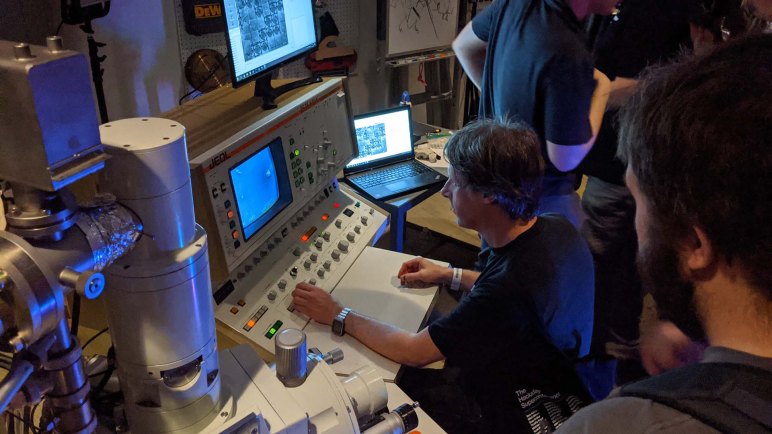
I never got time at the operator console, but I watched others turn knobs at their disposal. I had not known how many different parameters were adjustable to highlight different features on the sample. When we see a published picture generated from a SEM, an operator has already adjusted these knobs to the appropriate settings. Seeing less-than practiced operators adjust them live and experiment to see what works was mesmerizing.

I was also surprised at how feedback is visible immediately. It was explained to me the whole machine is a very analog process. The path from the electron beams striking the sample to picture on operator console CRT has no digital frame buffers or processing inserting delay. Every once in a while an image is recorded to the adjacent laptop, and that process consumes several seconds, but the knob-twiddling is effectively instantaneous on CRT as are interactions with the sample. I saw some small specs of dust dance around and initially thought it was due to air movement, but then I learned the sample is held in a vacuum. What is moving the dust? The electron beam!

My mind evaluates this technology from the perspective of an optical camera, and from that perspective the available range of magnification is astounding. Traversing several orders of magnitude of magnification with a single twist of a knob. I saw no indication that a SEM has any equivalent of focus or depth of field limitations: everything in the image is always razor sharp. I was not surprised to see panning across the sample, but I was surprised to see tilt was an option as well to see some items from different perspectives.
Watching a SEM in operation was not something I knew I needed to see until I saw it. The pictures afterwards are a great reminder, but no match for the live experience. The opportunity doesn’t come often, but if one is available I highly recommend it.


Examining Composite Video Signal Generated By Microcontrollers

There was a several-years-long period of my life when I spent money to build a home theater. This was sometime after DVD became popular, because the motivation was my realization of how much superior DVD picture quality was over VHS. With movies on VHS, noisy visual artifacts were a limitation of the analog magnetic medium. With movies on DVD, the media-imposed limitations were gone and now there are all these other limitations I could remove by spending money, lots of it, to do things like upgrade from composite video to S-Video connections.
Eventually home theater moved to all digital HDMI, and I stopped spending big money because even the cheapest flat panels could completely eliminate classic CRT problems like color convergence. (My personal peeve.) I thought I have left the era of CRT and composite video behind, but throwing out my pile of analog interconnects and video equipment turned out to be premature.
Now I’ve found an interest in old school video again, because they are accessible for the electronics hobbyist. It is much easier to build something to output a composite video signal rather than HDMI. Local fellow maker and tinkerer Emily likes the old school tech for aesthetics reasons in addition to accessibility. So one day we got together at one of our regular SGVTech meets to dig a little deeper into this world.

Emily brought an old portable TV with composite video input, and two candidate Arduino sketches each purporting to generate composite video. (arduino-tvout and one other whose name I can’t remember now.) I brought my ESP32 dev module running Bitluni’s composite video demo. For reference Emily had an actual composite video camera, the composite video Wikipedia page and the reference document used by Bitluni for his demo.

All three were able to get the little TV to show a picture. However, they looked very different under the oscilloscope. The [name will be filled in once I remember] sketch had the wildest waveform whose oscilloscope trace didn’t look anything like a composite video signal, but the proof is in the fact an animated 3D vector graphic cube showed up on the TV anyway. The waveform generated by arduino-tvout was a little rougher than expected, but unlike the previous, it was clearly recognizable as a composite video waveform on the oscilloscope and accepted by the TV. Waveform generated by Bitluni is the best fit with we expected to see, and matched most closely with output generated by the composite video camera.

Knowledge from tonight’s investigation will inform several of our project candidates.


Monoprice Maker Ultimate (Wanhao Duplicator 6) Dead Again But This Time It Was Not The Relay

My Monoprice Maker Ultimate (branded variant of Wanhao Duplicator 6) is dead again. This has happened before, but this time is different. Previously, the main 24V relay would die of overwork, and when that happens all stepper motor and cooling fan activity stopped while the display UI thinks it’s business as usual. This time around, the fans turn on but the display was dark.

Since the primary user interface was dark, the first order of business was to see if it’s just a dead display or if the problem went deeper. As a data point I tried an alternate control scheme: I put OctoPrint on my laptop and attempted to communicate with the printer via USB serial. This was only intermittently successful, and even when communication was established, it would quickly disconnect. So it’s not just the display that was dead, but the printer isn’t entirely dead, either.

Suspecting a bad power supply, all voltage output lines were measured and power levels would dip occasionally. Eventually we figured out something was causing the main system board to reset on a regular basis, and upon every reset, there would be a brief spike in power draw.

Diagnostics moved on to unplugging components one at a time from the control board to see which component is overloading the system. The printer powered on and stayed on once I unplugged the wires for the front control panel and display.

Maker Ultimate front panel disconnected

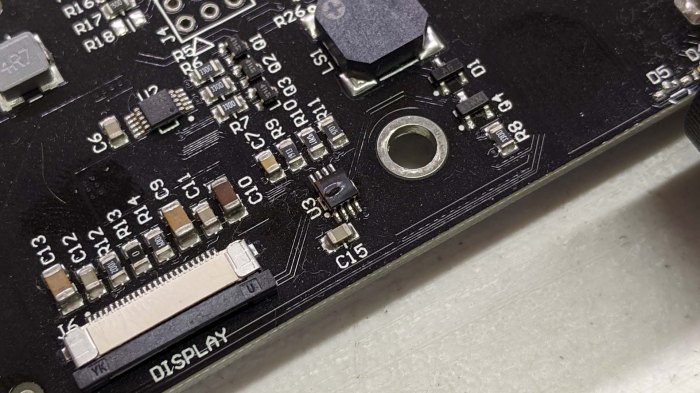
Removing the display and control panel, we took a closer look at the circuit board and found our culprit: component U3 has suffered some calamity that caused the chip inside to burn a hole in its casing.

Maker Ultimate fried U3

Judging by surrounding traces, U3 had some sort of power management role. It has either failed short, or it has failed open causing some other component to trigger a system reset.

With the display and user control panel disconnected, I could control the printer via USB using OctoPrint. However, this did not eliminate the random system resets, it just made it much less frequent. Apparently there was more damage elsewhere on the system. Unless the source could be found and repaired, it will be time for an upgrade of this printer’s main control board.

Sawppy at PCC Maker Festival

The city of Pasadena is fortunate to have an organization like Innovate Pasadena to build a community of companies and organizations around Pasadena. The city is large enough that people don’t always know what’s literally down the block. The flagship event is open to the public, to try to get everyone involved. This is Connect Week, a week long event in October filled with events that open doors and hopefully form connections.

Sawppy’s participation in Connect Week is the Maker Festival held at Pasadena City College (PCC). Representing one of the many subsets of San Gabriel Valley Technology enthusiasts (SGVTech.) Sawppy’s nominal job for the day is to roam around, get people’s attention, and direct them to the SGVTech table for more information.

Sawppy and JPL OSR at PCC

Sawppy wasn’t the only rover present, though. SGVTech’s neighboring table represents JPL and one of their Open Source Rover was also present. This is the exact same rover present at Sawppy’s first public outing.

I was a little disappointed at how many people suggested the rovers fight each other. These are robots celebrating exploration, science, and knowledge. They are not combat robots. I am not a fan of Battle Bots, Sumo Bots, or derivatives thereof and I wished these combat-oriented robots didn’t have such a high profile in people’s minds.

For the immediate future, the best thing I can do to raise the profile of non-fighting robots is to show off Sawppy to more people. Hopefully seeing that there’s more to hobby robotics than battle bots will open people’s minds about it.

Turn That Z-Axis Mechanism Around

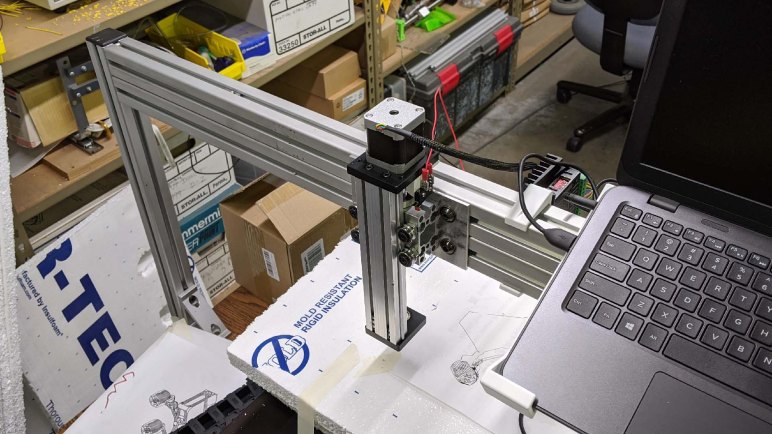
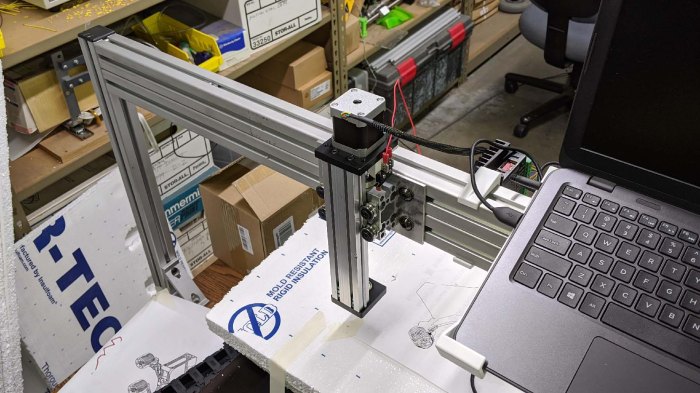
Fourth iteration of Z-Axis was mounted expediently for the pen plotter test, where we found the ball screw was bent but everything else looked good enough to proceed. Following that success, I will make a better mount for this linear actuator to solve some problems with the quick test configuration we had used.

Zv4 mounted by vertical extrusion with old bracket

Problem #1: the test mount was a 3D printed plastic bracket. The best thing that can be said about the rigidity of the mount was that it is better than tape.

Problem #2: old mount leaves long Z-axis mechanism in place, moving the small carriage. Fine for plotters, but for a small vertical CNC mill we want the Z-axis mechanism to move out of the way of the work piece. This means flipping the mechanism around, mounting it by the small carriage so motor moves the entire assembly out of the way.

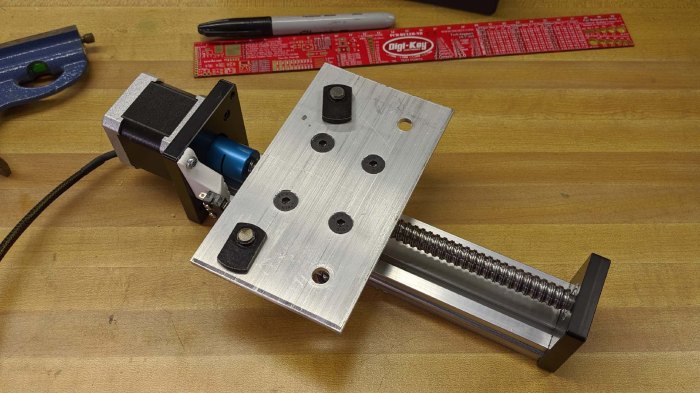
Zv4 aluminum mounting board in progress

A scrap piece of aluminum was drafted for this purpose. Holes were drilled by hand for fasteners. The accuracy leaves something to be desired, but the hope is that the machine will eventually get to a point where it can make a superior replacement for itself.

Zv4 aluminum mounting board almost ready

Because the carriage aluminum extrusion beam does not have the same spacing as the gantry aluminum extrusion beam, this plate allows us to bolt them together. Here it is almost ready for installation.

Zv4 mounted by aluminum sheet

Installation complete. Now when the tool moves up, the rest of the Z-axis moves up and out of the way with it. It is now ready for a CNC spindle.

Plotter Test With New Z-Axis Exposed Screw As Bent

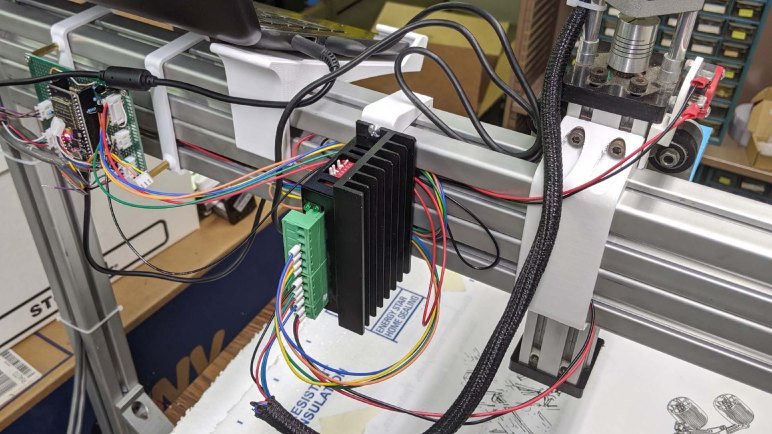
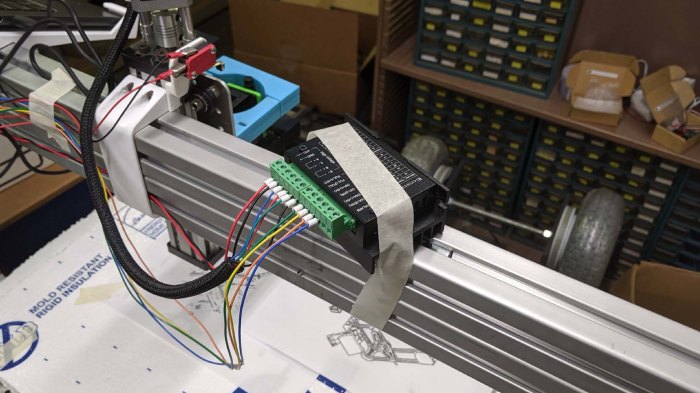
One of the reasons I didn’t design and print yet another iteration of the pen holder was that I thought it was more important to design and print a mounting bracket for the Z-axis stepper motor. Up until this point, the stepper controller module was merely taped to the gantry. This was never going to be an acceptable long term solution.

Stepper driver - tape mounted

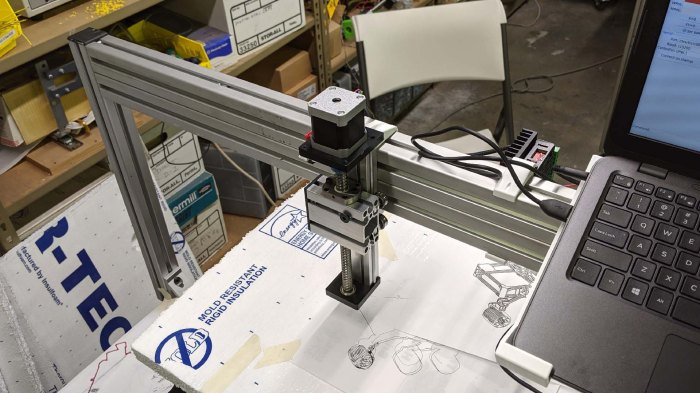
Once the stepper driver was mounted with a proper bracket and tested with the Z-Axis version 3, we removed Zv3 and installed Zv4 in its place. Complete with simple homing switch and parallel link pen holder. For this first test Zv4 was held with the same 3D-printed bracket used in Zv3, though that is already on the list for replacement.

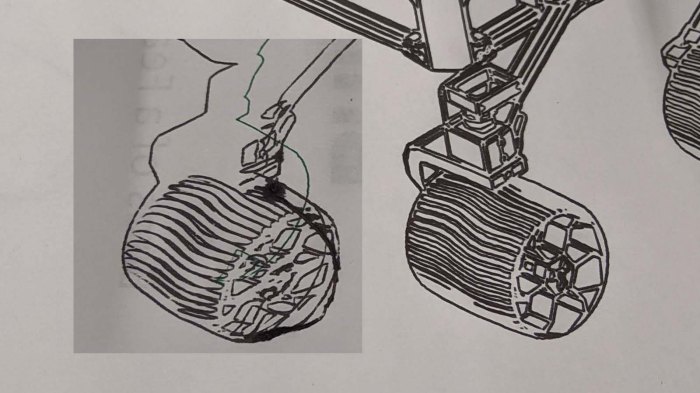
After the fourth Z-axis assembly was installed, I loaded and ran the Sawppy portrait program used for testing the third Z-axis assembly. The Y-axis flex really messed up the plot far more than originally expected.

After watching the thing mangling a Sawppy wheel, I stopped the test. There was no point in going further. Here’s Sawppy wheel drawn by fixed mount for comparison.

Sawppy portrait result of flexible pen holder

But a beautiful pen plotter was never the point of the exercise. Making the machine act as a pen plotter was merely a way for us to visually confirm that the Z-axis is moving more-or-less in sync with the rest of the machine. So as poor as the new pen plot is, the main objective was accomplished.

The test did, however, uncover a problem with the salvaged Z-axis: the ball screw is bent. Now that it is under computer control we can run it at a consistent speed (better than turning it by hand) and now we can feel a small but definite wobble in the carriage. This would explain why it was retired! This wobble was evidently too much for its previous owner, but it’s still too early for us to give up on it. It is possible the wobble won’t be the biggest source of inaccuracy in this pieced-together CNC mill, and even if it is, we’ve established that this is a common and affordable form factor we can easily replace.

Therefore, we shall leave Z-axis version 4 in place and continue working on the rest of the machine until the wobble proves to be a problem.